For decades, northern Nigerian women stitched intricate patterns into flowing robes while others captured most of the value. Today, through Queen Amina and a new partnership with Ibu Movement, that same embroidery is reaching international consumers at prices of up to $450 per piece – offering a vivid lesson in how culture, craftsmanship and market access can turn heritage into economic power.
In a modest workshop in Zaria, the sound is almost meditative. Needles move through cotton in measured rhythm. Geometric patterns emerge slowly, stitch by stitch, as they have for centuries in the Hausa tradition of embroidery. The women at work are not rushing. They know this craft cannot be hurried. Precision is part of its value.
For generations, however, the economic rewards rarely matched the skill required. Women produced the embroidery. Others – usually male traders and intermediaries – handled pricing, distribution and sales. The artisans preserved a cultural tradition but remained largely invisible in the market that surrounded it.
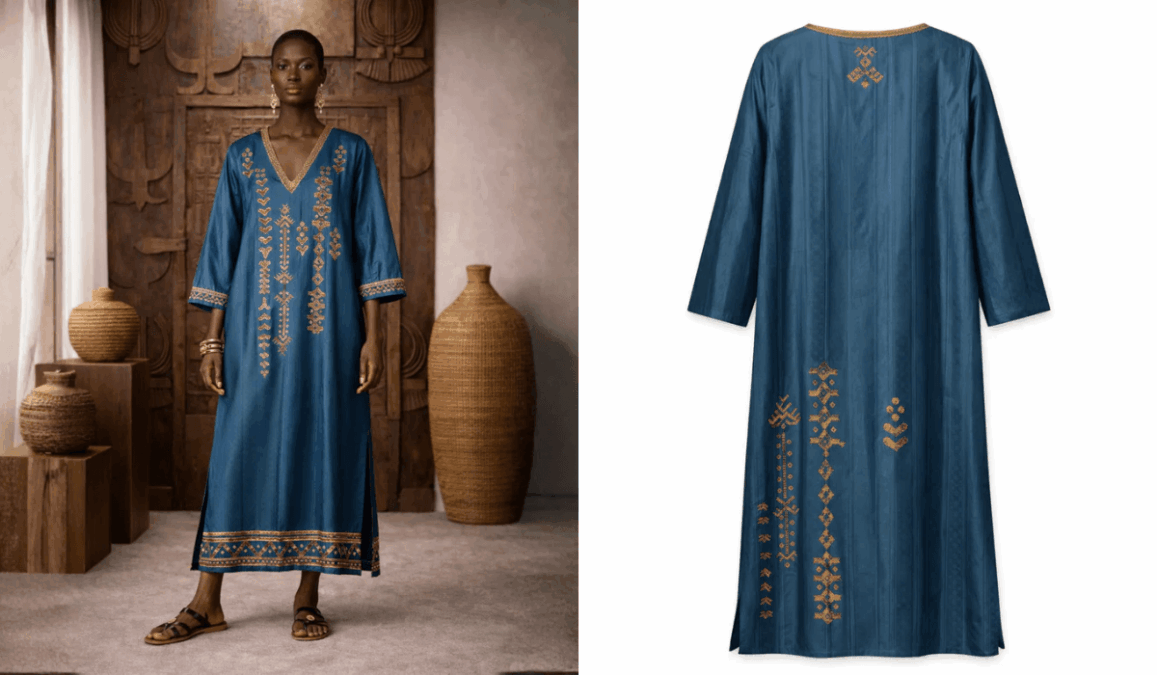
Now, one of those embroidered tunics sells for $380. A hand-finished caftan commands $450. Decorative pillows reach $145. The difference is not that the women suddenly became more talented. The difference is that they finally gained access to the market.
Support Systems Matter
That transformation is the story of Queen Amina, founded by Hassana Yusuf in northern Nigeria, and its recent inclusion in Ibu Movement’s new artisan incubator, Ibu Atelier.
The initiative, launched in May 2026 with support from Bank of America, selected ten women-led artisan enterprises from around the world and connected them to international design expertise, business training and direct retail access. Queen Amina’s debut capsule collection is now sold globally through Ibu’s online marketplace.
What appears, at first glance, to be a fashion story is in fact a development story. It shows how local craftsmanship becomes globally valuable when production is linked to design, branding and distribution.
The global opportunity is substantial. According to the United Nations Educational, Scientific and Cultural Organisation (UNESCO), the cultural and creative industries generate more than $2 trillion annually and support nearly 50 million jobs worldwide, with women representing a significant share of employment. Yet African artisans often remain concentrated at the lowest-value end of the chain, producing extraordinary work while others control the premium margins.
Nigeria’s fashion industry alone has been estimated by various industry studies to contribute billions of naira to the economy and employ large numbers of designers, tailors and craft workers. Still, much of the sector remains informal, undercapitalised and disconnected from international markets. Queen Amina demonstrates what changes when those barriers begin to fall.
The cooperative is named after the legendary Queen Amina of Zazzau, the sixteenth-century ruler remembered for courage, military strategy and commercial ambition. The symbolism is deliberate. The women of Queen Amina are not merely preserving tradition. They are reclaiming ownership over the value embedded in that tradition.
Their Hausa embroidery, long associated with the ornate babban riga and ceremonial garments, is among West Africa’s most technically sophisticated textile arts. It requires symmetry, patience and a highly trained eye. Each motif carries generations of knowledge.
When Deniz Roth, the design lead for Ibu Atelier, first worked with the embroiderers, she described them not as suppliers but as masters. That distinction matters. In global luxury markets, craftsmanship is increasingly prized as consumers seek products with authenticity, traceability and cultural meaning.
This Trend Is Not Confined to Nigeria
At Nairobi Fashion Week, designers across Africa have highlighted sustainable fashion and artisanal production. Labels such as Maisha by Nisria in Kenya and Bone Koboyi in Rwanda are building collections from recycled materials and indigenous techniques, responding to a growing cohort of consumers who want products that align with their values.
The message is clear: the future of fashion lies not only in aesthetics, but in provenance. People increasingly want to know who made what they wear, how it was produced and whether their purchases support communities rather than exploit them.
For Africa, this creates an underappreciated export opportunity. The continent has no shortage of cotton, dyes, weaving traditions, leather skills and design talent. What it has often lacked are the systems that convert these assets into globally competitive brands.
Those systems include: design collaboration, quality control, branding, e-commerce, logistics, and access to affluent consumers. Ibu Atelier supplies precisely these missing layers.
By combining Nigerian craftsmanship with global design standards and direct retail access, it enables artisans to capture a larger share of the final selling price. This is the essence of BusinessDay’s Go Local project. Produce locally. Add value locally. Connect to global demand.
Broader Implications Extend Beyond Fashion
When women artisans earn directly from their work, household incomes rise. Children stay in school longer. Communities retain more purchasing power. Cultural heritage becomes an economic asset rather than a fading memory.
This is what development economist Amartya Sen described as expanding capabilities – increasing people’s real freedom to shape their economic lives. Queen Amina embodies that principle in cloth and thread.
Back in Zaria, the embroidery continues as it always has: deliberate, intricate, deeply rooted in place. But the market surrounding the work has changed.
A tunic stitched in northern Nigeria can now appear in Charleston, London or New York City, purchased by consumers who value both its beauty and its story.
The artisan remains in Zaria. The value now travels farther – and returns more directly to the hands that created it. This is the quiet revolution at the heart of the Go Local agenda.
Economic transformation does not always begin with factories and smokestacks. Sometimes it begins with a needle, a cooperative and a marketplace that finally recognises what local skill is worth.
For decades, northern Nigerian women embroidered prestige for others to sell. Today, through Queen Amina, they are selling prestige to the world.
And in doing so, they offer one of the clearest examples of how Africa can convert cultural heritage into modern export power.

Join BusinessDay whatsapp Channel, to stay up to date
Open In Whatsapp