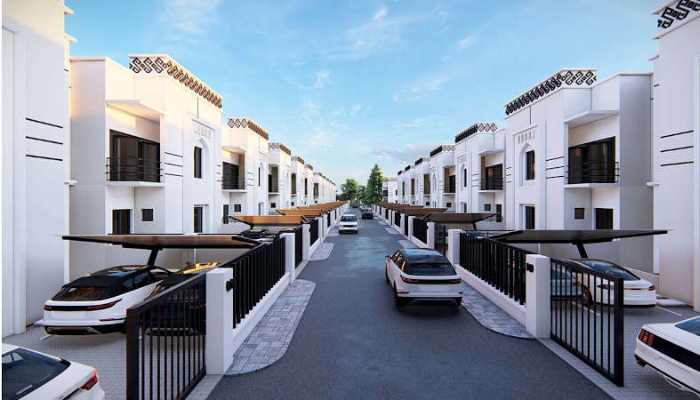
New real estate market trends show that money is leaving the city centre to new destinations because, according to findings by Panterra Real Estate Group, the centre can no longer absorb all that is on offer. Interestingly, this trend cuts across Africa as a continent.
According to Panterra, Africa’s urban story used to be simple: cities grow, capital follows, and returns accumulate. That story is still true. It has just changed its dynamics
“The centre can no longer absorb what the continent is building toward. With over half of sub-Saharan Africa’s population already urban and 1.4 billion urban residents projected by mid-century, the African Development Bank’s (AfDB) numbers are no longer forecast,” the findings noted.
“The investors and capital allocators who understand this are no longer asking which city to enter. They are asking which part of which city is being born right now, before the institutional money arrives and prices that question are out of reach,” the findings added.
Recently, three West African markets defined this shift, and none of them was such that made the front page five years ago.
Lagos is extending itself southeast. The Lekki-Epe Industrial Corridor and its adjacent free trade zones are attracting last-mile logistics investment at a pace that the city’s legacy infrastructure simply cannot meet from the centre. The gap between demand and formal supply is not a risk to manage; it is the opportunity itself.
Onitsha is the one the models keep missing. What reads on paper as an informal trading agglomeration is, in practice, one of West Africa’s highest-volume commercial hubs, structurally underserved by modern warehousing and formal logistics.
The yield case for whoever builds the infrastructure that formalises this market is neither subtle nor small.
Abidjan is quietly becoming the template. Cocody, Marcory, and the high-disposable-income districts surrounding them are generating demand for modern multi-family residential rentals and formal retail that existing stock cannot meet.
Côte d’Ivoire’s relative macroeconomic stability makes this one of the continent’s most legible yield stories running right now.
In Nigeria, Panterra found a contradiction in the country’s property market, noting that at a moment when the country is visibly short of homes and of warehousing its economy increasingly depends on, it appears to be on track to direct its most ambitious capital toward the single asset class it already holds in surplus— Grade A offices.
This oversupply is most pronounced in Lagos and the Federal Capital Territory, where analysts anticipate rental declines of between 5 percent and 8 percent through 2026.
A forty-floor banking headquarters is rising in Eko Atlantic, a 17,000m² corporate seat has joined the skyline, and new towers in Ikoyi and Ikeja have added more prime stock, with well over 150,000m² expected to arrive before the decade is out.
The impulse behind these buildings is understandable, even a tad convincing. A gleaming headquarters building is a statement of confidence; it signals stability – provided occupier fundamentals are sound. They are likely to be.
However, these statements amount to a great many unoccupied square meters, while the assets the market genuinely craves, such as residential and logistics capacity, remain grossly undersupplied.
What gives the pattern some weight is that it appears to be structural rather than cyclical. Hybrid working is now the norm. Occupiers are quietly trimming their footprint, and Lagos may have lived through this precise oversupply before; in 2016 and again in 2020, each occasion was followed by a correction.
Landlords are already adjusting. This is plain in the softening lease terms, the determined efforts to retain existing tenants, and a growing willingness to convert empty offices into alternative uses.
It is in this act of conversion that the more interesting opportunity quietly resides. The glut and the shortage are, on closer inspection, two faces of the same coin, provided one knows which assets, which sub-markets, and which conversions justify their cost.

Join BusinessDay whatsapp Channel, to stay up to date
Open In Whatsapp