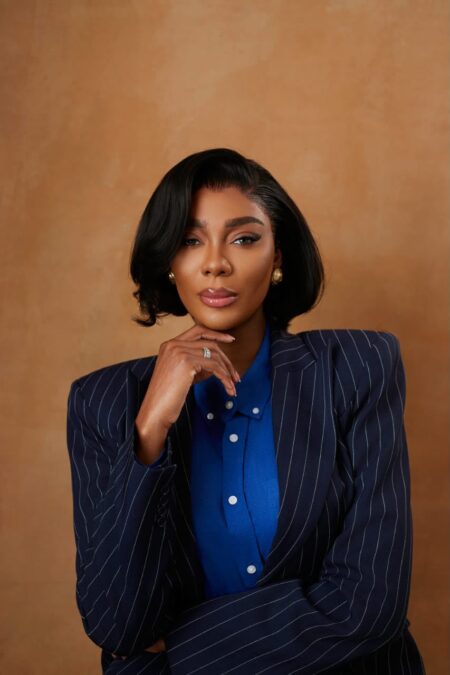
Faith Morey is a Nigerian-American philanthropist, entrepreneur, and founder whose career sits at the intersection of social development, fashion, and cultural intelligence. As the founder of the Okachi Charity Foundation (OCF), she has spearheaded targeted interventions across underserved public primary schools in Nigeria, focusing on restoring dignity to early childhood education through infrastructure repair, learning materials, and mentorship. Simultaneously, through her platform Gracefully Faith Morey, her upcoming book Things I Learned Before They Let Me In, and The Grace Circle world tour, she is advancing conversations around emotional intelligence, presence, and social literacy.
In this interview with IFEOMA OKEKE-KOREIOCHA, Morey reflects on the enduring legacy of her grandmother, the psychological impact of educational deprivation on children, and why true social mobility requires pairing academic qualifications with emotional discipline and presence.
You launched the Okachi Charity Foundation in honor of your grandmother, Charity Okachi, who taught at Sangana Primary School. How did watching her work shape your view on public school infrastructure and the dignity of early education?
Watching my grandmother teach at Sangana Primary School and San Andrew gave me an early understanding of something we often overlook: the condition of a public school is a public declaration of how seriously a society takes its children. Charity Okachi belonged to a generation of teachers who carried enormous responsibility with very limited resources. They did not only teach literacy and arithmetic. They taught order, self-respect, responsibility, and hope. In many communities, the teacher was one of the first people outside the family to look at a child and recognize possibility. But dedication cannot permanently compensate for structural neglect. A committed teacher still needs a functional classroom. A willing child still needs books. A family that believes in education still needs a school capable of receiving that belief.
My grandmother helped me understand that early education is where a nation first meets its future. If we fail children at that stage, we do not simply create an academic disadvantage. We weaken confidence, social mobility, economic participation, and the quality of leadership the country will depend upon years later. This is why OCF looks at infrastructure through a human lens. We are not repairing buildings for appearance. We are helping restore the conditions in which concentration, confidence, safety, and aspiration can grow.
Nigeria does not lack intelligent children. Africa does not lack gifted children. Too often, what is missing is the bridge between their natural ability and a fair opportunity to develop it.
My grandmother showed me that a teacher can open a child’s mind. OCF exists because neither the teacher nor the child should have to perform that miracle alone.
Rather than trying to rebuild or replace existing public education systems, OCF focuses on strengthening them through infrastructure repair, learning materials, and mentorship. What made you choose a model of strategic support over total reform?
I have never believed that meaningful service begins by arriving in a community and behaving as though nothing valuable existed before you came. Public schools already have teachers who understand their pupils, parents who want better opportunities for their children, and communities with knowledge that no outside organization can manufacture. What they often lack are the resources, relationships, and sustained attention needed to make those existing efforts succeed. OCF therefore begins by listening. We ask: What is preventing this school from serving its children well? Is it an unsafe classroom? A lack of books? Children arriving without uniforms or shoes? Pupils falling behind with no additional academic support? Young people reaching adolescence without exposure to mentorship or a practical skill? Then we intervene where support can unlock progress.
I also deeply believe that the government must remain responsible for public education. A foundation should not replace the state, and philanthropy should never become an excuse for public systems to withdraw. But while policies are being debated and budgets are being approved, a child is growing. Childhood does not pause for bureaucracy. Our model is therefore neither passive charity nor an attempt to build a parallel system. It is a partnership model. We strengthen the school that already belongs to the community, support the teacher who is already doing the work, and help the child who is already seated in that classroom waiting to be taught. The long term vision is bigger than what OCF can do alone. We want to create evidence of what becomes possible when the government, responsible businesses, civil society, other foundations, educators, and communities each bring what they have to the same table.
You’ve spoken about providing basics like proper uniforms and shoes to protect students from the emotional toll of feeling “less than.” How much of OCF’s work is about psychological confidence versus strict academic support?
I do not divide OCF’s work into psychological confidence on one side and academic support on the other, because the child does not arrive at school in separate pieces. The same child expected to solve a mathematics problem may also be hungry, ashamed of a torn uniform, worried that their shoes will attract laughter, or sitting in a classroom whose condition tells them that nobody important is paying attention.
Nigeria is rightly having an urgent conversation about its out-of-school population. UNESCO has estimated that more than 20 million Nigerian children and young people are out of school. Government is working to bring millions of them into classrooms. But OCF is asking the next question: once we bring a child into school, what are we doing to make that child willing and able to stay? A child can be registered, wearing the title “pupil,” and still be abandoned within the system.
In one of the Agege schools where we work, more than half of some classes may arrive without having eaten. We were also told that, in a typical week, four or five children may collapse or become faint from hunger. Imagine asking a child in that condition to concentrate. Hunger does not sit politely outside the classroom while a lesson is being taught. It enters with the child. It weakens the body, shortens attention, and turns a school day into something to endure rather than an opportunity to learn. The same is true of clothing. I have seen uniforms that have been sewn so many times that thread, rubber bands, and safety pins are doing the work fabric can no longer do. I have seen children wearing uniforms; several sizes too small, afraid that one ordinary movement will tear what is already barely holding together.
An adult understands the difference proper presentation makes. When you feel well put together for work or an important meeting, you tend to sit differently and participate differently. Why would we imagine that children are immune to that feeling? A child who is constantly pulling down a short uniform, hiding a tear, or avoiding the playground because their shoes are broken is spending mental energy protecting themselves from embarrassment. That is attention no teacher can redirect toward a textbook until the immediate anxiety has been addressed. This is why uniforms and shoes are often among our first interventions. We are not teaching children that their worth depends upon clothing. We are removing a visible source of shame so their minds are freer to learn.
And then there is the classroom itself. A good learning environment is not decoration. It communicates order, safety, expectation, and care. When parents see a school being repaired, when qualified and committed teachers are present, when children have learning materials, skills-acquisition opportunities, uniforms, and the possibility of scholarships, families begin to view that school differently. Across the schools where we have tracked the response to these combined interventions, we have observed enrolment rise by approximately 32.5 percent. That figure tells us something important: families are not indifferent to education. They respond when they can see that the school is prepared to take their children seriously.
Our experience in Abuja taught us another lesson. We met children attending school without adequate learning materials, including pupils who had already decided that they hated mathematics. We introduced educational board games that allowed them to encounter numbers through play, strategy, and problem-solving. Children who resisted the subject began engaging because mathematics no longer arrived only as correction on a chalkboard. It became something they could touch, enjoy, and understand. That is academic support, but it is also confidence. Sometimes a child does not hate learning. The child hates the repeated experience of feeling unsuccessful.
So OCF’s work is not about choosing between the mind and the emotions. It is about creating the conditions in which the mind can work: food in the body, dignity in appearance, safety in the environment, materials in the hands, encouragement in the classroom, and enough evidence for the child to believe, Perhaps I can do this after all. We must bring children into school, certainly. But we must also build schools that children do not experience as another place of deprivation.
Your core philosophy states: “Education may open doors, but confidence and social intelligence determine how people remain in the room.” What was the specific moment in your own career—transitioning across modelling, media, and business—where you realized access alone wasn’t enough?
I can trace that realization to one elevator ride. There was a CEO I had been trying to meet for a long time. I believed that one conversation with him could change the trajectory of my business, so I had done what I thought preparation looked like. I had developed my presentation, organized my materials, researched him, and sent numerous emails requesting a meeting. I knew my business, and I believed deeply in what I was building. Then, quite unexpectedly, I met him. He was stepping into an elevator on his way to an emergency meeting. He recognized my name from the emails I had sent and said, “You have until we get downstairs. Tell me about yourself and what you have in your hand.”
And I froze. I looked prepared. I was holding the presentation. I had spent years learning how to enter a room, how to stand, how to dress, and how to carry myself. But the opportunity had not arrived in the room I had imagined. There was no boardroom, no scheduled appointment, and no time to arrange my papers. There were only a few floors between me and the ground level and I did not yet know how to turn everything I had prepared into one clear minute. I later learned that this was what people called an elevator pitch: a brief and compelling explanation of who you are, what you do, what problem you solve, and why the person listening should care. It sounds simple, but nobody had ever taught me how to do it. I did not get the opportunity that day. That was painful because I knew I had the ability; I simply had not learned how to communicate it under pressure. But I also made myself a promise: no opportunity would ever meet me that unprepared again.
I practised until I could explain my work without hiding behind a presentation. I learned how to read the person in front of me, adapt quickly, and speak with clarity even when a moment caught me by surprise. Fortunately, I met that CEO again later. This time, I was ready. I still remember seeing him smile from across the room, the kind of smile that said, Now you understand. That encounter led to my first significant contract. That experience taught me something I have carried through modeling, business, and media: preparation is not only knowing what you want to say. It is being able to find your voice when life does not follow your script.
This is why I teach these skills now. Somewhere, there is another brilliant person holding a beautiful proposal, waiting for the perfect meeting, not realizing that their opportunity may arrive in an elevator.
While personal development platforms often default to targeting women, Gracefully Faith Morey caters to men, women, and children alike. Why is it critical to teach emotional intelligence and presence to young boys early on?
I have seen the answer to this question in my own son, who will soon be fifteen. I have watched him enter rooms that would have intimidated me even as an adult and hold a thoughtful conversation with senior executives from Fortune 500 companies. He is not performing or trying to sound older than he is. He knows how to introduce himself, listen, ask a sensible question, maintain eye contact, and allow the other person to feel that they are having a real exchange with him. Afterward, people often walk over to me and say, “What an impressive young man,” or jokingly ask whether they can take him home with them. As his mother, I am proud, of course. But I also understand that what they are responding to is not simply intelligence. They are responding to how he makes them feel in his presence.
That has confirmed something I learned much later in my own life: a child can be highly educated and still be unprepared for human interaction. In many African homes and, truthfully, in homes across the world parents work extremely hard to provide what they understand success to require. If they can afford it, they provide a good school, proper clothing, food, and perhaps opportunities they never had themselves. That sacrifice is enormous and should never be minimized. But we rarely sit with a boy and teach him how to enter a room, how to introduce himself, how to recognize discomfort, how to handle disagreement, or how to communicate what he feels without becoming aggressive or withdrawing completely. We prepare boys to earn a living, but not always to live well with other people.
The consequences eventually appear everywhere. They appear as capable adults who cannot build professional relationships. In the husband and wife who both feel unheard but only know how to defend themselves. In the talented candidate who loses an interview because no one taught him that eye contact, a greeting, a handshake, grooming, and the way he addresses people all communicate before his résumé is discussed. They also appear on a much larger scale. History has shown us what can happen when people have power but lack the patience to understand one another’s language, customs, fears, and values. Cultural literacy is not simply knowing a few facts about another country. It is knowing that what communicates confidence in one culture may communicate disrespect in another. Many conflicts become more dangerous because people listen only to answer, not to understand.
That is why I want these lessons to begin with boys, not as corrections when they become men. A boy who learns to listen without feeling diminished will become a man who can disagree without destroying a relationship. A boy who can name disappointment is less likely to disguise it as anger. A boy who understands that his presence affects others will carry that awareness into friendships, marriage, fatherhood, business, and leadership. My son is not perfect, and that is not the claim. What I have witnessed is the advantage of giving a child a language and a social awareness that many of us had to acquire through painful experience.
We cannot predict every room our children will enter. But we can make certain that when the door opens, they know how to meet the human being on the other side. They appear as capable adults who cannot build professional relationships. In the husband and wife who both feel unheard but only know how to defend themselves. In the talented candidate who loses an interview because no one taught him that eye contact, a greeting, a handshake, grooming, and the way he addresses people all communicate before his résumé is discussed. They also appear on a much larger scale. History has shown us what can happen when people have power but lack the patience to understand one another’s language, customs, fears, and values. Cultural literacy is not simply knowing a few facts about another country. It is knowing that what communicates confidence in one culture may communicate disrespect in another. Many conflicts become more dangerous because people listen only to answer, not to understand.
Your upcoming book is titled THINGS I LEARNED BEFORE THEY LET ME IN. What does “the room” or “they” represent to you, and what is one lesson from that draft that felt most uncomfortable to write?
The room” is not one physical place, and “they” are not one group of people. It is any environment where the people already inside appear to understand a language nobody formally taught you. Some people inherit that language. They grow up watching how their parents receive guests, conduct business, address authority, recover from embarrassment, or sit confidently among powerful people. They do not call it training because it is simply life at home. Then there are people like me. We arrive intelligent and ambitious, but without the benefit of that exposure. We are learning the rules while being judged for not already knowing them.
That is what “they” represent in the title: the institutions, social circles, industries, and sometimes individuals who appear to possess the authority to decide who is ready, refined, connected, or acceptable enough to enter. But the book also asks a more difficult question: how long will we allow other people to hold that authority over our lives? Things I Learned Before They Let Me In is partly a memoir and partly the education I wish someone had placed in my hands earlier. People have seen Faith Morey on television, at events, in fashion, and in polished rooms. They have not always seen Chituru, the girl who grew up with four children sharing a small bed, who carried water, prayed beneath a faded portrait of Jesus, and watched television through a neighbour’s window. The most difficult part to write was the opening chapter about my grandmother. It took me more than two weeks to finish because I was not simply remembering her; I was meeting her again in every sentence.
I wrote about watching her sell water at dawn, pick fruit, teach children, prepare for a traditional wedding, and suddenly emerge dressed with such dignity that the entire room adjusted itself around her. When I was younger, she was simply Bigmama. Writing as a grown woman, I could finally see the weight she carried, the sacrifices I did not understand, and the woman she had been beyond the role she played in my life. That was painful because some understanding arrives after the person is no longer here to receive it. I could thank her on the page, but I could not place the book in her hands.
The uncomfortable lesson was that we sometimes benefit from another person’s sacrifice long before we possess the maturity to recognize it. This book is my way of saying: I see it now. I understand what you were building in me.
It contains the lessons that helped me enter unfamiliar rooms, but its deepest purpose is not admission. It is inheritance. I want the person coming behind me to receive openly what many of us had to learn through rejection, embarrassment, grief, and observation.
As you prepare for The Grace Circle world tour, how do you adapt your message when speaking to schoolchildren in Port Harcourt versus women navigating high-profile careers in global cities?
I do not believe I carry one message to a child in Port Harcourt or Lagos , Abuja , kaduna and another to a woman or man building their career in Toronto, Ghana , London, or Los Angeles. The language changes, but the heart of the message remains the same: Where you begin should not decide how far you are permitted to go. With children, I begin with what they can touch. I ask what they enjoy doing, what they are curious about, and what they imagine for themselves. I may be speaking to a child who has never met an engineer, designer, entrepreneur, or filmmaker. Telling that child to “dream big” is not enough. A dream needs vocabulary, exposure, and a pathway. That is why the Okachi Charity Foundation combines academic support with mentorship, practical skills, and career exposure. Sometimes a child does not lack ambition; they simply cannot name a future they have never seen.
With women and men in global cities, the conversation becomes more layered. They may already have the degree, title, wardrobe, and invitation. But many are still negotiating visibility, cultural differences, leadership, family, self-doubt, and the pressure to become someone else in order to succeed. To them, I speak about sustaining opportunity: how to enter a room without shrinking, contribute without over performing, build meaningful relationships, understand unfamiliar cultures, and remain composed when the room tests your character. But I do not speak down to the child or speak above the professional woman. Both deserve honesty. Both may be standing at the edge of an unfamiliar room. One is asking, Can a life like that belong to me? The other may be asking, Now that I am here, how do I remain without losing myself?
OCF helps children imagine and prepare for possibility. Gracefully Faith Morey provides the human skills that help people navigate that possibility. The Grace Circle builds the community around it, because no one should have to travel the entire distance alone.
The school and the global city are not two separate worlds to me. I have lived in both. I know the child who begins with very little, and I know the woman who eventually enters the room people once told her was unrealistic. I speak to both because I am both.
Audiences know you through international media, fashion, and screen appearances like The Real Housewives of Lagos. How do you handle the contrast between the high-octane luxury portrayed on television and your grounded on-the-ground work in public schools?
I do not experience it as a contrast because I am the same woman in both places. The woman wearing couture on television still remembers carrying water in Port Harcourt. The woman stepping out of a luxury car still remembers walking long distances to catch a crowded bus home from school. The woman sitting at an elegant table remembers when rice and beans were reserved for special occasions. Luxury did not erase those memories; if anything, it made me more conscious of how dramatically access can alter a life.
I enjoy fashion. I enjoy beauty, travel, and the life I worked hard to build. I do not believe a woman must diminish her success to prove that she has compassion. The question is not whether you own beautiful things. The question is whether beautiful things have made you unable to see people. When I enter a public school, I do not imagine that hardship automatically makes every child noble or helpless. I see intelligence, mischief, ambition, embarrassment, talent, and enormous possibility. I recognize the child who is trying to appear fine while quietly measuring herself against classmates who have more. I know what it means to be in the same classroom but living in a completely different world. Television also tested whether I could remain that same person under pressure. People have described me as the first non-toxic breakout from the franchise. I believe what they responded to was consistency. They saw a woman who enjoyed fashion and luxury but remained a mother, a founder, and someone governed by family values. They saw that I could be direct without becoming destructive.
In environments built around performance, authenticity can make people suspicious. They wait for the mask to fall because they cannot imagine that the calm person and the strong person might be the same woman. But there was no separate character for the camera. Fashion is one of my languages; service is one of my responsibilities. Neither is the whole of me. The true measure of my success is not that I can now enter rooms of privilege. It is that I can enter them without forgetting the children whose names have not yet reached those rooms.
When people look back at the footprint of both OCF and Gracefully Faith Morey, what shift in culture do you hope to have permanently anchored?
When our children look back, I want them to remember more than the books, uniforms, summer classes, or skills they received. Children may forget the details of a programme, but they rarely forget the season in which someone made them feel that their life mattered. I want that memory to follow them into adulthood.
I want the child we teach today to become the volunteer who returns tomorrow. I want the pupil who received a scholarship to become the professional who funds another child’s education. I want the young person, introduced to a practical skill to build a business and eventually open its doors to someone whose hands are ready but whose circumstances are not.
The legacy of OCF should not be a permanent line of people waiting to be helped. It should be an expanding circle of people who were helped and learned how to help.
Gracefully Faith Morey extends that legacy from opportunity into identity and relationships. I want a woman to leave our work, able to say, “I did not become someone else. I finally learned how to present the woman I already was.” I want men to understand that provision is not the only language of love. A man may pay every bill and still leave his wife emotionally alone. He may place his children in excellent schools and still never create a home in which they feel safe enough to tell him the truth. I want men to discover that listening is also leadership, tenderness is also strength, and an apology does not reduce their authority.
I want people to tell us that a lesson helped them secure a job, preserve a marriage, repair a friendship, conduct themselves differently in conflict, or walk into an unfamiliar culture with respect rather than assumption because the real transformation does not happen only in our gatherings. It happens when a mother corrects her daughter with wisdom instead of shame. When a father gives his son language for feelings he was once told to suppress. When a family learns to disagree without wounding one another; when a successful person remembers the hand that once steadied them and turns around to steady someone else.
I hope that, years from now, our impact will be difficult to count because it will have travelled too far from its original source. It will live in schools we did not build, foundations we did not establish, marriages we never witnessed, children we never met, and opportunities we never knew our work helped create. That is the footprint I want: not a monument to Faith Morey, but a culture of people saying, “Someone once made room for me. Now it is my turn.”

Join BusinessDay whatsapp Channel, to stay up to date
Open In Whatsapp