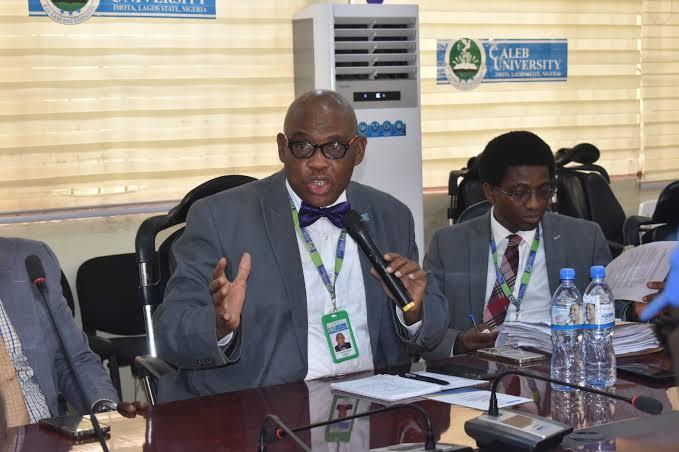
The conversation about how Human Resources Management (HRM) can drive Nigeria’s workforce through disruption and innovation, took centre stage during the Caleb University HR Space conference 2026.
Themed, ‘Reimagining HR for Business Resilience and Growth: Leading Nigeria’s Workforce Through Disruption and Innovation,’ was focused on how HR managers/practitioners can leverage technology adoption for workforce disruption, innovation, and business resilience.
“The old playbook is no longer fit for purpose. We cannot continue to manage people the way we did in the 1990s. The world has changed, the workforce has changed, and if we do not change, we will be left behind,” Olalekan Asikhia, vice-chancellor, Caleb University, Imota, Lagos, said.
According to him, Nigerian businesses are contending with the triple threat of economic volatility, talent scarcity and technological disruption. He therefore called for a deliberate push to upskill and reskill workers for an artificial intelligence (AI) driven economy.
Asikhia added that the old playbook of people management in HR practice from decades past is no longer fit for purpose. “This is where policy meets practice. This is where academia meets industry. This is where we forge a new path for the Nigerian workplace.”
According to the university administrator, the traditional role of HR as an administrative function has become obsolete, and must evolve into a strategic driver of innovation, competitiveness and sustainable business growth. “We asked ourselves a bold question: Is HR still relevant in the way we have practiced it over the last three decades? The answer is clear—HR must be completely reimagined.”
He said that the conference was organised to bridge the gap between academia, industry and policy by developing practical solutions capable of strengthening organisational resilience and workforce development.
The Human Resources (HR) Space conference was organised by Caleb University Business School in collaboration with Chartered Institute of Personnel Management of Nigeria (CIPM), Institute of Chartered Secretaries and Administrators of Nigeria (ICSAN), Cambridge University and Manchester University.
The conference was conceived exclusively for chief human resources officers (CHROs), HR directors, HR leaders, senior HR managers, chief executive officers (CEOs), chief operating officers (COOs), and business and industry leaders.
According to Asikhia, HR practitioners must reposition human resource management as a strategic driver of business growth, rather than a mere administrative function. He also disclosed that there is a need to deepen collaboration between universities and employers of labours towards producing market-ready graduates equipped with relevant digital, technical and leadership skills.
“We have the talent. We have the intellect. We have the resources. What we need is the collective will to reimagine HR and place it at the heart of business strategy,” Asikhia said, highlighting Caleb University’s Business School and Technology Hub efforts to close the skills gap, by exposing students to practical business challenges, including the development of digital and HR technology solutions.
“The future of work is not something we enter; it is something we create. Let us leave this conference not merely with ideas, but with the resolve to build the workplace and the nation we desire,” Asikhia said.
Ahmed Ladan, president and chairman of the governing council of the Chartered Institute of Personnel Management of Nigeria (CIPM), said future business success would depend on organisations’ ability to effectively manage diverse categories of workers.
“The future workforce will no longer exist solely within an organisational chart. It will include permanent employees, contractors, freelancers, outsourced teams, platform workers, advisers and specialists who may never set foot on the organisation’s premises,” Ladan stated in a keynote titled ‘Leadership Development in the Gig Economy: Alternative Workforce Models.’
Ladan, who was represented by Oluwatoyin Naiwo, registrar of the CIPM, said organisations must embrace new leadership models as the nature of work continues to evolve. According to him, leadership must go beyond supervising permanent employees to creating accountability, learning opportunities and inclusion across the entire workforce ecosystem.
According to Ladan, Nigeria’s labour market, characterised by widespread self-employment and informal work, requires policies that reflect emerging employment realities. He noted that between 154 million and 435 million people globally now participate in online gig work, while digital labour platforms continue to expand across Sub-Saharan Africa, according to data from the World Bank.
“The traditional model of stable wage employment is no longer the reality for most working Nigerians. Workforce strategies must reflect the realities of self-employment, informal work, portfolio careers and digitally mediated employment.”
Ladan called for stronger collaboration among government, employers, universities and professional bodies to modernise labour regulations, improve workforce data and expand access to portable social protection for Nigerian workers.
“The gig economy can become a pathway to opportunity, skills development and enterprise. Equally, it can become a source of unstable income and limited career progression. The outcome depends largely on the quality of leadership and the systems we create,” he stated, urging organisations to embrace flexible workforce models without sacrificing fairness and employee welfare.
Christian Harrison, professor of Leadership and Enterprise, University of Greater Manchester, UK, said lifelong learning is a leadership obligation. According to him, HR managers must go beyond just signing off annual training; to ensuring that the training is linked to things that will help employees develop continuously.
Speaking on the theme ‘Building Productive Future Skills: Upskilling, Reskilling, and Lifelong Learning in AI Disrupted and Inflationary Economies,’ Harrison said that a recent finding by Deloitte indicates that 94 percent of employees disclosed willingness to stay if the organization invests in learning opportunities.
However, only 34 percent of employees agree that managers encourage them to develop their learning. According to him, only 26 percent of Nigerian managers actively develop their teams. “So, it’s clear – if you want to keep people, invest in them; train them. That’s why this is important, you need to reskill and upskill your staff,” he said.
Harrison also urged HR managers to model vulnerability and should not make their people think they are perfect. “I talk to successful people, don’t share only your successes; share your failures. You have to make your employees know that you are human,” he said.
Jens Jenssen, fellow and senior researcher, Centre for International Human Resource Management, University of Cambridge, said HR has become a strategic partner in organisational transformation and must be integrated into overall business strategy.
Presenting a paper titled “From Administration to Architecture: Redesigning the HR Function for Business Resilience and Growth,” Jenssen disclosed that leading organisations now regard people management as a shared leadership responsibility rather than the exclusive preserve of HR departments.
“Outstanding HR begins with leadership. Accountability for people management rests with line managers, while HR provides the expertise, guidance and challenge needed to achieve organisational success,” Jenssen said.

Join BusinessDay whatsapp Channel, to stay up to date
Open In Whatsapp