The United States has carried out a seventh consecutive night of military strikes against Iran, intensifying hostilities after President Donald Trump declared that the temporary ceasefire between the two countries had ended.
The US Central Command (CENTCOM) said the latest wave of attacks targeted Iranian surveillance sites, military logistics infrastructure, underground weapons storage facilities and maritime capabilities.
According to CENTCOM, the operation concluded at about 9:30 p.m. Eastern Time (02:30 BST) after several hours, with US forces deploying fighter aircraft, drones, warships and other military assets.
The renewed offensive comes days after Trump announced that the ceasefire brokered in June to facilitate negotiations aimed at ending the conflict was no longer in effect, following the collapse of diplomatic talks.
Iran responded by launching attacks against US allies across the Gulf, with Kuwait reporting strikes on critical infrastructure.
Kuwait’s Ministry of Electricity and Water said one of its electricity and water desalination plants was struck, triggering a fire that forced the shutdown of some power generation units.
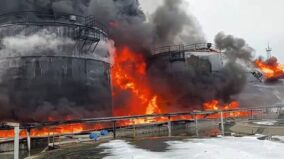
The country’s state news agency later reported that an oil facility sustained significant damage during repeated Iranian attacks, with several people injured.
Jordan’s military also announced that its air defence systems intercepted 10 Iranian missiles that entered its airspace overnight.
Authorities said no casualties or property damage were recorded.
Similarly, Bahrain said its air defence forces successfully intercepted Iranian projectiles aimed at the kingdom.
Iranian state media reported explosions in the central city of Yazd as well as on Qeshm Island and the strategic port city of Bandar Abbas near the Strait of Hormuz.
Verified footage showed extensive damage around the twin Shahid Mirzaei tunnels, a key transport route north of Bandar Abbas.
Authorities in Hormozgan Province also confirmed attacks on electricity infrastructure and desalination pumps near Jask, leaving about 10,000 residents across 20 villages without access to drinking water.
More than 100 telecommunications masts were reportedly knocked out during the strikes, disrupting mobile phone, landline and internet services across parts of northern Hormozgan Province.
The United States denied Iranian accusations that it had deliberately targeted civilian infrastructure, including bridges, a railway station and an airport.
However, verified footage confirmed severe damage to Gariveh Bridge, where a section of the roadway collapsed following overnight strikes.
Provincial authorities said at least seven people were killed in the attacks.
A White House spokesperson maintained that US operations were directed solely at military objectives.
“We carried out strikes exclusively on military targets, including military logistics infrastructure,” the spokesperson said.
The Pentagon also confirmed destroying a control tower at Iran’s Chabahar Port, describing it as part of the Islamic Revolutionary Guard Corps’ maritime surveillance network. US Defence Secretary Pete Hegseth released imagery showing the tower collapsing after being struck.
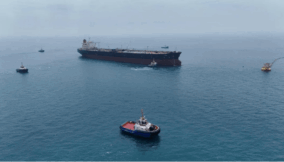
The renewed fighting has further heightened tensions around the Strait of Hormuz, one of the world’s most critical maritime trade routes.
Following the breakdown of the ceasefire, the United States reinstated its naval blockade of Iranian ports, while Tehran declared the Strait of Hormuz closed to commercial shipping.
Commercial vessel traffic through the waterway has largely come to a halt.
About one-fifth of global oil and liquefied natural gas exports normally pass through the Strait of Hormuz, prompting concerns over international energy security.
Fatih Birol, International Energy Agency Executive Director has warned that prolonged disruption to shipping through the strait could significantly affect global energy supplies.
The US military also dismissed Iranian reports that two oil tankers exploded after passing through a mined route south of the Strait of Hormuz.
CENTCOM described the claim as false, saying it was consistent with previous misinformation attributed to Iran’s Islamic Revolutionary Guard Corps.
Earlier, Iran claimed to have attacked multiple US military facilities in Kuwait, Bahrain, Jordan and, for the first time, Syria.
While Washington denied the attacks on Syria, sources told CBS News that several American service members were injured during Iranian strikes on two US bases in Jordan over the past week.

Join BusinessDay whatsapp Channel, to stay up to date
Open In Whatsapp