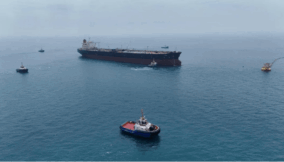
The United States launched a sixth consecutive night of airstrikes on Iran, targeting military sites as fighting intensified over control of the Strait of Hormuz, a key global oil shipping route.
Read also: us-says-fresh-wave-of-strikes-against-iranian-targets-underway
The US Central Command (Centcom) said the latest attacks were aimed at “further degrading Iranian military capabilities” and confirmed its forces boarded an oil tanker and intercepted commercial vessels as part of Washington’s renewed blockade of Iranian ports.
Iranian state media accused the US of striking civilian infrastructure, including bridges, a railway station and an airport. The BBC verified damage to one bridge west of Bandar Abbas in Hormozgan province. Iranian media said seven people were killed in the latest strikes.
Read also: iran-expands-attacks-on-gulf-states-after-us-strikes-says-strait-of-hormuz-closed
Centcom, however, said its forces targeted “coastal surveillance and air defence sites, military logistics infrastructure and maritime capabilities” near Bandar Abbas, Bushehr and Qeshm Island. It did not mention civilian infrastructure.
Iran’s Islamic Revolutionary Guard Corps (IRGC) said it retaliated by striking US maritime surveillance radar sites in Oman, as well as targets in Kuwait and Bahrain. The group also claimed to have attacked a US special operations command centre at al-Tanf in Syria, saying the strike was in response to the killing of Iranian soldiers earlier this week. Neither the United States nor Syria has confirmed the claim.
Jordan’s military later said it intercepted three Iranian missiles without casualties or damage, while Kurdish security forces in Iraq reported shooting down eight drones over Erbil.
Read also: iran-launch-wide-scale-military-operation-targeting-multiple-gulf-arab-states
The latest escalation comes as the Strait of Hormuz remains effectively closed following Iran’s response to US-Israeli military action, disrupting global oil shipments and raising concerns over energy supplies.
International Energy Agency Executive Director Fatih Birol warned the prolonged disruption could have serious consequences for global markets.
“We should be worried, and I am worried, if the situation does not improve in the next few weeks,” Birol said.
China and Pakistan on Friday urged both Washington and Tehran to halt hostilities and return to negotiations.
The renewed US strikes also followed President Donald Trump’s earlier warning that Iran’s bridges and power infrastructure could be targeted if Tehran refused to resume talks.
Read also:
After Trump made similar threats in April, UN High Commissioner for Human Rights Volker Türk warned that deliberately targeting civilians and civilian infrastructure could constitute a war crime.
Iran’s state news agency IRNA reported that strikes hit Iranshahr Airport, a railway station in Bandar Khamir and five bridges in Bandar Abbas. Iran’s health ministry said at least 38 people have been killed and more than 400 injured since fighting with the US resumed.
Centcom also said US Marines boarded an oil tanker in the Gulf of Oman and diverted three commercial vessels attempting to breach the blockade. Separately, the United Kingdom Maritime Trade Operations reported that a tanker sailing near Khasab, Oman, was struck by an unidentified projectile on Thursday, although all crew members were safe.
Despite the military escalation, the White House said President Trump remained open to diplomacy.
Karoline Leavitt, US Press Secretary, said Washington was still in contact with Tehran but insisted the US would respond if Iran continued attacks on shipping in the Strait of Hormuz.
Mohammad Bagher Ghalibaf, Iran’s chief negotiator, said Tehran saw “no reason” to honour any agreement that failed to serve its interests, adding that Iran’s national security depended on maintaining its own security arrangements in the strategic waterway.
Conflicting accounts also emerged over the reported release of American detainee Dena Karari. Trump said Iran had freed her as a gesture of goodwill, and her lawyer confirmed she was travelling back to the United States. However, Iran’s judiciary denied that any US prisoner had been released or exchanged.

Join BusinessDay whatsapp Channel, to stay up to date
Open In Whatsapp