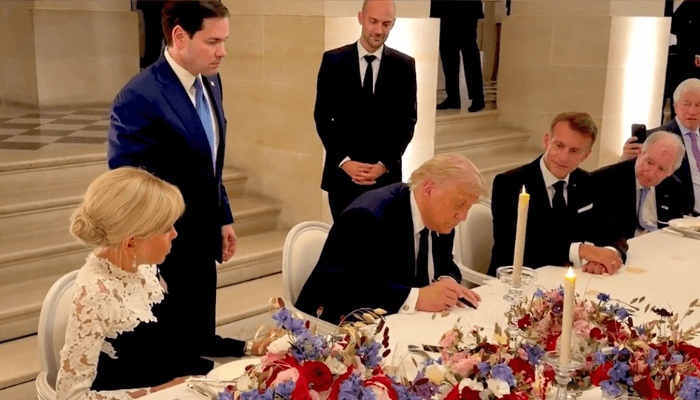
The United States and Iran have signed a historic interim agreement aimed at ending months of war, but Donald Trump, the United States president, warned that Washington would launch fresh military attacks and target Iranian leaders if Tehran failed to uphold its commitments.
The agreement, signed by Trump and Masoud Pezeshkian, Iran president, marks the first known accord signed by leaders of both countries since the Islamic Republic was established in 1979. It extends a ceasefire by 60 days and opens the door for negotiations on a permanent peace settlement.
Read also: explained-the-key-details-of-the-us-iran-deal-to-end-conflict-restore-stability
Speaking at the G7 summit in France, Trump made clear that the United States would respond forcefully to any breach of the agreement.
“We’re going to bomb the hell out of them if they violate the agreement,” Trump told reporters. “I don’t want them to. I want them to honour the agreement.”
He added that if Iran did not “behave”, the United States would return to military action.
The remarks underscored the fragile nature of the agreement despite hopes that it could bring an end to a conflict that has shaken the Middle East, disrupted global energy markets,ts and raised fears of wider economic instability.
Trump also appeared to soften his earlier position on Iran’s missile programme. Having previously pledged to destroy Iran’s ballistic missile capability, he said it would be “unfair” to expect Tehran to be the only country in the region without such weapons.
Read also: trump-says-israel-exists-because-of-us-support-as-tensions-with-netanyahu-deepen
Iranian officials did not publicly respond to Trump’s latest threats and instead celebrated the agreement as a diplomatic victory.
Mohammad Baqer Qalibaf, Iran’s lead negotiator, told state television that diplomacy had achieved far more than military action.
“Everything we sought to achieve through military action, we obtained several times over through negotiation. It was not even comparable,” he said.
According to Reuters, th14-pointnt memorandum provides for an immediate halt to fighting across all fronts, including Lebanon, the restoration of unrestricted maritime traffic through the Strait of Hormuz, the lifting of the United States blockade of Iranian ports, the easing of sanctions, the release of frozen Iranian assets and the creation of a 300 billion dollar reconstruction investment fund.
The war began on February 28 when the United States and Israel launched attacks on Iran that killed Supreme Leader Ayatollah Ali Khamenei and several senior military figures. The conflict rapidly expanded across the region, leaving more than 7,000 people dead, mostly in Iran and Lebanon, while triggering sharp rises in energy prices and increasing concerns over inflation and food security in poorer nations.
Financial markets reacted positively to the agreement, with oil prices falling as traders anticipated the full reopening of the Strait of Hormuz, a crucial global oil route between Iran and Oman. Brent crude fell below 80 dollars a barrel, its lowest level since the conflict began, before recovering some losses after Trump’s renewed threats of military action.

Join BusinessDay whatsapp Channel, to stay up to date
Open In Whatsapp