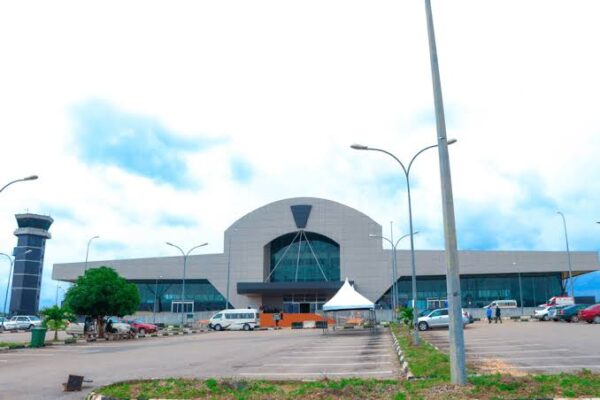
LAGOS — A newly released preliminary report by the Nigerian Safety Investigation Bureau (NSIB) has exposed several infrastructure failures at the Asaba International Airport (DNAS) in Delta State.
The investigation follows a serious incident on June 10, 2026, where a US-registered Bombardier Challenger 601-3A executive jet mistakenly landed on a paved highway under construction outside the airport’s perimeter fence.
Among the NSIB’s disclosures is that the Asaba Tower voice recording system was completely unserviceable during the occurrence. This forced investigators to artificially reconstruct vital pilot-to-controller communications from manual operational logs, severely limiting the availability of recorded audio evidence
The NSIB report laid bare the blackout of critical ground-based navigational and safety aids at the Asaba Airport on the day of the serious incident. The bureau confirmed that the following vital systems were non-functional: MHz Instrument Glide Slope, Airfield Lighting Control Panel, Wind Velocity Indicator, and Asaba Tower Voice Recorder.
These systemic blind spots directly crippled the air traffic control environment precisely when the flight crew was battling intermittent, low-hanging cloud cover.
The business jet (nationality and registration marks N989BC), operated by VMO Aero Limited, was operating an Instrument Flight Rules (IFR) flight from Lagos to Asaba with seven persons on board—four crew members and three passengers.
Human factors and cockpit friction emerged as central elements in the pre-flight phase. The Pilot-in-Command (PIC), acting as the Pilot Flying, had joined the charter company just ten days prior, and this was his first-ever flight into the challenging Asaba terrain.
During pre-departure programming of the Flight Management System (FMS) database in Lagos, an onboard Observer Pilot flagged multiple data entry discrepancies. The PIC reportedly dismissed the warning, telling the observer that because he was not rated on the Challenger aircraft type, he “should not interfere with the aircraft preparation.”
Further friction erupted during the pre-flight briefing regarding the cruising altitude, leading the cabin crew member to notify corporate management of the crew’s operational disagreements before takeoff.
Upon arriving in Asaba airspace at approximately 08:31 h, the tower cleared the jet for an Area Navigation (RNAV) Approach onto Runway 11. Due to thick, low-hanging clouds, the aircraft lost visual contact, executed a right 360-degree orbit, initiated a missed approach (go-around), and climbed back to 3,000 feet to reposition.
During the second approach, the cockpit instruments showed the jet was perfectly aligned with the RNAV coordinates. However, the runway environment appeared visually displaced to the right.
According to the crew, the Observer Pilot pointed out a fresh, black paved strip ahead and identified it as the runway. Relying on this visual confirmation, the PIC landed the multi-million-dollar private jet directly onto an uncompleted, paved roadway outside the airport’s perimeter fence.
Fortunately, no injuries were sustained among the three passengers and four crew members, and the aircraft suffered no structural failure or fire.
After the jet ground to a halt on the active construction site, the passengers quickly disembarked, and the PIC inspected the exterior.
While the Nigerian Airspace Management Agency (NAMA) logs show that an airport emergency rescue team was dispatched, the flight crew stated that no rescue or airport emergency personnel ever reached the site.
Instead of waiting for an aviation safety audit, the pilot contacted his company management from the highway, spoke briefly with an individual identified as the Airport Manager, fired up the twin-engine jet, and took off directly from the under-construction public roadway to fly the damaged aircraft back to Murtala Muhammed International Airport in Lagos.

Join BusinessDay whatsapp Channel, to stay up to date
Open In Whatsapp