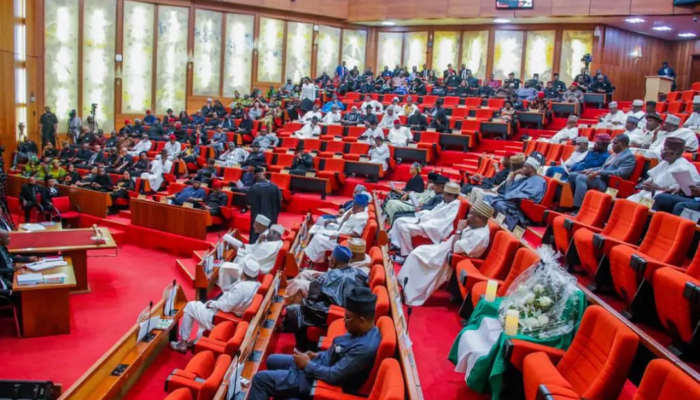
The Senate on Wednesday passed for second reading a bill seeking to subject foreign aid, donor-funded projects and grants received by government agencies, non-governmental organisations (NGOs) and state governments to stricter legislative oversight amid growing concerns over transparency, accountability and national security.
The proposed legislation, sponsored by Ibrahim Dankwambo (Gombe North), scaled second reading after lawmakers expressed worries that billions of naira in foreign assistance entering Nigeria, particularly through NGOs, are largely outside public scrutiny.
Opening the debate, Dankwambo noted that although Nigeria remains one of the world’s largest recipients of grants, humanitarian assistance, technical support and concessional financing from bilateral and multilateral development partners, the management of such funds has remained fragmented and poorly coordinated.
He said many donor-funded projects are executed outside the national budget framework and spread across various Ministries, Departments and Agencies (MDAs), resulting in duplication, weak coordination and poor accountability.
According to the lawmaker, the bill seeks to establish a legal framework that would ensure all foreign assistance received in the country is integrated into Nigeria’s fiscal planning process and subjected to constitutional oversight.
He explained that the legislation proposes the establishment of a National Donor Coordination Framework, compulsory registration of all donor-funded projects, the creation of a national database for foreign assistance, integration of donor interventions into government budgets, mandatory public disclosure of funding and project implementation, as well as sanctions for the diversion, misuse or non-registration of donor-funded programmes.
Contributing to the debate, Tahir Monguno, Senate Chief Whip, described the proposal as long overdue, noting that foreign assistance is currently driven largely by donor agencies with limited domestic coordination.
Jibrin Barau, the Deputy President of the Senate, said while foreign assistance received directly by the Federal Government is usually reflected in the national budget, funds channelled to NGOs and state governments are often beyond public accountability.
Barau said, “We can’t tell what money goes into the coffers of NGOs. Fraudsters set up bogus, pseudo NGOs and collect money from there.”
He said the absence of effective regulation of donor funds had remained a longstanding concern and urged lawmakers to ensure the bill is passed into law.
Also supporting the bill, Adamu Aliero said improved regulation of foreign assistance would enhance transparency and encourage development partners to deepen their support for Nigeria.
He recalled instances during oversight visits by the Senate Committee on Agriculture where agencies could not satisfactorily account for donor funds received.
Aliero called for the legislation to expressly cover NGOs and state governments, saying such provisions would strengthen the National Assembly’s oversight responsibilities.
Sani Musa, the Chairman of the Senate Committee on Finance, said the proposed law would align Nigeria’s donor funding regime with international best practices while promoting greater accountability and confidence among development partners.
He also raised concerns over the security risks associated with unregulated foreign assistance.
Musa said, “Most of the aid coming to so-called NGOs is not subjected to scrutiny.
“We have seen instances where such arrangements create security concerns because we do not know who is accounting for what. Is it insurgents taking money meant for victims?”
According to him, the bill would also provide a clear distinction between foreign investments and grant inflows, thereby improving fiscal planning and policy coordination.
Adams Oshiomhole backed the proposal, insisting that all donor funds entering Nigeria should be declared, properly documented and subjected to legislative oversight.
He also advocated mandatory disclosure of financial resources received by NGOs and civil society organisations, alongside stiff penalties for organisations that violate the law.
President of the Senate, Godswill Akpabio, equally endorsed the bill, warning that foreign funds coming into the country could be deployed in ways capable of undermining national security.
Following the debate, the Senate referred the bill to its Committees on National Planning and Economic Development and Finance for further legislative work, directing the panels to report back within four weeks.

Join BusinessDay whatsapp Channel, to stay up to date
Open In Whatsapp