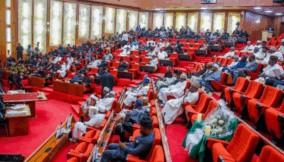
backs CBN’s recapitalisation plans
The National Assembly has directed the Nigeria Deposit Insurance Corporation (NDIC) to ensure that failed institutions are resolved in a timely and efficient manner.
The directive comes as the banking industry assets increased by 49.68 percent to N107.27 trillion in November 2023 from N71.59 trillion in 2022.
“I commend the role NDIC has played over the years to protect depositors and the banking system from instability occasioned by the loss of depositors”?, confidence,” Mukhail Adetokunbo Abiru, chairman, Senate committee on banking, insurance and other financial institutions, said in Lagos, at the committee’s retreat, with the theme “Deepening deposit insurance knowledge for effective legislative functions”.
He noted that banking, insurance, and other financial institutions sector of the Nigerian economy has remained resilient despite economic headwinds occasioned by rising inflation, and forex challenges.
To buttress his point, he referred to the data from the National Bureau of Statistics, which indicates that the sector, which contributed 4.36 percent to GDP in the third quarter of 2023, grew by 28.21 percent, year-on-year in real terms, higher by 15.52 percent points from the rate recorded in the third quarter of 2022.
This growth rate, he said was achieved in a period when the real GDP growth rate for the entire Nigerian economy was only 2.54 percent.
Also, data from the Central Bank of Nigeria (CBN) show that this sector is associated with healthy financial soundness indicators. As of November 2023, the Capital Adequacy Ratio of the banking sub-sector was 12.3 percent and within regulatory requirements of between 10 percent and 15 percent. The liquidity ratio of 41.6 percent was more than the minimum requirement of 30 percent while the non-performing Loans ratio of 4.2 percent was within the threshold of a maximum of 5 percent.
Abiru welcomed the move by the CBN to recapitalise commercial banks. “While these are encouraging developments, we should not lose sight of the fact that these numbers pale in significance when viewed against the backdrop of naira depreciation. The financial sector requires to be continuously strengthened to be able to perform its role of intermediating between surplus and deficit units in the economy. It is in this light that I welcome the plan by the Central Bank of Nigeria to recapitalise the banks. In doing so, the CBN will be well advised to engage all critical stakeholders including the National Assembly,” he said.
He said the National Assembly is ready to support any effort geared towards protecting the interest of bank depositors in the overall interest of our financial system.
“This retreat marks a significant step forward in our collective effort to unlock the full potential of the deposit insurance scheme in Nigeria. By working together, with a clear understanding of its challenges and opportunities, we can engender more confidence in the banking system and hence bring about a more stable financial system,” he added.
Speaking at the retreat, Bello Hassan, managing director/CEO at NDIC, said the deposit insurance system (DIS), is an important component of the financial safety net, and plays a crucial and indispensable role in the attainment of financial system stability.
“In Nigeria, the effective discharge of the corporation’s mandate since its establishment about 35 years ago, has gone a long way in engendering public confidence in our banking system, while also providing strong support to the monetary authority in the formulation and implementation of sound banking policies,” he said.
“it is instructive to point out that a robust legal framework, is at the heart of an effective Deposit Insurance System in any jurisdiction. It is against this backdrop, that principle two of the International Association of Deposit Insurers (IADI) Core Principles for Effective Deposit Insurance, harps on the powers of a deposit insurer (DI). It underscores the necessity for a DI to have all powers necessary to fulfill its mandate and further emphasises that these powers should be formally specified in enabling legislation,” Hasan said.

Join BusinessDay whatsapp Channel, to stay up to date
Open In Whatsapp