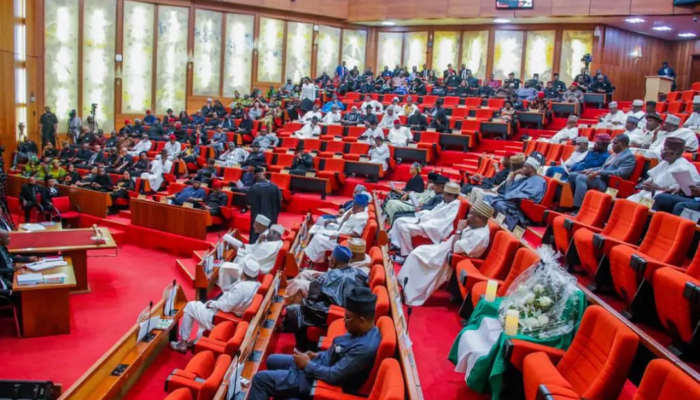
The Senate on Wednesday passed the Constitution of the Federal Republic of Nigeria (Alteration) (State Police) Bill, 2026, marking a major step towards the establishment of state police services across the country.
The bill scaled third reading after senators considered and voted on its provisions clause by clause during the Committee of the Whole.
In an unusual move ahead of the passage of the legislation, the Senate suspended its standing rules to allow non-members, referred to as “strangers” under parliamentary procedure, into the chamber.
Following the amendment of the rules, several state governors were admitted into the Senate chamber to observe proceedings on the State Police Bill, a constitutional amendment that has enjoyed strong backing from state governments and other stakeholders advocating the decentralisation of policing in the country.
The governors watched from designated seats as senators considered the bill clause by clause during the Committee of the Whole before its eventual passage.
During the voting process, senators raised their hands in support of the various clauses.
Senator Garba Maidoki (Kebbi South) was the only senator who did not indicate support for the bill before leaving the chamber.
Leading the debate on the bill, Senate Leader, Senator Michael Opeyemi Bamidele (Ekiti Central), described the legislation as “one of the most significant constitutional reforms in our nation’s democratic evolution.”
According to him, the bill seeks to alter the Constitution to provide for the establishment of state police services while retaining a federal police structure.
“This important Bill is an Executive Bill transmitted by Mr. President and Commander-In-Chief of the Armed Forces of the Federal Republic of Nigeria, seeking to alter the Constitution to provide for the establishment of State Police Services and other related matters,” Bamidele said.
He noted that the existing centralized policing structure has come under increasing pressure due to evolving security challenges.
Read also: Tinubu seeks an end to exploitation of Africa’s natural resources
“The framers of the 1999 Constitution established a single and centrally controlled police force for the Federation.
“While that arrangement may have served the country at a particular stage of our national existence, the realities of contemporary Nigeria have exposed significant challenges associated with a centralized policing architecture,” he said.
Bamidele said Nigeria’s diversity and growing insecurity had strengthened calls for decentralized policing.
“It is common knowledge that Nigeria is a vast Federation, comprising Thirty-Six States and the Federal Capital Territory with diverse cultures, languages, geographical terrains, security dynamics and socio-economic conditions.
“The increasing complexity of security threats, which include terrorism, banditry, kidnapping, communal conflicts, farmer-herder clashes, cybercrime, organised criminal networks and other transnational crimes, have placed enormous pressure on the existing policing framework,” he said.
He added that, “The present structure often limits the ability of local authorities to respond swiftly and effectively to security challenges within their jurisdictions.”
The Senate Leader said the bill would establish a constitutional framework for state police while preserving national standards and accountability.
“The principal objective of this Bill is to establish a constitutional framework for the creation and operation of State Police Services while retaining a strong Federal Police Service and maintaining national standards, accountability and oversight,” he said.
According to him, the bill seeks to retain a Federal Police Service, establish State Police Services for states that choose to create them, provide safeguards against abuse and political manipulation, create independent State Police Service Commissions, establish national minimum policing standards and promote cooperation between federal and state policing institutions.
Read also: PTML plans $50m Lagos port expansion to handle larger ships
He explained that under the proposed framework, a Federal Police Service would continue to handle protection of federal institutions, policing of the Federal Capital Territory, counter-terrorism, organised crime, cybercrime, border security, arms trafficking, inter-state criminal activities and other national security matters.
On the role of state police, Bamidele said they would be responsible for the enforcement of state laws, maintenance of public safety and order, prevention and detection of crimes within their jurisdictions, and protection of lives and property.
Addressing concerns over possible abuse by state governors, he said the legislation contains constitutional safeguards.
“One of the major concerns expressed regarding the establishment of State Police is the potential for political abuse by State Governments.
“This Bill directly addresses that concern by prohibiting any Governor from directing a State Police Service to target specific persons, political parties, groups or associations unlawfully.
“The Bill also expressly prohibits the use of police powers for partisan, ethnic, religious, sectional or personal purposes,” he said.
Bamidele further stated that the National Assembly would be empowered to prescribe minimum national standards covering recruitment, training, vetting, promotions, discipline, use of force, firearms, accountability and professional conduct.
“These minimum standards will ensure that State Police Services remain professional, accountable and compliant with national standards,” he said.
He also disclosed that the bill provides for federal intervention in exceptional circumstances.
“The Bill creates carefully regulated mechanisms for federal intervention where there is a breakdown of public order, a State Police Service becomes incapable of functioning, there are serious abuses of fundamental rights, there is partisan or electoral intimidation, or national security is threatened,” he said.
According to him, such intervention must be “authorized in writing by the President, limited in scope and duration, subject to Senate oversight and open to judicial review.”
Highlighting the expected benefits of the legislation, Bamidele said state police would improve community policing, strengthen intelligence gathering, enable faster response to security threats, decongest federal security responsibilities, strengthen federalism and enhance accountability.
“Security is most effective when law enforcement personnel understand local communities, languages, customs and terrain. State Police Services will strengthen intelligence gathering and community engagement,” he said.
He added that, “This Bill is not merely a security reform; it is a constitutional response to the evolving realities of our nation. It seeks to balance local policing autonomy with national cohesion, accountability with operational effectiveness and federal oversight with state responsibility.”
Urging senators to support the proposal, Bamidele said the bill “provides robust safeguards against abuse, preserves federal authority where necessary, protects constitutional rights and creates a modern policing framework capable of addressing contemporary security challenges.”
The bill was subsequently read the third time and passed by the Senate.

Join BusinessDay whatsapp Channel, to stay up to date
Open In Whatsapp