
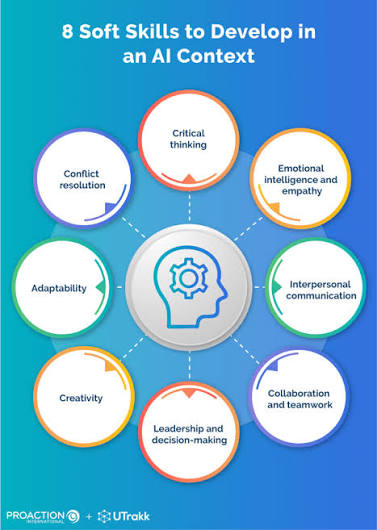
As artificial intelligence(AI) evolves from a tool that assists workers into autonomous agents capable of completing complex tasks independently, technical proficiency alone will no longer guarantee job security, but uniquely human capabilities such as critical thinking, emotional intelligence, creativity, and leadership will become most valuable workplace assets.
AI agent software systems that can independently plan, execute, and complete multi-step tasks with minimal human intervention are becoming part of enterprise operations.
Unlike traditional AI assistants that require constant prompts, these systems can manage calendars, draft reports, analyse data, coordinate workflows, conduct research, and even communicate with customers autonomously.
Major tech companies are officially transitioning from passive AI assistants to proactive, autonomous AI agents in workplace software. Systems like Microsoft Copilot, Salesforce Agentforce, Amazon Quick, and Google Workspace Studio are designed to independently plan, execute, and monitor multi-step business workflows with minimal human micromanagement.
While this transformation promises significant productivity gains, it is also reshaping what employers value most.
The World Economic Forum’s Future of Jobs Report predicts the displacement of 92 million roles globally, offset by the creation of 170 million new jobs, while fundamentally shifting the specific skills required to stay competitive.
Rather than replacing every job, AI is expected to redistribute work. Routine administrative activities, which include scheduling meetings, generating presentations, writing standard emails, compiling reports, analysing spreadsheets and processing documentation, are becoming responsibilities AI agents can handle faster and at lower cost.
The shift means human workers will be evaluated by how effectively they solve problems, influence decisions and build relationships rather than just how efficiently they perform repetitive tasks.
Artificial Intelligence is becoming exceptionally good at executing processes, but organisations will still rely on people to provide judgment, context and trust.
Why soft skills matter more than ever
As AI assumes operational responsibilities, soft skills are becoming strategic business capabilities rather than optional professional traits. Among the most important are:
Emotional intelligence
Despite the rapid advances in generative AI, machines cannot genuinely understand human emotions or build authentic relationships.
Hence, employees who demonstrate empathy, conflict resolution, active listening and interpersonal awareness will remain indispensable in customer service, leadership, sales, healthcare, education and people management.
Managing difficult conversations, motivating teams and understanding organisational culture remain deeply human responsibilities.
Critical thinking
Artificial Intelligence can generate answers within seconds, but determining whether those answers are accurate, ethical or strategically appropriate still requires human judgment.
Hence, workers who can evaluate AI-generated outputs, identify risks, challenge assumptions and make informed decisions will become valuable. Organisations may produce incorrect or biased outcomes if employees accept AI responses without independent reasoning.
Communication
Artificial Intelligence can draft emails and presentations, but persuading stakeholders, negotiating agreements and inspiring teams require communication skills rooted in authenticity and credibility.
Strong communicators can adapt messages to different audiences, manage sensitive discussions and influence decision-making in ways AI cannot easily replicate.
Creativity
Although Artificial Intelligence can produce text, images and software code, genuine innovation often comes from combining lived experience, curiosity and original thinking.
Businesses will need employees capable of identifying new opportunities, designing products, developing business models and solving unfamiliar problems. Creativity remains valuable because Artificial Intelligence largely generates outputs based on existing patterns rather than lived human insight.
Leadership
As organisations integrate Artificial Intelligence into daily operations, leaders must guide teams through technological change, and this involves making ethical decisions, managing uncertainty, allocating responsibilities between humans and AI, and maintaining employee trust.
Leadership will focus on helping people work alongside Artificial Intelligence rather than compete against it.
AI supervisors
A new category of work is also emerging, which is supervising AI agents. Instead of manually performing every task, employees may coordinate multiple AI systems, verify outputs, intervene when necessary, and ensure work aligns with business objectives.
This shift places greater emphasis on strategic oversight than operational execution. The ability to ask better questions, define objectives clearly, and evaluate outcomes may become more valuable than completing every task manually.
Human judgment remains difficult to automate
AI agents excel in environments with abundant data and clearly defined objectives. However, workplaces frequently involve ambiguity, ethical dilemmas, competing priorities, and interpersonal dynamics that cannot easily be reduced to algorithms.
Some situations require judgment developed through experience rather than computation.
Employers seek valuable talents
Recruiters are now looking beyond technical qualifications because while digital literacy and AI fluency are becoming expectations, organisations are placing greater emphasis on adaptability, collaboration, resilience and continuous learning.
Professionals who embrace Artificial Intelligence while strengthening their human capabilities are expected to remain the most competitive.
Rather than resisting automation, there is a need to learn how to work effectively with AI. This is using it to eliminate repetitive work while focusing more time on higher-value responsibilities.
Human-AI collaboration
The future workplace is unlikely to be defined by humans versus AI, but it will involve collaboration between human workers and autonomous digital agents.
Artificial Intelligence may complete routine tasks with speed and precision, but people will continue providing vision, ethics, creativity, emotional understanding, and strategic direction.
As AI agents become more capable, the skills that distinguish people from machines will become their greatest professional advantage.
For employees navigating this transition, there is a need to develop the distinctly human qualities that technology cannot easily replicate because these qualities will be the most valuable currency in the age of autonomous work.


Join BusinessDay whatsapp Channel, to stay up to date
Open In Whatsapp