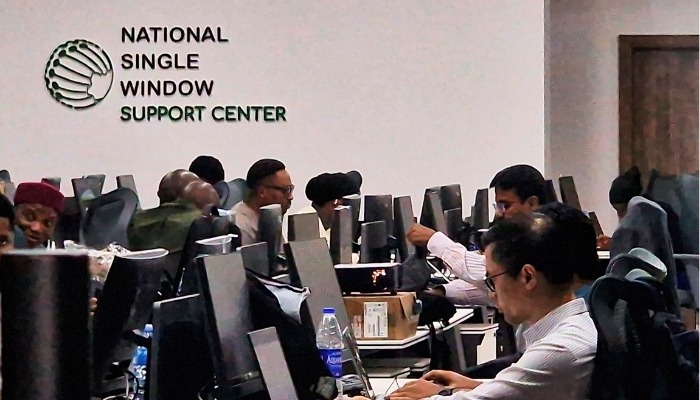
…first phase begins with non-oil import permits processing
The National Single Window (NSW), a long-awaited digital platform designed to ease Nigeria’s cumbersome trade procedures and help its ports compete, officially went live today after decades of waiting.
The unified digital system seeks to streamline all import, export, and transit processes through a single online platform, eliminating the tedious process of submitting documents to multiple government agencies, a practice that has long frustrated traders and cost Nigeria billions in lost revenue annually.
Adegboyega Oyetola, minister of Marine and Blue Economy, said that the high cost of doing business at Nigerian ports, up to 40 percent higher than in neighbouring West African countries according to the World Bank, leads to annual losses of N2.5 trillion.
“The Single Window could reduce these costs by at least 25 percent and slash average cargo clearance times by 60 percent,” he said in January 2025.
What is new
The project will be rolled out in phases, according to the NSW Secretariat. It is starting off easy. The first phase of the rollout, effective today, focuses exclusively on licensing approvals for non-oil imports.
Importers will be able to submit applications for licenses, certificates, and permits from the Standard Organisation of Nigeria (SON), the National Agency for Food and Drug Administration and Control (NAFDAC), and the Nigeria Agricultural Quarantine Service (NAQ) without physical visitations.
“Whatever they need, in terms of their end-to-end processes, will happen on the single window platform,” said Tayo Fakolade, the NSW secretariat director.
Shipping lines and airlines will also submit air and sea manifests once. For the first month, Grimaldi group alone will pilot sea cargo manifest submissions at PTML, while DHL will pilot air cargo manifests.
Users must have a valid Tax Identification Number (TIN).
Electronic payments will be integrated into the platform through Interswitch, Remita, and eTranzact.
On its portal, the system reports as “facts and figures” for the first quarter of 2026, 2,847 registered traders and licensed Customs agents, 45,623 manifests submissions and 12,156 permits and licenses issued. The secretariat could not immediately confirm if these figures were linked to the Single Window.
The system, contracted to Crimson Logic, a Singaporean firm, was been built with cybersecurity protections, the secretariat assured. It claims a 99.9 percent system uptime.
Fakolade said his office is working with the National Information Technology Development Agency (NITDA) to ensure compliance with IT regulations and data protection standards
Catching up
The project is benchmarked on global successes such as in Indonesia, where the NSW program launched in 2007 reduced clearance times at ports from seven days to just three, saving traders millions annually in administrative costs and delays, and in Vietnam where the NSW introduced in 2014, streamlined interactions with over 20 government agencies.
In Africa, Benin, Djibouti and Kenya, which had their Single Window in the early 2010s have seen clearance and cargo turnaround times slashed 90 percent to an average of two days, making them more attractive for shippers.
Importers currently find it faster and cheaper to ship goods to neighbouring countries’ ports, clear them there, and truck them into Nigeria through land borders.
Ambitious targets
The federal government, in January 2025 said it is targeting over $3 billion annually from the NSW, though the NSW Secretariat set a more conservative estimate of $2 billion in annual benefits from the platform’s operations in February 2026.
The government has yet to disclose the project’s spending or funding pipeline, but the Nigeria Revenue Service has claimed it is part of its budget.
The steering committee set a “North Star” goal of 24-hour clearance times for both imports and exports, down from the current 21 days, though officials said achieving this will take time. “We are not putting a timeline on this, but we know where we want to be,” Fakolade said. “Benefits won’t materialise overnight.”
Next steps
Phase two, expected in the second to third quarter of 2026, will extend the system to all non-oil export-related processes, according to the secretariat.
The final phase, scheduled for the first quarter of 2027, will include Customs declarations and full system integration, with the oil and gas sector incorporated at this stage.
“When you launch in phases, it’s very easy to fix issues and make sure that it doesn’t have a negative impact on the importers or their agents,” Fakolade said.

Join BusinessDay whatsapp Channel, to stay up to date
Open In Whatsapp