…Tinubu sends fresh legislation, seeks quick passage
…Committee harmonising bills ahead of Wednesday’s passage
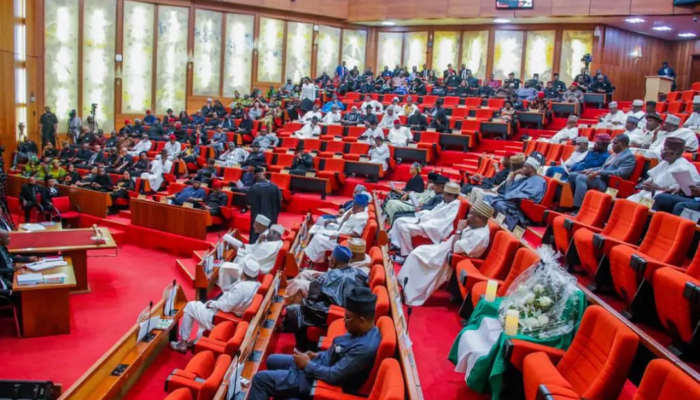
The Senate will pass the state police bill on Wednesday after its consideration by lawmakers.
The death of a member of the House of Representatives, Yaya Bauchi Tongo, on Tuesday slowed legislative activities in the Senate, delaying what was expected to be the final push towards the passage of the proposed constitutional amendment establishing state police in Nigeria.
Senate President Godswill Akpabio informed lawmakers at plenary that proceedings would be abridged in honour of the late federal lawmaker who represented Gombe/Kwami/Funakaye Federal Constituency of Gombe State and died after a prolonged illness in Abuja on June 12 at the Nizamiye Hospital.
The development came as President Bola Tinubu formally transmitted a fresh executive bill seeking to establish state police services across the country, a move seen as one of the most ambitious attempts yet to restructure Nigeria’s security architecture.
The proposed legislation, titled the Constitution of the Federal Republic of Nigeria (Alteration) State Police Bill, 2026, seeks to amend the 1999 Constitution to create a constitutional framework for the establishment and operation of state police services.
In a letter addressed to Akpabio and read on the floor of the Senate on Tuesday, Tinubu said the bill would provide a legal pathway for the creation of a dual policing system capable of addressing the country’s evolving security challenges.
“I am delighted to present to the Senate for consideration the Constitution of the Federal Republic of Nigeria (Alteration) State Police Bill, 2026, which seeks to amend the Constitution of the Federal Republic of Nigeria 1999 to create a constitutional pathway for the establishment of state police services in Nigeria,” the president stated.
According to the president, the bill builds on previous legislative efforts undertaken by both chambers of the National Assembly and includes additional safeguards designed to ensure the effective implementation of a dual policing structure.
“The bill builds on the significant work already done in this regard by the House of Representatives and the Senate, and incorporates additional safeguards to ensure that the creation of a dual policing structure to address our nation’s evolving national security challenges will be achieved quickly and effectively to the benefit of all Nigerians,” he said.
President Tinubu described the proposed legislation as a critical component of his administration’s broader strategy to reorganise the nation’s security framework and improve the protection of lives and property across the country.
“The proposed legislation is a critical component of our administration’s strategy to reorganise Nigeria’s security architecture to better protect our citizens, and I am confident that the Senate will act quickly to consider and pass this bill,” Tinubu added.
Meanwhile, Senate Leader Opeyemi Bamidele appealed to senators to attend Wednesday’s sitting, stressing that the constitutional amendment process requires a high voting threshold.
“We need a minimum of two-thirds of members to vote on constitutional alterations.
“The issue of state police is non-partisan and cuts across geopolitical zones and interests,” he said.
The renewed push for State Policing comes amid worsening insecurity across several parts of Nigeria and growing consensus among political leaders that the country’s centralised policing model is no longer adequate for present-day security realities.
Nigeria currently operates a single police force under Section 214 of the Constitution, with command and control vested in the Federal Government.
However, decades of terrorism in the North-East, banditry and mass kidnappings in the country have exposed limitations in the country’s centralised security framework.
Supporters of state police argue that governors, who are constitutionally designated as chief security officers of their states, often lack operational control over security agencies and are therefore unable to respond swiftly to emerging threats.
They contend that decentralised policing would improve intelligence gathering, speed up emergency responses and strengthen community policing.
Two weeks ago, the Senate commenced legislative consideration of the Constitution of the Federal Republic of Nigeria (Sixth Alteration) Bill, 2026 (Establishment of State Police) (SB. 794), one of the most consequential constitutional amendment proposals since Nigeria’s return to democratic rule in 1999.
The bill seeks to move policing from the Exclusive Legislative List to the Concurrent Legislative List, thereby empowering states to establish and operate their own police formations alongside the Federal Police.
Leading debate on the bill, Senate Leader Opeyemi Bamidele described the proposal as one of the most significant security reforms contemplated since the restoration of democracy.
“This constitutional amendment is one of the most significant security reforms contemplated since the return of democratic governance in 1999.
“It addresses a fundamental challenge confronting our nation: the inability of a centralised policing structure to adequately respond to the complex, evolving and localized security threats facing our communities,” he said.
Bamidele noted that Nigeria currently operates a single police force under Section 214 of the Constitution, a model he argued is no longer sufficient for a country of more than 230 million people facing increasingly complex security challenges.
According to him, the nation is confronted with terrorism, banditry, mass abductions, farmer-herder conflicts, cultism, armed robbery, pipeline vandalism, communal clashes and emerging cyber-enabled crimes, all of which require localised responses.
“Unfortunately, the centralised structure of the Nigeria Police Force has become overstretched, under-resourced and unable to provide the level of security required in a nation of over 230 million people spread across 36 States and the Federal Capital Territory,” he said.
Making a case for the reform, the Senate Leader argued that security operations are often most effective when driven by officers who understand the terrain, language, culture and peculiar security dynamics of the communities they serve.
He said the establishment of state police would improve intelligence gathering, facilitate rapid response to security threats, strengthen community policing and ease the burden currently placed on the Nigeria Police Force.
“Modern policing relies heavily on intelligence rather than force. State Police will significantly strengthen Nigeria’s intelligence architecture,” he stated.
Under the proposal, the federal police would retain responsibility for interstate crimes, terrorism, organised criminal networks, border security, cybercrime, protection of federal assets and national security operations, while state police formations would focus on maintaining law and order within their respective jurisdictions.
The bill specifically seeks to establish federal and state police structures, define their respective responsibilities, create State Police Service Commissions, provide oversight mechanisms, transfer policing from the Exclusive Legislative List to the Concurrent Legislative List and strengthen cooperative federalism in security administration.
Bamidele argued that the proposal aligns with practices in other federal systems, including the United States, Canada, Australia and Germany, where sub-national policing institutions operate alongside federal law enforcement agencies.
“As such, Nigeria should not remain an exception among federal systems,” he said.
The latest development comes barely two weeks after the National Assembly advanced the state police proposal through the constitutional amendment process, bringing Nigeria closer than ever to adopting a decentralised policing model.
The proposal still requires approval by at least two-thirds of the state Houses of Assembly before it can become law.
Support for the proposal also received a boost from the Nigeria Governors’ Forum (NGF), which last week reaffirmed its commitment to the establishment of State Police.
In a communiqué issued after its meeting, the governors said they had consulted with state attorneys-general on the constitutional amendments and legal framework required for state policing.
According to the communiqué, the governors emphasised “the need for the State Police to be constitutionally sound and aligned with federalism and citizens’ rights” and expressed confidence that ongoing consultations would strengthen the states’ collective position on the reform.
The governors’ endorsement is considered significant because state governments are expected to bear primary responsibility for establishing, funding and administering the proposed Police formations once the constitutional amendments are completed.
Meanwhile, BusinessDay gathered that the Senate Constitution Review Committee is currently harmonising the executive bill transmitted by Tinubu on Tuesday with the version already being processed by the National Assembly.
A senior legislative source familiar with the process said the committee was reviewing both documents to eliminate inconsistencies and produce a unified version for consideration by lawmakers.
“The committee is currently harmonising the President’s bill with the version already before the National Assembly.
“The objective is to ensure that senators work with a single document that reflects both executive and legislative inputs,” the source said.
The source disclosed that Senate leadership is working to ensure a consensus document is ready for consideration.
“We do not want multiple versions creating confusion on the floor.
“The idea is to present a harmonised bill to senators on Wednesday for deliberation and eventual passage,” the source added.
Should the proposal scale the constitutional hurdles ahead, it would represent the most far-reaching restructuring of Nigeria’s policing system since independence and fundamentally alter the country’s security governance framework.

Join BusinessDay whatsapp Channel, to stay up to date
Open In Whatsapp