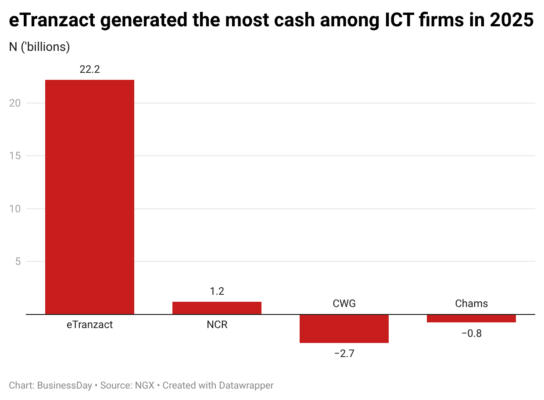
eTranzact International Plc emerged as the top cash generator among Nigeria’s listed ICT firms in 2025, as operating cash flow increasingly becomes a more telling measure of financial strength than reported profit.
The 2025 results reveal a widening gap between firms that convert earnings into liquidity and those that remain dependent on financing to sustain operations.
Among all listed players, eTranzact International Plc stood out as the most efficient cash generator, underlining the value of disciplined operational management and working capital control.
Operating cash flow is widely recognised as a more reliable indicator of financial health than reported profit. Unlike profit, which may include non-cash items such as depreciation or amortisation, operating cash shows the actual money moving through a business. It reflects the cash available to fund operations, repay debt, reinvest in the business, and sustain shareholder returns.
In capital-intensive sectors like ICT, where infrastructure, network expansion, and technology upgrades require substantial investment, strong operating cash is essential to ensure operational continuity and financial resilience.
eTranzact posted a modest net profit of N2.97 billion for 2025 but generated N22.27 billion in operating cash flow, a dramatic reversal from a negative N5.48 billion the previous year. Investing outflows were contained at N1.99 billion, while financing outflows stood at N1.24 billion.
By the end of 2025, eTranzact’s cash and cash equivalents had risen to N31.7 billion, up from N12.65 billion in 2024. The results demonstrate that operational efficiency, not sheer scale, can produce significant liquidity, giving eTranzact the flexibility to fund day-to-day operations, invest in technology, and sustain shareholder returns without heavy reliance on external financing.
Read also: Foreign investors account for 28% of bank recapitalisation – Cardoso
The performance of eTranzact stands in sharp contrast to other ICT firms, which recorded profits but struggled to convert them into cash.
CWG Plc, for instance, reported a profit of N4.98 billion for 2025 but recorded a negative operating cash flow of N2.7 billion, reversing the positive N5.81 billion in 2024.
Trade receivables rose by more than N7 billion and inventories by roughly N3.79 billion, absorbing cash from operations. Although trade payables increased by N5.88 billion, the inflow was insufficient to bridge the gap.
To maintain liquidity, CWG relied on N1.74 billion in financing inflows, primarily from borrowings, but cash and cash equivalents still declined to N5.2 billion from N6.04 billion.
The data highlight the risks of relying on reported profit without generating sufficient operational cash, leaving firms exposed to liquidity pressures and limiting their ability to fund expansion or weather financial shocks.
Chams Holdings Plc experienced a similar trend. Despite posting a profit of N605.6 million, the company’s operating cash flow was negative N0.766 billion, a steep fall from N629.8 million positive in 2024. Trade receivables rose by N3.31 billion, while inventories and deferred income further absorbed cash.
Trade payables grew by just N761 million. Financing inflows of N5.12 billion, primarily from equity issuance and borrowings, lifted cash balances to N6.01 billion from N1.29 billion, but this improvement relied heavily on external funding rather than core operations, raising questions about sustainability if financing conditions tighten.
NCR Nigeria Plc illustrates a more measured recovery. The company posted a profit of N196 million for 2025, compared with a loss of over N2.17 billion the prior year. Operating cash flow remained positive at N1.21 billion, slightly below N1.90 billion in 2024.
The company benefited from a N3.23 billion rise in trade payables, which helped offset a N2.25 billion increase in receivables. Cash and cash equivalents rose to N1.74 billion from N522.6 million.
While NCR’s liquidity improved, negative equity of N4.61 billion limits financial flexibility and the capacity to absorb operational shocks or fund network expansion, illustrating that cash generation alone may not fully insulate a firm from structural weaknesses.
The 2025 results reveal three clear patterns across the sector. First, disciplined operators like eTranzact demonstrate that strong liquidity can be achieved even without large profits, provided working capital is carefully managed.
Read also: Business confidence hits one-year high on rate cut, bank recapitalisation drive
Second, firms such as CWG and Chams highlight the risks of cash-strained profitability, where rising receivables and inventories can absorb cash faster than earnings generate it, forcing reliance on external financing. Third, NCR shows that recovery is possible, but structural balance sheet weaknesses can constrain operational flexibility, even with positive cash flow.
The divergence between profit and cash flow is particularly pronounced in capital-intensive industries.
Firms with negative operating cash, like CWG and Chams, must turn to external financing to fund operations and growth, exposing them to interest rate fluctuations, foreign exchange volatility, and tighter credit conditions.
By contrast, eTranzact’s operating cash of N22.27 billion exceeded both investing and financing needs, providing ample liquidity to self-fund operational and strategic initiatives.
Working capital management remains the principal driver of liquidity differences. CWG and Chams saw large increases in receivables and inventories that absorbed cash, while eTranzact maintained strong liquidity through disciplined collections and supplier management.
NCR’s partial recovery demonstrates the importance of matching payables and receivables to maintain positive cash flow, though balance sheet limitations continue to restrict flexibility.
For investors, creditors, and management teams, the data suggests cash flow, not profit, is the key measure of financial resilience. Companies that generate strong operating cash can fund day-to-day operations, invest in technology, service debt, and pay dividends without overreliance on borrowing.
Firms with weak operational cash face constraints regardless of reported profit, exposing them to liquidity risk and limiting their ability to pursue growth or absorb shocks.
The 2025 results confirm that Nigeria’s ICT sector is increasingly defined by the ability to turn earnings into liquidity. eTranzact’s disciplined cash and working capital management positioned it as the leading cash generator among listed ICT firms.
CWG and Chams reveal the risk of profitability without liquidity, while NCR shows that moderate recovery is possible but fragile without structural balance sheet improvements.
As the sector contends with rising costs, continued investment pressures, and the need for technological upgrades, the capacity to generate, manage, and retain cash will remain the defining metric of resilience.
Revenue growth and profit are important, but operating cash flow ultimately determines which firms can sustain operations, fund strategic initiatives, and deliver shareholder value.

Join BusinessDay whatsapp Channel, to stay up to date
Open In Whatsapp