Nigeria’s banks increased their spending on information and technology (IT) by 30.8 percent in the first quarter of 2026, driven by the growing adoption of artificial intelligence and digital channels.

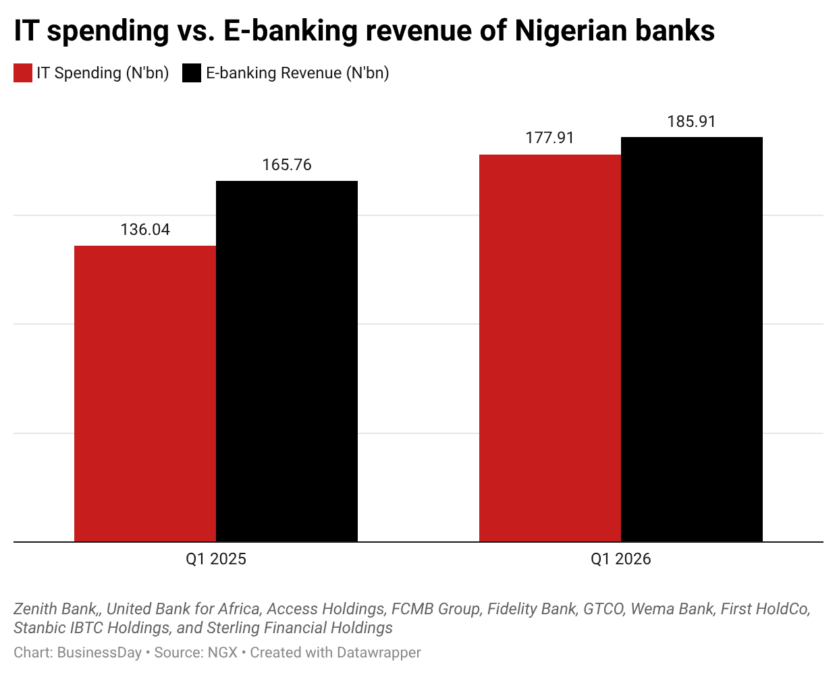
A BusinessDay analysis of the first-quarter (Q1) 2026 financial statements of 10 lenders shows that combined information technology (IT) spending rose by 30.8 percent to N177.91 billion from N136.04 billion in the corresponding period of 2025.

They include Zenith Bank, United Bank for Africa, Access Holding, First HoldCo, GTCO, Stanbic IBTC Holdings, FCMB Group, Fidelity Bank, Wema Bank, and Sterling Financial Holdings.

The increase came alongside a 12.2 percent rise in e-banking income, which increased to N185.91 billion from N165.76 billion a year earlier, underscoring the growing importance of digital channels to lenders’ earnings.

The numbers highlight a broader shift in Nigeria’s banking industry, where competitive advantage is increasingly moving away from physical branches and towards digital ecosystems, artificial intelligence, cybersecurity, and analytics.

“Technology is useful in terms of development. People are talking about AI, robotics, and advances in technology,” said Akinjide Akande, a financial analyst.

“It will not only make transactions faster, but it also makes business decisions smoother.”

Read also: Stanbic, FCMB, Access drive decline in Nigerian banks’ lending appetite

The surge in technology spending comes as banks emerge from the industry’s recapitalisation exercise with stronger balance sheets and a renewed focus on deploying capital to build long-term competitive advantages.

Zenith, Access, First HoldCo lead spending

Zenith Bank recorded the largest IT expenditure in the first quarter, nearly doubling spending to N43.83 billion from N21.92 billion in the same period last year.

Access Holdings followed with N36.7 billion, while First HoldCo almost tripled technology spending to N29 billion from N10.53 billion.

United Bank for Africa increased IT spending sharply to N22.1 billion from N6.17 billion, representing one of the biggest jumps among peers.

FCMB Group spent N9.66 billion compared with N8.36 billion previously, while Sterling Financial Holdings raised spending marginally to N1.01 billion.

Some lenders moderated spending after major investments in previous years. GTCO reduced technology expenditure to N8.5 billion from N13.32 billion, while Wema Bank lowered spending to N2.21 billion from N5.09 billion.

The investments are increasingly directed towards cloud infrastructure, cybersecurity, artificial intelligence, data centres, application programming interfaces (APIs), core banking systems, and digital lending platforms.

These investments have become non-negotiable as banks confront competition from fintech companies and changing customer expectations.

In a recent update, the Central Bank of Nigeria (CBN) has directed banks, fintech firms, mobile money operators, and other payment service providers to store all payment transaction data generated within Nigeria on local servers, with a January 1, 2027, timeline for compliance.

The move is expected to have significant implications for banks, fintech companies, payment processors and other digital finance operators that currently rely on foreign data infrastructure for parts of their operations.

Premier Oiwoh, managing director/CEO of the Nigeria Inter-Bank Settlement System (NIBSS), said the success of the new vision will not be measured by its quality but by execution.

“Technology is only 20 percent of the solution; implementation accounts for 80 percent,” he said.

He also called for zero-cost financial transactions to support the vision’s financial inclusion goals and other expected outcomes.

Post recapitalisation is changing competitive dynamics

The race to strengthen technology capabilities has been accelerated by the recapitalisation exercise.

Banks that raised over N4 trillion in fresh capital are now directing resources toward infrastructure that can generate superior returns over the long term.

According to a BusinessDay report, GTCO, Access Holdings, and Fidelity Bank allocated N186 billion from their public offerings to enhance their IT infrastructure.

Akande said institutions that invested early in technology are likely to enjoy structural advantages over competitors.

“If I have AI at my disposal and the necessary capabilities, people and resources to drive it, growth will come faster. You have that edge over your competitors,” he said.

Artificial intelligence systems are already transforming banking operations, enabling lenders to process loans within minutes, automate customer service, analyse risks and detect fraud in real time.

Several lenders have begun repositioning themselves accordingly.

Wema Bank strengthened its ALAT platform during the recapitalisation period, while Access Bank and UBA have expanded the use of predictive analytics in credit underwriting to improve lending decisions and reduce turnaround time.

Read also: Ten banks that control more than $44trn in assets

CBN’s cashless policy drives digital revenues

The rise in technology spending aligns with the Central Bank of Nigeria’s ambition to deepen financial inclusion and accelerate the transition to a cash-lite economy.

The Nigeria Payments System Vision 2028 (PSV 2028), launched by the CBN,  forms part of its broader reform agenda and seeks to modernise the country’s financial infrastructure amid growing digital commerce and increasing regional economy.

According to Olayemi Cardoso, the CBN’s governor, the strategy sets a target of raising financial inclusion to 95 percent by 2028, potentially bringing an additional 50 million Nigerians into the formal financial system.

“The plan also seeks to deepen digital payment adoption, reduce reliance on cash, improve cross-border payment capabilities, and strengthen cybersecurity protections,” he said.

The continued expansion of mobile banking, internet banking, and electronic transfers is creating new revenue streams for lenders.

Combined e-banking income of the 10 banks increased to N185.91 billion in Q1 2026 from N165.76 billion a year earlier.

Access Holdings generated the highest e-banking revenue at N55.7 billion, up from N48.3 billion.

UBA followed with N46.9 billion, although slightly below the N47.8 billion recorded a year earlier.

Zenith Bank’s digital income rose strongly to N26.88 billion from N16.17 billion, while GTCO posted one of the strongest increases, with e-banking revenue surging nearly 69 percent to N21.9 billion from N12.98 billion.

First HoldCo generated N20.75 billion, while Sterling Financial Holdings earned N2.89 billion.

The figures suggest banks are beginning to reap returns from years of investment in digital infrastructure.

In 2025, the Nigeria Inter-Bank Settlement System Plc (NIBSS) recorded massive milestones in Nigeria’s digital financial sector. Cashless transactions hit N295 trillion in just the first quarter of the year.

According to DataReportal’s official Digital 2026, there are 109 million internet users in Nigeria, representing an internet penetration rate of 45.5 percent, with most accessing the internet through mobile devices.

This demographic shift is creating enormous opportunities for lenders with strong digital platforms to capture younger customers, transaction volumes, and fee income.

Fraud losses remain high

However, the rapid expansion of digital banking is exposing institutions to increasingly complex threats.

In line with Section 5.1.2 (L) of the Central Bank of Nigeria’s Code of Corporate Governance, banks disclosed fraud and forgery incidents in their annual reports.

BusinessDay’s analysis of seven lenders showed total fraud losses increased marginally to N4.7 billion in 2025 from N4.64 billion in 2024.

Interestingly, the number of fraud cases fell to 60,775 from 64,905.

Banks tightened their algorithms, fintechs erected stronger digital fortresses, and everyday users grew wiser to the tricks of the trade.

According to the latest data from the NIBSS, this collective resistance paid off dramatically in 2025.

Digital payment fraud fell by 51 percent over the course of twelve months. The bleeding was effectively cut in half, with losses dropping to N25.85 billion.

The figures indicate that while banks are becoming more effective at blocking numerous low-value fraud attempts, successful attacks are becoming costlier.

First HoldCo recorded the highest losses at N1.69 billion, followed by Access Holdings with N1.23 billion.

UBA reduced fraud losses to N621 million from N1.14 billion, while GTCO’s losses increased to N269 million from N159 million.

Wema Bank recorded one of the steepest increases, with fraud losses rising to N847 million from just N29 million a year earlier.

The pattern points to increasingly sophisticated cyberattacks, phishing schemes, insider abuse and identity theft.

“As your need for technology increases, risk management has to be top priority so that customer data and finances are safe,” Akande warned, citing fraud, malware, and data theft as key concerns.

More from our Market Intelligence Column

Chinwe Michael is a financial inclusion advocate and economy journalist who uses compelling storytelling to drive awareness. With a background in Banking and Finance and experience across accounting, media, and education, she applies sharp analysis and attention to detail to every piece. She simplifies complex financial and economy concepts into engaging content for Africa and global audience. Chinwe also doubles as a speaker with global recognition for her expertise.

Join BusinessDay whatsapp Channel, to stay up to date

Open In Whatsapp