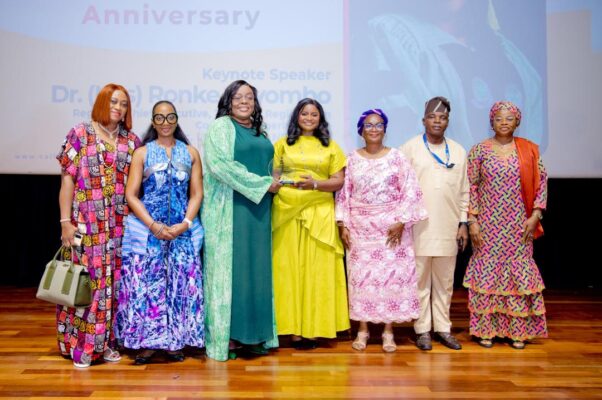
Call To Love Initiative, a Lagos-based non–governmental organisation (NGO), has reaffirmed its commitment to restoring dignity in the education system, ensuring that every child has the opportunity to learn, grow and thrive.
Executive Director of the organisation, Omowunmi Akingbohungbe announced this at its I5th anniversary which held in Lagos recently.
Akingbohungbe regretted that the circumstances surrounding the birth of many children in the country continued to shape their life outcomes.
According to her, across Nigeria, millions of children are already at a disadvantaged, adding that current estimates indicate that between I0.5 million and nearly 20 million children are out of school.
“Even among those children that were enrolled, learning outcomes remain alarmingly low, with as much as 75 percent of the children aged 7- I4 unable to read at a basic level’’.
These statistics, she said, highlight not just a crisis of access, but a crisis of quality and inclusion.
“In low- income and peri -urban communities, many children are either out of school or enrolled in low-cost private school that operate under significant constraints.
“While these schools play a vital role in expanding access to education, they often face challenges such as limited funding, overstretched teachers, inadequate infrastructure, and restricted exposure beyond their immediate environments.
“As a result, many children remain at risk of exclusion and are unable to reach their full potential”.
Stating that exclusion is often subtle and systemic she said: “it manifests in missed opportunities, unsafe learning environments, low confidence, hunger and limited academic support.
She added that these factors compound over time, reinforcing inequality and limiting life choices.
Considering Nigeria’s broader education landscape, she observed that it reflects imbalance, adding that public schools are insufficient to meet the demands of rapidly growing population.
“With over 22.7 million children enrolled in public primary schools compared to about 5. 4 million in private institutions.
“In states like Lagos, the disparity is even more pronounced, with a significantly higher number of private schools many of them low-cost serving underserved population”.
On her organisation which was established fifteen years ago, she said: “Fifteen years ago, this work began with a conviction that every child, regardless of circumstance, deserves access to dignity, opportunity, and quality education. Today, we are not just celebrating impact; we are defining what comes next.”
To her, the initiative over the years has worked across underserved communities in Lagos, delivering mentorship programmes, scholarships, and teacher development initiatives aimed at keeping children in school and improving learning outcomes.
Its interventions, she added have also extended to strengthening low-cost school systems through training and professional development for educators.
Akingbohungbe noted that while these interventions delivered impact at the grassroots level, a major gap persisted the absence of structured, usable data to inform large-scale decision-making.
“We were collecting insights from communities and schools, but there was no consistent way to translate these realities into evidence that could shape policy, that is why we built the Education Observatory to ensure our work is not just responsive, but evidence-informed.”
The observatory, she said, has now evolved into the AIEI, a framework that measures affordability, accessibility, and inclusion in education, particularly within low-cost schools that serve a significant proportion of children from low-income households.
Delivering her keynote, Registrar and Chief Executive of the Teachers Registration Council of Nigeria (TRCN), Ronke Soyombo, described the initiative as a critical bridge between grassroots realities and national education reform efforts.
“We cannot fix what we cannot measure. By creating a community-focused research platform, this initiative is providing the eyes that our education system needs. This data will not sit on a shelf; it will drive evidence-based decision-making in Lagos State and beyond.”
She emphasised that the initiative aligns with federal priorities on human capital development, particularly in ensuring equitable access to quality education and strengthening teacher capacity.
Highlighting ongoing reforms, Soyombo noted that while teacher certification would become mandatory by 2027, affordability remains a major barrier for many educators.
According to the AIEI findings, 61.5 per cent of teachers in surveyed schools are uncertified, yet 93.3 per cent are willing to obtain certification.
Beyond policy and data, the human impact of the initiative remains central. From children gaining access to education for the first time, to teachers improving their capacity, stakeholders say the ripple effects are visible across communities.
Soyombo commended the initiative for going beyond academics to support holistic child development.
“You are not just developing literacy and numeracy; you are developing the whole child. What we see here proves that quality learning can happen anywhere, not just in elite schools.”
On his part, chairman of the I5th anniversary planning committee, Abiola Salami who spoke on ‘education is the oxygen of opportunity,’ affirmed that without education, potential suffocates.
“When l say education is the oxygen of opportunity, I do not say it as slogan. l say it as truth. Because l have seen what happens when people are denied that oxygen, and l also seen what happens when they receive it. Confidence rises, voices strengthen, dreams become decisions and decisions become destinies.’’

Join BusinessDay whatsapp Channel, to stay up to date
Open In Whatsapp