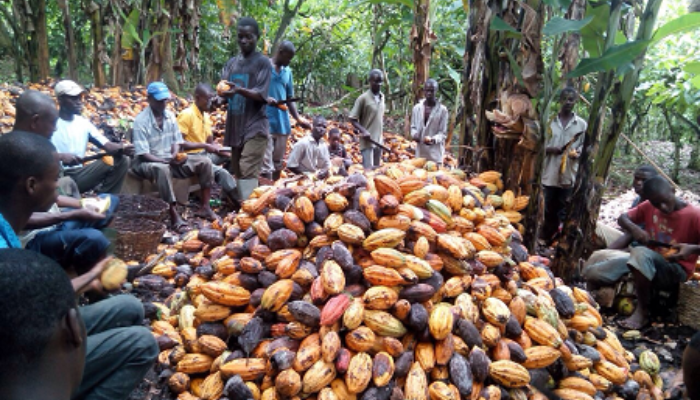
Back in 1960, as at political independence Nigeria was renowned as a country with huge agricultural potentials.
In fact, commodities such as rice, maize, yam, rubber, cassava, cotton and cocoa were the backbone of the economy, contributing about 30percent to Nigeria’s foreign exchange revenues with a dominant share of its GDP.
But by 2026, cocoa export’s direct contribution to overall GDP is a dismal sub-1percent, though it remains the leading agricultural export.
A critical look at the shift between 1960 and 2026 shows that as at 1960 known as the Agrarian Era, agriculture contributed over 60percent of the total GDP, and cocoa was the single highest source of foreign exchange and government revenue.
So profound was the impact that the income from cocoa funded major foundational infrastructure projects in the then Chief Obafemi Awolowo -led Western Region, cementing it as the premier economic driver for the newly independent nation. But as of
2026 during the current he Oil-Dependent Era, the discovery and dominance of the petroleum sector in the 1970s vastly shifted Nigeria’s economic paradigm.
This has caused the direct contribution of cocoa to total GDP to drop to below 1percent. Despite this drop with regards to overall GDP contribution, cocoa remains highly lucrative in raw financial terms. The crop accounts for roughly 24percent to 30percent of Nigeria’s non-oil export earnings.
Considering the market revenue and buoyed by sustained high global prices, Nigeria’s targeted export earnings for cocoa sit in the multi-billion-dollar range. That is, with raw and processed exports making up a vital part of the Superior-quality cocoa beans led exports. So, it is gratifying that the federal government is driving cocoa value chain support through the One Million Improved Cocoa Seedlings Roll-Out Programme. But what is it all about and how beneficial would it be in terms of economic value chain? The answer is not far-fetched.
The Roll&,Out Programme is targeting farmers across 14 producing states. Spearheaded by the Federal Ministry of Agriculture and Food Security, the initiative aims to rehabilitate aging plantations, boost export earnings, and improve compliance with global sustainability regulations. This is a noble initiative.
The support begins with seedlings’ distribution of 1 million disease-resistant and climate-resilient hybrid cocoa seedlings to replace old, unproductive trees.
And there are: ongoing plans to resuscitate state-owned processing facilities and establish cottage factories to transition from raw bean exports to local processing and finished products.
Good enough, there are measures being taken for global compliance: alignment with the EU Deforestation Regulation (EUDR). The aim is to ensure Nigerian cocoa remains competitive in international markets, heavily emphasizing farm traceability and sustainable farming.
As far as Extension Services are concerned there are strengthening agricultural advisory services and farmer training programs to help farmers adopt climate-smart practices and improve yield per hectare.
On how to access and benefit farmers seeking to plug into these federal interventions, they are advised to connect with local chapters of the Cocoa Farmers Association of Nigeria (CFAN). They can also reach out to their respective State Ministries of Agriculture. State governments—such as those in Ekiti, Ondo, and Osun—routinely partner with the federal government to ensure these inputs and financing initiatives reach registered cooperative clusters
Vied objectively, this is a bold and timely intervention because of what the Nigerian cocoa industry has witnessed over the decades. Yet, it
is the largest agricultural non-oil export earner and is valued at approximately $6 billion. The sector generates over N356 billion annually for the GDP, accounting for roughly 5.6 percent of all non-oil exports. It directly employs over 300,000 smallholder farmers.
On the core economic value, Nigeria is the third-largest producer in Africa, generating up to $700 million from raw bean exports annually, with recent export revenues hitting N1.23 trillion year-on-year.
Cultivating an estimated 1.4 million hectares of land, the industry sustains local economies by providing a primary source of livelihood in major producing states like Ondo, Cross River, and Osun. Industrial Processing Potential:
While the bulk of cocoa is exported as raw beans, the push for domestic processing into chocolate, cosmetics, and beverages is projected to unlock an estimated $25 billion in potential market value.
Despite its massive footprint, the sector suffers from a lack of mechanised infrastructure. Nigeria loses around 90,000 tonnes of cocoa (equivalent to $180 million) every year due to inadequate processing and storage facilities. Additionally, the dominance of aging farmers and aging cocoa trees creates systemic yield gaps. For more insights into the macroeconomic performance of the sector, you can track current non-oil export data via the Nigerian Export Promotion Council.
To walk the talk on this potentially great programme with value addition the plans for full implementation at the states concerned should be well articulated. Funds should be provided as at when due. There should be records of progress made and challenges to be overcome. And above all, it must not be politicised.

Join BusinessDay whatsapp Channel, to stay up to date
Open In Whatsapp