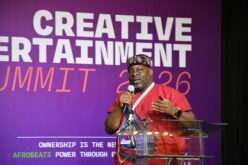
The new intellectual property framework has been hailed to unlock capital formation in Nigeria’s creative industry, allowing artists and startups to access venture capital, private equity, and pension funds using ideas and catalogues as collateral.
Obi Asika, director-general of the National Council for Arts and Culture, told delegates at the Africa Music Business Roundtable 2026 that this shift moves away from traditional demands for physical assets toward financing long-term patient capital, similar to practices in the film industry.
“This is the single biggest unlock for capital formation this industry has ever had. And it’s the same thing, actually, for the startup ecosystem. Because the startup ecosystem is all about your IP, the idea, the core idea,” Asika said.
He noted that in the past Nigerian creators were told they could not use village houses or similar assets as security, but the new framework opens opportunities for other financial institutions beyond conventional banks.
Asika said the goal is to move from reliance on viral hits to building sustainable institutions. “It’s great to have a hit record; it’s great to do a couple of streams; that’s really wonderful. But what’s even better is to create a framework that institutionalises everything you do,” he added.
A new Nigerian Business Council for the music industry will operate primarily as a private sector-driven body. Asika said the council draws on models from the United Kingdom and the United States, such as the Recording Industry Association of America.
“The Nigerian Business Council, basically a governing institution, is driven primarily, at least 100 percent by the private sector, but the public sector has helped to bring it together,” he explained.
Plans are also advancing for a National Centre of Excellence for Music. “The National Center of Excellence for Music – we really want to have a tertiary institution level where you can get undergraduate and graduate degrees for music, musicology, music history, and preservation,” Asika stated.
He emphasised that Nigeria’s music tradition exceeds 1,000 years and requires study, elevation, and canonisation. A national museum for music will track history, host a hall of fame, and support awards.
These institutions will follow a government-adjacent model. “Government has a role, clearly, because you’re sort of like the convener, but government is not the whole story. Because these are sectors that have been driven by the private sector, and you don’t want to kill that entrepreneurial side of this thing,” Asika said.
He cited examples from the United Kingdom where art in public buildings holds significant value and institutions benefit from structured private sector involvement.
International partnerships form an important part of the strategy. Asika chairs the Nigerian side of the creative and cultural industries technical working group under the UK-Nigeria Enhanced Trade Partnership.
“We also have a partnership with the University for the Creative Arts, which is on the academic side of the curriculum. And then more importantly, with the British Council, it’s been announced, but there’s no real media; there’s something called a ‘Season of Culture,’ which will happen in 2028 for six months in the UK and in Nigeria,” he announced.
The programme will cover 10 states in Nigeria and 10 cities in the UK across music, movies, fashion, animation, gaming, literature, visual arts, and culinary arts. The British Council will issue requests for proposals in the coming months.
Asika referenced the Black Music Business Report launched at the UK House of Parliament. “When they did this report, it turned out that 80 percent of UK music revenue over the last 25 years was from Black music. That’s a very powerful statement,” he said. He works with UK Music and noted the report’s coverage of the past 25 years.
On the United States front, Asika attended events with the Recording Industry Association of America and Universal Music Group. He also highlighted collaboration with Mavin Records, Universal’s West Africa partner. Partnerships with France through Make Music Lagos and with the European Union on workforce mobility for creatives are also active.
“One of the things Nigerians are always keen about is travel. So we call it workforce mobility, where people who are talented in these spaces are able to travel freely across Europe and the rest of the world and earn,” Asika said.
The National Licensing Agency and Discover Nigeria platform form part of the institutional infrastructure. Asika stressed that these bodies will be incubated with strong private sector leadership.
The overall approach seeks to professionalise the sector, improve capital access through IP, and strengthen Nigeria’s position through domestic institutions and international cooperation.
He pointed to the convergence of technology and media as transformative, referencing Apple’s growth after the iPod. The framework aims to support similar long-term value creation in Nigeria by moving beyond short-term streams to structured, investable assets and institutions.
Implementation of the IP collateral rules will require coordination with banks and other financial institutions. Asika expressed confidence that venture capital and patient capital will follow once the framework becomes fully operational.
The combination of new institutions, reformed financing, and global partnerships is expected to increase the creative economy’s contribution to national development.

Join BusinessDay whatsapp Channel, to stay up to date
Open In Whatsapp