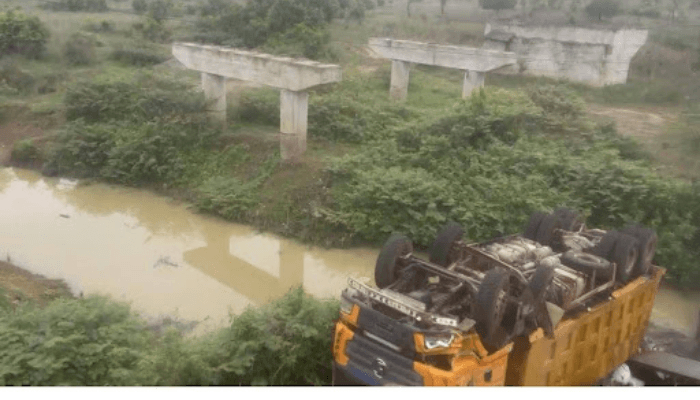
…Over 20 communities stranded
Despite repeated warnings and fatal accidents on the colonial-era Moro bridge that connects Kwara and Oyo states, BusinessDay Investigations found that the federal government disbursed about N320 million to a contractor for a replacement bridge project that stalled for about 10 years before the structure collapsed, killing a commuter and crippling business routes. Oluwatobi Odeyinka writes.
Rasheedat Ibrahim was in the passenger seat of an ageing car on the Ilorin-Igbeti Highway, heading back to Saki after a business trip to Ilorin.
As the driver slowed to approach the steel-framed, rickety Moro bridge, he looked in the rear-view mirror and saw a truck approaching at full speed. In a desperate attempt to avoid being rammed from behind, the panicked taxi driver swerved sharply, crashing first into a bus and then into the edge of the bridge. A protruding iron tore into Rasheedat’s lap while another slit her right wrist.
The 42-year-old trader from Saki in Oyo State’s Oke Ogun region deals in building materials, including roofing sheets, nails, paints and cotton slides, which she buys from wholesalers in Ilorin, Kwara State. The accident, which occurred in 2023, not only left her hospitalised but also cost her over a million naira in lost goods, leaving her business in jeopardy.
“The boot was forced open, and the paints and roofing sheets rolled off. I couldn’t even bother about the goods because I was severely injured and rushed to the hospital,” she narrated to this reporter.
Rasheedat’s experience is one of many on the Ilorin-Igbeti road, where lives have been lost and goods worth millions destroyed in repeated accidents. Yet traders, farmers and transporters continue to ply the route daily because it serves as a critical link to major farmlands and market centres across Kwara and Oyo states.
End of the road
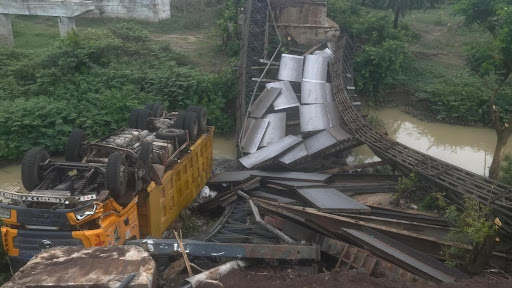
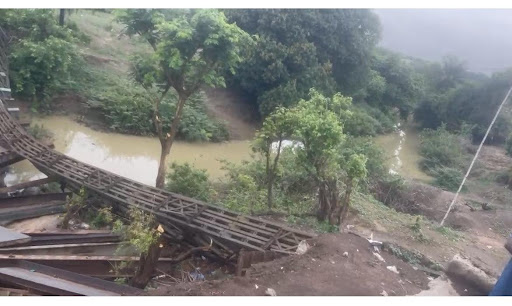
On Thursday, April 30, the Moro Bridge on the Ilorin-Igbeti Federal Highway finally succumbed to the weight of a stone-laden truck. It collapsed totally, claiming the life of an Okada rider while dozens of people sustained varying degrees of injuries.
Even though many commuters have lost wares worth millions and suffered fatal accidents on the bridge, the road is a lifeline for them, and the recent collapse means a collapse of livelihoods.
“All the people going to Ilorin from Saki, Igboho, and Igbeti will have to pass through Ogbomoso, which is a longer route. Traders will find it difficult to access farmlands,” said Raji Afolabi, a farmer and regular user of the bridge.
Earlier this week, heavy rainfall caused the Moro River to overflow beyond its banks, flooding communities and totally submerging the collapsed bridge.
Heavy-duty trucks and motorcycles that had been navigating the shallow river as an improvised crossing after the bridge collapsed were trapped in the flood.
Rasheedat and Afolabi wondered why the bridge has been neglected by the government, despite its economic value to millions of residents and businesses in Oyo and Kwara states. Many residents of the area and commuters do not know when the bridge was built, but they have known it to be in that bad state all their lives.
Built as a Colonial Asset, Neglected by FG
Built by the British colonial government between 1920 and 1940, the Moro Bridge was part of a strategic masterplan to integrate the Nigerian hinterland into the global market.
Records show the road was key in ensuring that the Ilorin Emirate, which had been a commercial hub, could access farm produce from Oke Ogun in today’s Northern part of Oyo state, which had been a “food basket” since the colonial era.
Also, the road was key in the British colonial government’s strategy to strengthen the country’s amalgamation. Historical accounts show that bridges such as Moro were “Bailey bridges” designed to support troop movements and the transport of agricultural resources from the hinterland to commercial hubs.
Over 20 communities (such as Igboho, Igbeti, Kishi, Mandala, and Shikanda, among others) in Oyo and Kwara states rely on this road for daily economic activities, particularly to transport their goods and farm supplies to urban market centres. Despite its importance, it has been abandoned by both federal and state governments.
Construction of new bridges
Nine years before the collapse, the federal government had already approved the construction of new bridges to replace the ageing Moro and Ohan bridges along the Ilorin-Igbeti road. Nearly N1 billion was earmarked for the project, and hundreds of millions of naira were eventually disbursed to a contractor.
Business Day Investigations found that during the administration of former President Muhammadu Buhari, three budgetary allocations (2016,2017, and 2018) were made for the rehabilitation of Ohan and Moro bridges, both of which are on the Ilorin-Igbeti road and some metres away from each other.
In 2016, the Federal Ministry of Works, then headed by former Lagos State governor Babatunde Fashola, allocated N200 million to the project. Another N122.2 million was budgeted in 2017, followed by N253.5 million in 2018, when the project was officially classified as “ongoing.” This allocation was for the construction of new bridges to replace the old ones, which began in 2017.
Contract documents reviewed by BusinessDay Investigations show that the contract for the construction was awarded in March 2017 to a company called Bilijoe + Berger, for the sum of N865 million.
According to data from GovSpend, an open source platform for tracking federal government spending, at least N320.6 million has been released to Bilijoe + Berger Nigeria Limited for the project. The funds were released in five tranches between 2018 and 2023. The first tranche was released in September 2018, the second and third in May and October 2021. The last two payments were made in October 2022 and 2023, respectively.
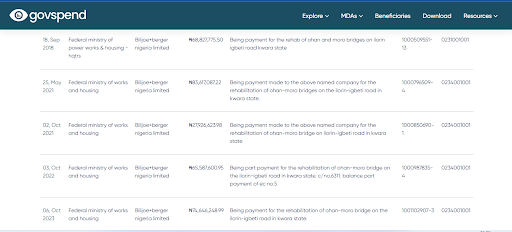
Meanwhile, residents and commuters familiar with the road told BusinessDay Investigations that construction work on the bridges was suspended around 2020/2021.
Investigations showed that the federal government released funds to the company in 2022 and 2023, after the contractor had abandoned the site. The last payment was the sum of N74.6 million, made in October 2023, about five months after Buhari handed over to the current administration.
Why we abandoned work on new bridge
According to the Corporate Affairs Commission (CAC) public search portal, Bilijoe + Berger Nigeria Limited was registered in February 2007, and the nature of the operation is “Manufacture of Fabricated Metal Products, Except Machinery and Equipment”.
A search on NG-Check showed the names of the company directors and shareholders to include: Musa Ismail Olatunji, Olorunkemi Oluwatoyin, Babtuntunde Joseph Ojo, Muhammed Olawale, and Hauwa Jummai Musa.
When BusinessDay contacted the company via a mobile number on its website, the receiver identified himself as Tunji Musa, a director in the company.
He explained that the construction was abandoned because of poor funding and that the federal government was still owing the company.
“We couldn’t complete the project because of a lack of funds… Some work was done. You know the way a contract runs… You use your money, as it is, as it stands today, they are still owing me on that project. When I say me now, I’m talking about the company,” Musa said.
He told Business Day that contractors often inject personal funds into government projects while waiting for reimbursement, but prolonged delays in payment have made the arrangement unsustainable.
Tunji further explained that before contractors receive subsequent payments, they are expected to execute work beyond the value of the initial mobilisation paid by the government.
“For instance, if you are given mobilisation of N10,000, as a good businessman, you want to spend that N10,000 and even do work worth N15,000 before asking for another payment. To achieve that, you have to put in your money,” he said.
He added that the project was further affected by the devaluation of the naira and the sharp increase in the prices of construction materials.
“When this job was given to us, a bag of cement was less than N3,000. Today, it is about N13,000,” he said.
“For almost a year plus, there’s no funding of projects in the country. Up to this minute, it is still the same issue of funding,” he said.
When asked to disclose the exact amount his company received from the government, he declined further comments on the matter and referred the reporter to the federal government.
Ibrahim AbdulRasak, a site engineer who participated in the construction as a subcontractor, told BusinessDay Investigations that he was forced to leave in 2019 due to poor funding from the government.
“I was a site engineer on the project, and we started work in 2017, but the poor funding was evident even to us workers, so I had to leave,” he told this reporter.
Transport workers spent on bridge repairs before eventual collapse
Usman Abdulkareem, the Chairman of the transport workers union in Oloje-Sakwe, while speaking with a community radio station, Sobi FM, said the union had been doing minor repairs of the bridge “in the past 30 years”, while hoping that the government would heed calls for its rehabilitation.
“We have been calling on the government, but they don’t respond to us. It is on this road that we make a living; we have no other means. With this total collapse, there’s nothing we can do again. The government has to step in.”
Meanwhile, to salvage the federal government’s neglect, the Kwara State government said it approved a rehabilitation of the Moro bridge in 2024. However, residents described what was done at the time as “minor repairs on the old bridge.”
In response to public outrage after the collapse of the bridge, the state government, in a statement, denied reports that it spent N1.2 billion on the said rehabilitation. It argued that it spent only N27 million for “palliative intervention” on the bridge.
“The last palliative intervention on the said bridge gulped N27m only. It was to put the bridge back to temporary use, even as the Federal Government has already started the construction of a new bridge. At no time in the life of this administration did the Ministry of Works or any state government organ spend N1.2bn on such interventions,” the statement by Olajide Moyo Abolarin, press secretary, read.
Collapse of Moro bridge raises concerns
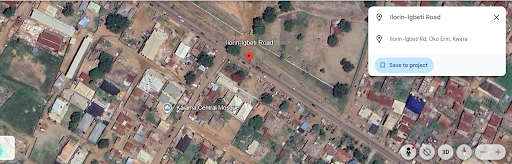
The widely reported collapse of the bridge has raised concerns for farmers and traders in over 20 communities who depend on the Ilorin-Igbeti road to access major markets and urban centres in Ilorin, Ogbomoso, and towns close to the Republic of Benin.
Adejumo Kabir, a senior researcher at Good Governance Africa (GGA) expressed disappointment that abandoned projects litter the country despite the disbursement of public funds because of a lack of accountability.
Kabir argues that the recent bridge collapse is a setback for Nigeria in its quest for food security. He noted that the situation will deepen food wastage as farmers in the Oke Ogun region will struggle to access markets and urban centres.
“Nigeria is already grappling with inflation and food insecurity, and the neglect or abandonment of strategic rural infrastructure projects has consequences that extend far beyond the immediate community,” he noted.
Lanre Osho, Kwara-based activist and deputy coordinator at Elites Network for Sustainable Development (ENetSuD), called on the federal government to reevaluate the contract for the project and release adequate funds for its completion.
He told Business Day that the organisation had once investigated the project and noted the poor funding that stalled its execution.
He called on lawmakers representing Kwara State at the National Assembly to table the matter at both chambers for the president’s attention.
“They are representing the people. And they are expected to raise the matter urgently in the chamber, to let the president know the challenges that are confronting the people of this area. So that the project can be completed,” he said in an interview with this reporter,” he noted.

Join BusinessDay whatsapp Channel, to stay up to date
Open In Whatsapp