BusinessDay Investigations analysed the 2026 Appropriation Act and found duplicated functions, fragmented projects and parallel funding streams in different budget codes spread across ministries and agencies, making public spending difficult to track for citizens, SODIQ OJUROUNGBE writes.
For years, Nigerians have been told that the country can no longer afford waste.
Successive governments have defended painful economic reforms, from fuel subsidy removal to foreign exchange reforms, as necessary sacrifices to restore fiscal stability and strengthen public finances.
But a BusinessDay Investigations review of Nigeria’s 2026 budget suggests the government may not be holding itself to the same standard.
Analysis of the 2,604-page Appropriation Act found at least N210.23 billion linked to overlapping allocations, duplicated functions and fragmented projects spread across Ministries, Departments and Agencies (MDAs).
The investigation uncovered instances where the same office received funding through separate budget provisions, flagship government programmes appeared under different spending channels and identical projects were split into multiple budget lines carrying near-identical descriptions.
Each year, the federal budget is presented as a roadmap for government spending and national priorities.
For lawmakers, development partners, investors and taxpayers, it is supposed to provide a clear picture of how public resources will be allocated and monitored.
Yet BusinessDay Investigations found that determining exactly how much government intends to spend on certain programmes is not always straightforward.
Across different sections of the budget, similar activities are funded through multiple channels, while some programmes appear under separate codes despite pursuing the same objectives.
The result is a budgeting structure in which the full financial footprint of government activities is scattered across numerous allocations rather than presented in a consolidated manner.
Among the findings, the Office of the Special Adviser on Policy and Coordination appeared twice under the service-wide vote with separate allocations amounting to billions of naira.
Further review showed that the National Poverty Reduction with Growth Strategy received funding through different budget channels, while separate Lagos liaison offices were maintained under both the State House and the Office of the Secretary to the Government of the Federation.
It was also discovered that the Federal Road Safety Corps’ mass transit bus programme was divided into several budget entries with similar descriptions and combined allocations running into billions of naira.
Hidden duplications of projects
A closer examination of the budget provisions reviewed by BusinessDay Investigations provides insight into how these spending arrangements are structured and where they appear across government.
The first indication emerged within the Service Wide Vote, a section of the budget intended to capture centrally managed expenditures. There, BusinessDay Investigations found the Office of the Special Adviser on Policy and Coordination appearing under separate allocations worth N1 billion and N2.73 billion respectively, despite referring to the same office.
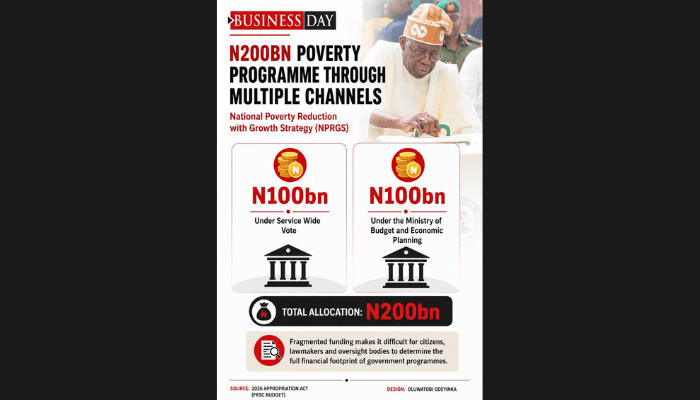
Further analysis by our correspondent revealed a similar pattern around one of the federal government’s flagship social intervention initiatives, the National Poverty Reduction with Growth Strategy.
Designed as a key vehicle for tackling poverty and expanding economic opportunities, the programme appeared under the Service Wide Vote with an allocation of N100 billion.
This paper also identified an additional allocation linked to the programme under the Ministry of Budget and Economic Planning through a separate budget code with a similar amount.
Nearly three decades after Nigeria relocated its capital to Abuja, BusinessDay Investigations found that a Lagos liaison office continued to operate under both the State House and the Office of the
Secretary to the Government of the Federation, each receiving its own allocation.
Although the two institutions perform different constitutional roles, it was observed that the SGF and State House are funding a parallel liaison structure in Lagos.
One programme, five budget lines
Documents reviewed by BusinessDay Investigations showed that the Federal Road Safety Corps’ mass transit bus intervention was spread across multiple budget entries despite pursuing a similar objective.
It was discovered that rather than appearing as a single project, the initiative was presented through five separate budget provisions, each carrying an allocation of N1.3 billion.
While the descriptions varied slightly, all five entries centred on the procurement, deployment or distribution of public transportation buses to support economic activity, mobility and regional connectivity. The allocations amounted to approximately N6.5 billion in total.
A comparison of the project descriptions showed that while each provision was framed around a policy objective, all five allocations were anchored to the same underlying activity of acquisition and distribution of public transportation buses.
What the law says
The country’s budgeting and procurement systems are governed by several laws and regulations, including the Fiscal Responsibility Act 2007 and the Public Procurement Act 2007, both of which were enacted to improve the management of public resources and reduce waste in government spending.
The Fiscal Responsibility Act requires government institutions to conduct their affairs in a transparent manner and ensure that public resources are managed efficiently and prudently.
Similarly, the Public Procurement Act established a framework intended to ensure that public procurement is carried out through open, competitive and transparent processes that deliver value for money.
Although neither law expressly prohibits different agencies from funding similar activities, public finance experts said the spirit of both legislations is to promote clarity in public expenditure and prevent situations where government spending becomes difficult to track.
Financial experts and budget analysts described the practice as project fragmentation or budget atomisation, known as the division of a larger programme into several budget lines rather than presenting it as a consolidated allocation.
They noted that while such arrangements may have administrative justifications, this can complicate oversight and make it more difficult for citizens, lawmakers and auditors to track the full scale of government spending
Rahman Ademola, a public finance analyst who reviewed the findings, explained that when expenditures are fragmented across multiple budget heads, transparency becomes more challenging because the public sees separate allocations rather than the total amount being committed to a particular objective.
He added, “In a period marked by fiscal pressures, mounting debt obligations and repeated calls for prudent spending, even legitimate overlaps can obscure government priorities and complicate efforts to assess whether public resources are being used efficiently.”
The finance expert also stressed that while project segmentation may sometimes be justified by technical or operational considerations, excessive fragmentation can raise questions about whether spending is being presented in the most transparent manner possible.
He added, “When projects are fragmented into several allocations or when similar responsibilities are funded through different agencies, it can complicate oversight and make it harder for auditors, lawmakers and citizens to determine the total amount committed to a particular objective.
“The Public Procurement Act also places emphasis on proper procurement planning, requiring procuring entities to prepare detailed plans that reflect their needs and expected expenditures before contracts are awarded.”
Corroborating him, Joseph Amenaghawon, the director, Strategy & Growth, BudgIT, said such patterns not only reflect poor budget formulation but also fuel legitimate suspicions of potential corruption.
He noted, “While a clearer picture would emerge from a closer look at implementation records, these data are often not readily accessible to the public or oversight bodies.”
Budget padding taken to another level
Budget experts and civil society advocates said the recurring pattern of overlapping allocations, duplicated programmes and fragmented projects reflects deeper weaknesses in Nigeria’s budgeting process and raises fresh concerns about transparency and accountability.
Amenaghawon, who is also the head of CivicHive, said the recurring appearance of duplicated programmes and overlapping allocations across Ministries, Departments and Agencies (MDAs) has long been a concern for civil society organisations.
According to him, groups such as the Centre for Social Justice and BudgIT have repeatedly flagged questionable allocations in federal budgets, yet similar patterns continue to surface.
He lamented that the persistence of such allocations raises concerns about budget formulation, transparency and accountability, particularly where implementation records are not easily accessible for public scrutiny.
Amenaghawon said the findings should attract the attention of anti-corruption and oversight agencies, stressing that addressing duplication is essential to ensuring value for money in public spending.
Opeyemi Adamolekun, executive director of Enough is Enough Nigeria (EiE), took a more critical view, arguing that questionable allocations cannot be considered legitimate budgeting practice.
She expressed concern about what she described as increasing opacity in the budgeting process, blaming weak legislative oversight for allowing problematic allocations to pass through the system.
“When the legislature refuses to perform its oversight role and provide a check to the executive, this is what you have,” Adamolekun said.
To understand the rationale behind the allocations identified in this investigation, BusinessDay Investigations sent detailed enquiries to the Federal Ministry of Budget and Economic Planning, the
Budget Office of the Federation, the Office of the Secretary to the Government of the Federation, and FRSC.
Our correspondent also made several attempts to reach officials through the contact numbers listed on their official websites, but the calls did not connect.
As of the time this report was filed, none of the four institutions had responded to the questions raised regarding the allocations and budget structures identified in the 2026 Appropriation Act.

Join BusinessDay whatsapp Channel, to stay up to date
Open In Whatsapp