The Energising Education Programme of the Rural Electrification Agency (REA) is an initiative of the Federal Government to develop off-grid, dedicated and independent power plants, as well as rehabilitating existing distribution infrastructure, to supply clean and reliable power to 37 federal universities and 7 affiliated university teaching hospitals.
The programme will in addition provide street lighting for illumination and safety, as well as training centre at each of the EEP beneficiary institutions. The project is being developed in phases – the first phase is currently under construction, which covers 9 universities and 1 affiliated teaching hospital.
Under Phase 1, seven of nine universities will be powered with electricity from solar hybrid technologies, the other two universities will receive electricity from gas fired power plants. The first 180 female STEM students in Phase 1 have commenced their EEP internship.
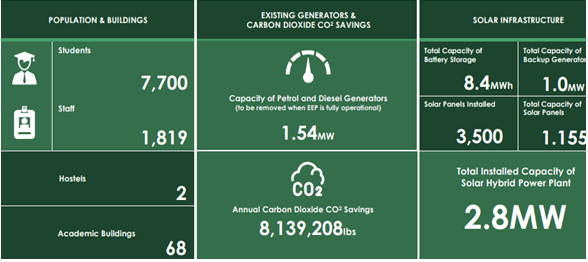
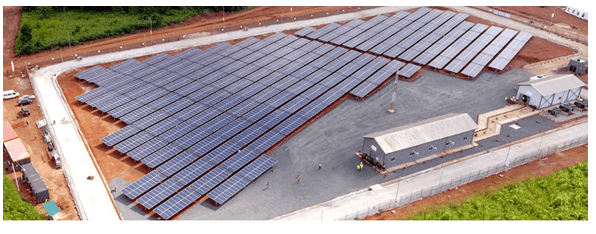
On August 3, vice president Yemi Osinbajo commissioned a 2.8MW solar hybrid power plant delivered under the programme at Alex Ekwueme Federal University, Ndufu Alike-Ikwo (FUNAI). The project will almost double present capacity of diesel generators and lead to 8,139,208lbs annual carbon dioxide CO2 savings
Benefits to the school are enormous
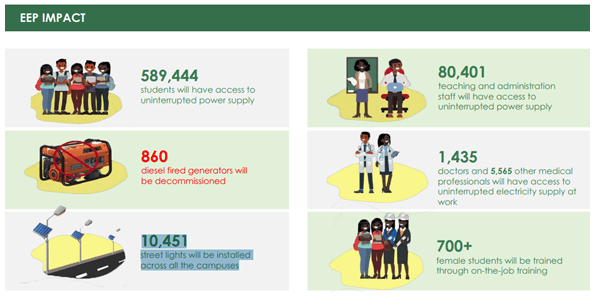
The Energising education programme will benefit over 580,000 students and 80,401 teaching and administration staff who will now have access to uninterrupted power supply. This will lead to shutting down 860 diesel fired generators and the construction of 10,451 street lights across the campuses.
Funding for the project include contribution from the Federal Government, to construct projects in 9 universities and 1 teaching hospitals, the World Bank will provide funding for projects in 7 universities and two teaching hospitals and the African Development Bank will bankroll projects in 8 universities.
Damilola Ogunbiyi, managing director of the REA said of the programme, “The Energizing Economies Initiative (EEI) was launched in September 2017 to increase energy access and economic growth by providing clean, reliable and affordable power to economic clusters; such as markets, shopping complexes and agricultural/industrial clusters.
“EEI is fully private sector funded, which means the investor can only ensure return on investment by providing adequate power to the SMEs within these economic clusters. Each customer has a dedicated meter installed under a Pay-as-You-Go model. This private sector-led approach ensures sustainability of the programme.”
Indian firm, Sterling and Wilson Pvt. Ltd constructed solar hybrid project at Alex Ekwueme Federal University, Ndufu Alike-Ikwo (FUNAI). Other local and international players are handling projects under the scheme.
The net effects these projects will have in universities are enormous. Students will study in more comfortable halls and medical tests and labs will function free of the deafening roar of angry generators.
However, these are not the first initiative of this kind in public institutions. Similar projects have failed because of a dearth of maintenance culture. But unlike previous projects, the inclusion of the private businesses may help guarantee longevity for the projects.
Nigeria is signatory to the Paris Agreement which seeks to …. one way Nigeria can honour this agreement is through programmes like the EEE which will significantly decrease the country’s carbon footprint.

Join BusinessDay whatsapp Channel, to stay up to date
Open In Whatsapp