…Debt service consumed 67 percent of federal revenue
…as government earnings fell N12 trillion short of target
There is a number buried in Nigeria’s budget implementation reports that tells the story of the country’s public finances more clearly than the debt stock itself. It is 67.2 percent.
That was the share of Federal Government revenue consumed by debt service between January and September 2025. In practical terms, for every N100 earned by the government, about N67 went to creditors.
The figure highlights a growing problem at the centre of Nigeria’s public finances. The challenge is no longer simply how much debt the country owes. It is how much of government revenue is being swallowed by the cost of servicing that debt.
The budget earned less and paid more
The latest Budget Implementation Reports show that debt service reached N12.52 trillion in the first nine months of 2025, exceeding the prorated budget of N10.45 trillion by N2.07 trillion.
Including sinking fund contributions, total debt-related payments rose to N12.63 trillion, compared with a budget of N10.74 trillion, a difference of N1.90 trillion. The overspending came at the same time that government revenues fell sharply short of expectations.
The Federal Government projected N30.67 trillion in revenue during the period. It generated only N18.63 trillion, leaving a gap of N12.03 trillion. That combination created a fiscal squeeze from both directions. The government earned far less than planned while spending more than expected on debt obligations.
Muda Yusuf, chief executive officer of the Centre for the Promotion of Private Enterprise (CPPE), has consistently argued that Nigeria’s debt sustainability should be assessed less by debt-to-GDP ratios and more by the government’s capacity to generate revenue. He maintains that high debt-service obligations significantly constrain fiscal space for infrastructure, security and social spending, making revenue mobilisation a more urgent priority than the headline size of the debt stock.
“Nigeria is not being squeezed only by how much it owes. It is being squeezed by the cost of servicing what it owes against a revenue base that remains dangerously shallow,” said Olugbenga Olaoye, a member of the United States Association for Energy Economics (USAEE).
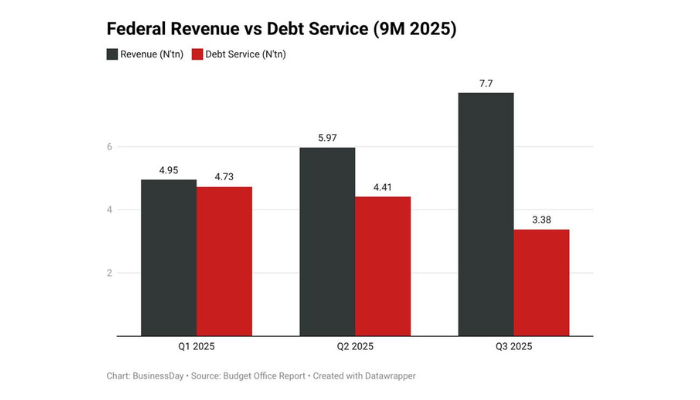
The numbers reveal a problem that worsened early in the year. In the first quarter, debt service reached N4.73 trillion, far above the budgeted N3.48 trillion. Revenue during the same period stood at N4.95 trillion, meaning almost all the money earned by the government went to debt service.
The second quarter brought little relief. Debt service remained elevated at N4.41 trillion, driven largely by foreign debt obligations, which surged to N2.70 trillion against a budget of N1.69 trillion.
Conditions improved in the third quarter. Revenue increased to N7.70 trillion, while debt service declined to N3.38 trillion, reducing the pressure on government finances.
The hidden cost of debt service
Even with that improvement, the cumulative picture remained troubling. The consequences are visible in other areas of the budget. Nigeria allocated approximately N2.48 trillion to the health sector in 2025.
The N1.90 trillion debt-payment overrun recorded between January and September is equivalent to about 77 percent of the entire annual health budget. Using the narrower debt-service overrun of N2.07 trillion, the figure rises to about 84 percent.
In other words, the extra amount spent on debt service beyond what was originally budgeted could almost have matched the Federal Government’s entire health allocation for the year. The impact on capital spending is equally striking.
The government budgeted N17.58 trillion for capital expenditure during the first nine months of the year. Actual spending was only N3.10 trillion. As a result, Nigeria spent roughly four times more on debt-related payments than on capital projects.
Ayo Teriba, chief executive officer of Economic Associates, a Lagos-based economic research and policy advisory firm, this is where the real economic cost emerges. He has argued that when governments devote a large share of their earnings to debt service and recurrent obligations, fiscal space for growth-enhancing investments becomes severely constrained. The result is less money for infrastructure, power, transport and other productive sectors that can expand the economy’s future revenue base.
This matters because debt obligations are fixed. Roads, schools, hospitals and other development projects are not. When revenues fall short, debt service must still be paid. Development spending is usually where the adjustment occurs.
A revenue problem disguised as a debt problem
That helps explain why the Budget Office repeatedly identifies revenue mobilisation as one of the country’s biggest fiscal challenges. The first three quarters of 2025 show why.
Debt service exceeded the budget by N2.07 trillion. Revenue missed the target by N12.03 trillion. Capital spending fell far below plan. The result is a budget increasingly shaped not by policy priorities but by debt obligations. Nigeria’s fiscal challenge is therefore not simply a debt problem.
It is a revenue problem. Until government revenues grow fast enough to create room for investment after debt payments are made, the pressure on healthcare, infrastructure and other public services will remain.
Join BusinessDay whatsapp Channel, to stay up to date
Open In Whatsapp