Nigeria has two economies. Only one is governed. One appears in GDP figures, tax records and government policy documents. The other runs on cash, trust, daily wages and informal networks. It grows the country’s food, moves its goods, builds its houses and keeps its neighbourhoods running. It employs more than nine out of every ten Nigerian workers, yet it remains largely outside the institutions designed to support economic activity.
That contradiction increasingly explains why many of Nigeria’s biggest reforms struggle to produce the broad-based improvements policymakers promise.
According to the National Bureau of Statistics’ Labour Force Survey, 92.93 percent of employed Nigerians worked in the informal economy in 2023. The Nigerian Economic Summit Group (NESG) reached virtually the same conclusion in its 2025 report, From Hustle to Decent Work, estimating that 93 percent of Nigerian workers operate outside the formal economy.
The implications extend well beyond employment statistics. They shape how monetary policy works, how taxes are collected, how inflation spreads and ultimately how citizens judge the success or failure of economic reforms.
Why reforms often fail to reach most Nigerians
The past three years have produced one of Nigeria’s most ambitious reform programmes. Fuel subsidies have been removed. The exchange rate has been liberalised. Electricity tariffs have risen. Interest rates have reached their highest levels in decades. New tax laws have been enacted.
Yet the benefits have proved far slower to reach households than the costs. Part of the explanation lies in the structure of the economy itself. Economic shocks move rapidly through the informal economy because traders, transport operators and farmers adjust prices almost immediately. Policy benefits, however, often travel through formal institutions such as banks, registered employers and tax systems that serve only a small minority of workers.
A workforce that is 93 percent informal means minimum wage increases benefit relatively few Nigerians. Higher interest rates influence only businesses with access to bank credit. Tax reforms primarily affect registered companies. The economy policymakers are trying to influence is not the economy in which most Nigerians earn their living.
For the government, that translates into a persistently narrow tax base despite a population exceeding 200 million. For the Central Bank of Nigeria, it weakens monetary policy because millions of businesses finance themselves through personal savings, cooperative societies and informal lenders rather than commercial banks. For investors, however, it presents a different reality: an economy of roughly 40 million micro, small and medium enterprises that increasingly transact digitally despite remaining outside formal regulation.
The sectors policy makers struggle to reach
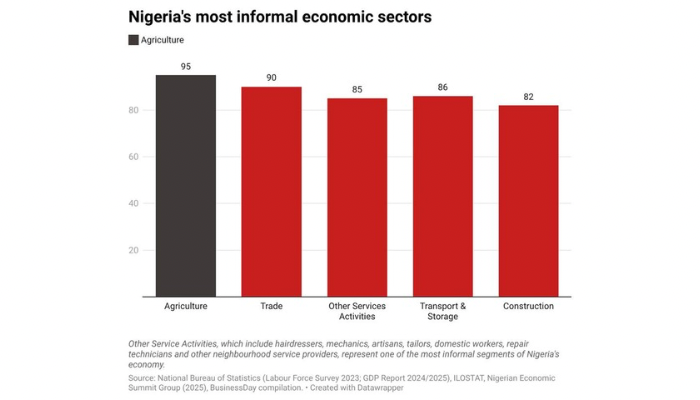
The disconnect becomes clearer when viewed through the sectors that dominate Nigeria’s informal economy.
Following the 2024 GDP rebasing, agriculture accounted for 27.8 percent of GDP, according to the NBS while employing roughly one-third of the workforce. Yet more than 95 percent of agricultural employment remains informal. Farmers without secure land titles struggle to access bank credit, limiting investment in irrigation, mechanisation and improved inputs. The consequence is not merely lower productivity. It is greater food inflation and weaker fiscal capacity.
Wholesale and retail trade tells a similar story. The sector contributes more than 15 percent of GDP and consists largely of millions of small, unregistered businesses. Rather than paying formal corporate taxes, many face multiple local levies and unofficial collections while remaining excluded from affordable finance. Businesses therefore remain too small to expand and too informal to benefit from policies designed for registered enterprises.
Transport demonstrates how informality magnifies inflation. Fuel price increases are passed almost immediately to passengers because informal operators lack long-term contracts, insurance or financial buffers. Rising transport costs then feed directly into food prices and production costs, spreading inflation throughout the economy.
Construction has expanded alongside infrastructure investment, yet much of its workforce remains employed on daily wages without written contracts, pensions or health insurance. Growth in output therefore does not necessarily translate into greater household security or stronger social protection.
The same pattern extends across Other Service Activities, including mechanics, artisans, hairdressers, tailors, repair technicians and domestic workers. These neighbourhood businesses keep local economies functioning but remain largely invisible to formal finance, labour protections and government support programmes.
Together, these sectors account for well over half of Nigeria’s economic output. They are not peripheral to the economy. They are its productive core.
Formalisation must create value
For years, informality has often been framed as a compliance problem. Increasingly, economists argue it is an institutional one. Muda Yusuf, chief executive of the Centre for the Promotion of Private Enterprise (CPPE), has repeatedly argued that many businesses remain informal because the costs of formalisation outweigh its benefits. Multiple taxation, weak infrastructure, limited access to affordable finance and burdensome regulation reduce the incentive for small businesses to enter the formal economy.
Recent evidence from Moniepoint’s Informal Economy Report, produced with SMEDAN and the Federal Ministry of Industry, Trade and Investment, suggests technology may be achieving what regulation alone has struggled to accomplish. Digital payments are helping informal businesses build transaction histories, access financial services and participate more actively in the formal financial system without immediately facing the administrative burdens that discourage formal registration.
That presents an important policy lesson. Formalisation is less likely to succeed through enforcement alone than by making participation in the formal economy economically worthwhile.
Governing the economy that actually exists
Nigeria’s next economic challenge is no longer simply attracting investment, stabilising the naira or passing new tax laws. It is designing institutions around the economy that actually exists rather than the one policy assumes exists.
Until farmers can use land as collateral, traders can access affordable credit, artisans can build financial identities and small businesses see tangible benefits from registration, many reforms will continue to deliver weaker outcomes than expected.
The informal economy is often portrayed as Nigeria’s biggest weakness. Increasingly, it looks like the country’s way of adapting to institutions that have not kept pace with economic reality. The real challenge for policymakers is not bringing millions of Nigerians into the formal economy by decree. It is building a formal economy that millions of Nigerians have a reason to join.

Join BusinessDay whatsapp Channel, to stay up to date
Open In Whatsapp