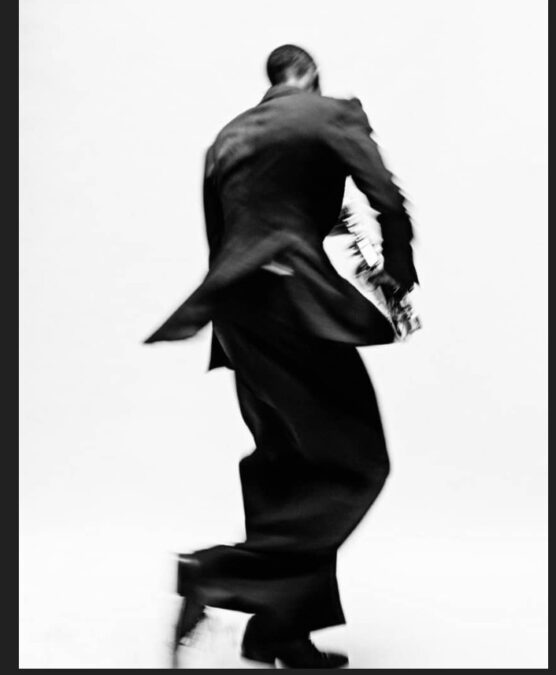
Adebayo Jolaoso’s work in photography blurs the lines between fine art and documentation, between photography and painting. His catalog is deep and impressive, displaying a remarkable diversity and range that defies easy categorisation.
This intersection is compelling precisely because of the breadth of his practice, spanning fine art, still life, intimate portraiture, fashion portraiture, celebrity portraits with the likes of Mai Atafo, Wizkid and Ayra Starr, nature, and architecture.
Yet beneath this variety there lies a consistent artistic sensibility: a quiet and deliberate eye that approaches every subject with the same reverence, whether he is photographing a global superstar or an enigmatic or anonymous figure on the streets of Lagos where he was born and resides.
Jolaoso’s practice is rooted in a deep curiosity about people—how they inhabit their bodies, how they present themselves, and what photographs can reveal about the ways individuals and sometimes communities are seen, remembered, celebrated, and understood.
This sociological foundation can be viewed as an extension of his status as a graduate of Sociology from the University of Ilorin, Kwara State, Nigeria; it permeates his work, transforming what could ordinarily be surface-level images into meditations on identity, representation, and visibility. Over the years, he has built a body of photographic work shaped by his curiosity about people, art, style, and everyday culture and structures.
One of the most consistent features of Jolaoso’s work is his frequent engagement with black and white photography.
This monochromatic preference forces the viewer to engage more directly with his subjects, stripping away the distraction of colour to reveal form, texture and perhaps emotions, in their bare essentials. But what makes his usage of black and white notable is not the choice itself, as it is typical of photographers to employ it but rather how he deploys it with intentionality. In his colour work, particularly in his fashion and portrait commissions, Jolaoso demonstrates an equal mastery, capturing the vibrancy that dark skin requires with a care that feels almost painterly.
Every shot carries a distinct sensitivity to its subject; Jolaoso seems to understand very specifically what each subject requires, whether it is the drama of movement and dance or the intimacy of a quiet portrait. This is one of his major and consistent strengths as an artist—this ability to read his subjects and respond accordingly, treating each image as a unique conversation rather than a formulaic exercise.It is tempting to view this tendency to treat different subjects with different technical requirements—as simply the mark of a proficient photographer. But as mentioned earlier, such a framing would be reductive.
Jolaoso’s journey has involved various genres of photography, and his work in different spaces has earned him recognition, but it should not dominate how we understand his practice. Even Eclectic, the project most visibly engaged with the fashion industry, is ultimately much broader than that.
It is a project concerned with people, human interaction, ingenuity, and photography as an artistic medium.
What Jolaoso captures backstage is beyond the clothes and the models; he captures the rituals, the absurdity, and the quiet exchanges that shape the experience but can tend to go unseen.
He specifically pairs the chaos and the intimacy, the exhaustion and the joy, the resilience required to show up and create beauty in a city like Lagos where power outages, transportation struggles, and systemic challenges are part of the daily reality, also speaking to his penchant for documentation.
This is not fashion photography in the conventional sense; but documentary work that uses fashion as its entry point but arrives somewhere far more human.
The Eclectic: As We Are & A Little Bit More exhibition and book, released last year, represent the culmination of six years of this documentation.
The project began in 2018 when Jolaoso photographed a fashion show and felt something shift. He describes the rush, the chaos, the conflict, the creativity, and the passion as something amazing to watch. He believed there was a larger story to tell, one that deserved more than an Instagram post.
Over the years, he surrendered himself to the process of looking for moments, emotions, beauty, and creativity. The result is a visual love letter to an industry, an archive that showcases growth and celebrates Nigerian artisans, people, models, creatives and fashion on its own terms.
What distinguishes Eclectic from typical fashion documentation is Jolaoso’s artistic sensibility. Some images blur the line between photography and the works of expressionist painters like Egon Schiele or James Ensor, where the body becomes distorted, brimming with emotion, and alive with tension. This is the work of someone who does not just capture what is present; he captures what presence feels like, what it is like to be there.
This is the mark of an artist who sees photography as fine art, understanding that a photograph can indeed carry the weight of a painting, and refusing to separate beauty from meaning.
This same sensibility extends to his more recent work. In A Language of Motion, the exhibition from March of this year, Jolaoso tackles the ironic brilliance of capturing motion with stills.
Motion and photography appear to be contrasting concepts. Once photographs move, they become something else entirely. The concept of expressing the profundity of movement within a still is not particularly new, but Jolaoso brings to it a powerful ability to evoke a special type of observation.
When you look at these images, they provide a different way of perceiving motion, more intimate than what we are typically used to.
This is because the moment occurs all at once; seconds of action express a plethora of transient feelings and emotions, and this exhibition gives them to you in the exact same moment.
What this tells us about Jolaoso is that he is an artist who understands that the power of stillness is in its density, as opposed to just the silence of it. It is
typical of photographers to be fixated on singular moments — the fractions that result in the stills, because indeed, it is the nature of the medium to freeze time and preserve what would otherwise be lost.
But Jolaoso gives this sentiment new meaning by not simply capturing a moment. He captures the weight that moment carries; the accumulation of everything that led to it and everything it contains.
Where most photographers might settle for the spectacle of movement, Jolaoso pursues its interiority. This is not the work of someone who merely documents motion; it is the work of an artist who studies it, and possesses the patience and sensitivity to translate that language into something still, but profoundly alive.
To be honest, however, Jolaoso’s work is not without its limitations. One might argue that his reliance on black and white, while often effective, can at times feel like a crutch, a manner of lending gravitas to images that might otherwise lack it.
When colour is stripped away, the viewer is forced to engage with form and composition, but there are moments in his catalog where this choice feels more like default than decision. Similarly, his engagement with fashion, while often elevated by his artistic instincts, occasionally risks being overshadowed by the commercial demands of the industry.
Some of his celebrity and commission work, though technically proficient, sometimes do not measure up to the emotional resonance of his personal projects, suggesting that his most compelling work emerges when he is free to follow his own curiosity rather than a brief.
These are minor criticisms, and they do extremely little to diminish the overall strength of Jolaoso’s practice. What they reveal, perhaps, is an artist still in the process of fully reconciling the commercial and artistic dimensions of his work, a tension that many photographers face and one that often produces the most interesting results when navigated with intention.
Ultimately, what distinguishes Jolaoso is the evolution of his eye. Looking through his Instagram feed over the past three years reveals a clear progression between fine art work, client commissions, personal experiments, and even landscapes.
There is a certain soul and curiosity that connects those images, a consistent sensibility that treats every subject with care. Jolaoso is definitely more than the summation of his practice as a a documentary photographer or a fine art photographer or a fashion photographer.
He is a visual artist who refuses to be contained by categories, whose work sits at the intersection of multiple traditions and emerges with something entirely his own. Whether freezing a gesture backstage or the poetry of a body in motion, he pursues the interiority of his subjects with patience and sensitivity. His work reminds us that a photograph can carry the weight of a painting, that stillness can hold the density of movement, and that the most powerful images are not those that simply show us something, but those that ask us to see differently.
Jojolola William Dopamu is an art curator, journalist, and the founder of Almanak Media, a Nigeria-focused art documentation platform dedicated to preserving and amplifying contemporary artistic narratives.

Join BusinessDay whatsapp Channel, to stay up to date
Open In Whatsapp