The Rural Electrification Agency (REA) has renewed and expanded its partnership with German technology company VIDA to deploy artificial intelligence (AI)-driven data and analytics in guiding the implementation of Nigeria’s $750 million rural electrification programme, aimed at providing electricity to 17.5 million Nigerians.
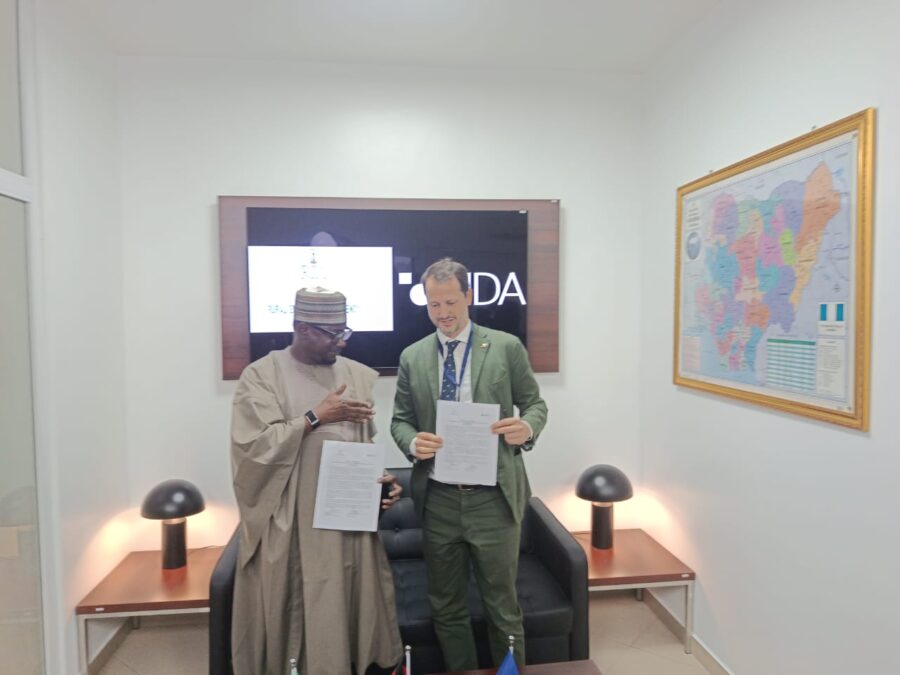
The renewed collaboration, formalised through the signing of a joint statement in Abuja on Wednesday, is expected to strengthen data-driven planning for the deployment of renewable energy infrastructure, ensuring that public investments are directed to underserved communities in the most cost-effective manner.
Speaking at the signing ceremony, Abba Abubakar Aliyu, Managing Director and Chief Executive Officer of the REA, said reliable data is critical to achieving universal energy access, particularly in a country with one of the world’s largest populations without electricity.
According to him, President Bola Ahmed Tinubu has approved $750 million in funding for the agency to electrify 17.5 million Nigerians through the deployment of 1,350 mini-grids, making strategic planning essential to maximise the impact of the investment.
“We do not want to just take this funding and start electrifying communities. We need data. We need a plan that tells us where these Nigerians without electricity are located and what the least-cost option is for providing them with electricity,” Aliyu said.
He explained that VIDA has developed an artificial intelligence platform capable of mapping communities across Nigeria, identifying the number of households, analysing socio-economic indicators and determining communities that remain without electricity.
The platform, he said, enables the agency to allocate public funds more efficiently while reducing the time and cost associated with field surveys.
“Imagine if we had to visit every community ourselves to determine the number of households and identify unelectrified areas. Artificial intelligence has helped us avoid those costs while giving us better information for planning,” he added.
Aliyu noted that the partnership, which operates on an annual basis, has been in place for about 18 months and has now been extended for another year.
Beyond supporting electrification planning, he said the data generated through the collaboration could also be applied to broader economic development planning.
He added that the agency is also prioritising knowledge transfer to ensure REA personnel can continue using AI-powered planning tools independently in the future.
According to him, Nigeria’s experience has attracted interest from other African countries seeking to replicate the data-driven approach to rural electrification.
Speaking at the meeting, Tobias Engelmeier, Co-founder and Chief Executive Officer of VIDA, described Nigeria as one of the company’s most dynamic markets for deploying artificial intelligence to improve infrastructure planning.
He said VIDA’s technology combines data, mapping and analytics to help governments make faster, smarter and more efficient infrastructure investment decisions.
“My interest is to make the best available technology accessible to the people who need it most, and Nigeria is a very strong use case,” Engelmeier said.
He noted that the collaboration with REA and development partners, including the World Bank, has demonstrated how AI-driven data can improve transparency and accelerate private sector participation in renewable energy projects.
According to him, the data platform has supported the design of REA’s subsidy scheme for distributed renewable energy projects by providing investors with greater visibility into potential markets and underserved communities.
“That level of transparency did not exist before. It has helped accelerate private sector investment in electrification across Nigeria, and we can monitor progress on the platform every day,” he said.
Engelmeier added that while VIDA operates as a commercial technology company, its pricing depends on the scope of work, enabling it to continue investing in talent and innovation while supporting governments with advanced planning tools.
The renewed partnership forms part of broader Nigerian-German cooperation to expand universal energy access through technology-driven planning, improve investment efficiency and accelerate the country’s transition to renewable energy.

Join BusinessDay whatsapp Channel, to stay up to date
Open In Whatsapp