In a bold move signalling a new chapter for Nigerian farming, the Ibom Innovation Network (IIN) is backing artificial intelligence to modernise farms nationwide, launching an initiative that brings robotics, smart sensors, and data-driven farming to the grassroots.
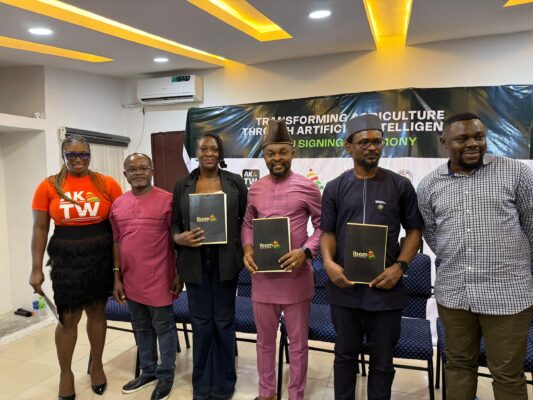
The network formalised its commitment through the signing of a Memorandum of Understanding with five other institutions, giving birth to Transforming Agriculture Through Artificial Intelligence Project (TAT AI) — a coalition-driven programme designed to pull high-tech innovation out of university laboratories and plant it firmly in the soil of commercial farms across Akwa Ibom State and across.
Hanson Johnson, president, IIN and an engineer, explained that the country’s agriculture has long been plagued by erratic weather, crumbling infrastructure and a dependence on guesswork have cost farmers dearly season after season. That era, he insists, is drawing to a close.
“We are moving beyond the era of farming by chance,” he noted at the coalition MoU signing ceremony held in Uyo, recently. “By integrating AI with mechanical engineering, we are providing farmers with the tools to predict, adapt, and scale,” he said.
“This isn’t just about technology; it’s about economic resilience for the entire region,” he added.
He stressed that the project homes in on two of the most persistently broken links in Nigeria’s food supply chain.
The first which he identified as harvesting, where the rising cost and growing scarcity of manual labour have left farmers vulnerable to losses at the very point of production.
He stated that Project TAT AI proposes to address this through autonomous robotic harvesting systems capable of working in the heat and humidity of a tropical agricultural environment.
He identified the second challenge as storage, where crops routinely rot before they can reach any market.
He noted that the initiative plans to deploy Internet of Things sensors and climate-controlled storage environments to dramatically cut post-harvest losses.
According to him, what distinguishes the project from the parade of tech interventions that have faded into academic obscurity is what its architects call a “Lab-to-Land” philosophy — a deliberate effort to ensure that innovations developed in research centres are tested and functional under real farming conditions.
The University of Uyo, Akwa Ibom State University and the Technology Incubation Centre in Uyo are all partners in the MoU, providing an institutional backbone designed to carry ideas from the drawing board to the field.
Uduak Asuquo, a professor and the director at TETFund Centre for Computational Intelligence , University of Uyo, described the moment as a turning point, arguing that AI and IoT tools have crossed the threshold from experimental novelty to practical necessity.
“With the adoption of precision sovereignty, there is a turning point in the agricultural landscape.” “IoT and AI are no longer experimental approaches but very important technologies to global food security.”
According to him, with techniques like soil heat maps and atmospheric intelligence, there is hope for an agricultural transformation through AI.
Also, Bassey Asanga, chairman, NIMechE Akwa Ibom Chapter, decribed the initaitive as the coalition’s contribution to national development through innovative engineering solutions and sustainable practices.
Similarly, Bassey Nkanang, head of the department of mechanical engineering ,Akwa Ibom State University, extended an open invitation to the farming community to help shape the direction of the project.
“We are calling on young innovators, farmers, and partners to identify with this initiative,” he urged, recognising that those who work the land daily carry knowledge that no laboratory can replicate.”
The public will get its first look at what Project TAT AI has produced when its early innovations are showcased at the Akwa Ibom Tech Week 2026, scheduled for November at the Ibom Hotels and Golf Resort in Uyo.
Speaking on the week, Enoabasi Emah, chairperson , planning committee, Akwa Ibom Tech Week 2026, expressed confidence that the convergence of minds behind the project would deliver results felt well beyond the state’s borders.
“This is a beautiful synergy that is bound to create maximum impact,” she said. “Our community needs more of these collaborations to boost economic growth.”

Join BusinessDay whatsapp Channel, to stay up to date
Open In Whatsapp