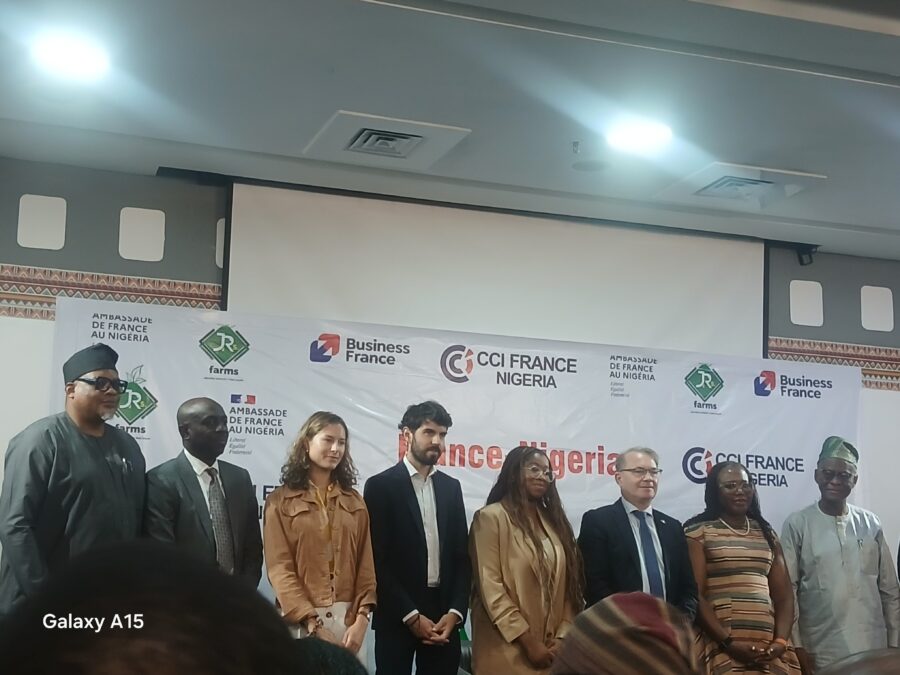
France and Nigeria have launched a new Agribusiness Club to scale investments, technical transfers, and trade in agriculture as both countries seek to position Nigeria as a regional food hub.
The club was announced at the inaugural France-Nigeria Agribusiness Dialogue series in Lagos by Laurent Favier, Consul General of France. “We decided to organise, to structure an organisation that we have decided to call France-Nigeria Agribusiness Club,” Favier said.
He added the club will be housed within the Franco-Nigerian Chamber of Commerce and will target more than 500 members from the industry, finance and government.
The launch comes as France commits new funding to African agriculture. Favier said France, with African partners, announced a €27 billion commitment under its FARM programme, with a €300 million facility dedicated to strengthening agricultural value chains across the continent.
“Nigeria has the potential of becoming one of the biggest hubs of agri-food,” he said, citing the African Continental Free Trade Area and access to “ over 1 billion consumers” as key drivers for the partnership.
In her keynote address, Olayinka David-West, a professor and dean of the Lagos Business School, said the gap in Nigerian agriculture is not finance but data and inadequate information.
“The distance between the high-altitude promise and the ground-level reality of Nigerian agriculture is not primarily a distance of resources. It’s a distance of information, institutions, and partnerships,” she said.
She noted Nigeria has “over 70 million hectares of agricultural land” and a domestic market of “over 220 million people,” with agriculture contributing “a quarter of our GDP” and “more than a third of our workforce.”
However, she added that the “granular reality” includes “post-harvest losses that can consume over 50 percent of what we grow” and 35 million Nigerians in food insecurity, “the highest in the world,” according to the World Food Programme.
David-West said capital is avoiding agriculture because opportunities are “opaque.” “Capital does not avoid Nigerian agriculture because the opportunities are absent. Capital avoids Nigerian agriculture because the opportunities are opaque,” she said.
Through the Nigeria Agribusiness Data and Investment Hub at LBS, she said over “250 data sets” have been mapped across “55 institutions,” but most “sit in silos” and are “rarely interoperable.”
“Data infrastructure is investment infrastructure. What a reliable yield dataset does for agricultural land is what a credit bureau does for consumer finance. It converts the unknowable into the priceable.”
Using cassava as an example, she said Nigeria produces “over 60 million metric tonnes a year” but captures “nearly two percent of the global cassava processing market, which is worth more than $180 billion.”
She called for Franco-Nigerian co-investment in “data systems, the risk-sharing facilities, the insurance instruments” and said: “The future of Nigerian agriculture is a digital, data-driven, investment-grade future, or it is a future of managed.
David-West proposed three instruments for the new club: joint research programmes, two-way technical fellowships, and executive education partnerships.
“First of all, how do we get joint research programmes that pair French research institutes with Nigerian counterparts around defined value chains. Cassava, maize, horticulture, aquaculture, with co-funding and co-authorship as non-negotiables,” she said.
“Second, technical fellowships that move in both directions. How can Nigerian food scientists spend a season in a French processing facility and a French agronomist embedded in a Nigerian agricultural programme?”
She added that LBS would also support executive and vocational training.
“The skill gaps in Nigerian agriculture are not only at the laboratory bench, but also in farm management, quality assurance, and agribusiness finance. And that’s the territory we know well at the business school.”
Also, Rotimi Olawale, founder and chief executive of JR Farms, said Nigeria and France have a long history of trade but must now focus on technology and productivity to meet food demand.
“Nigeria today, for a long time, has been the largest trading partner of France in sub-Saharan Africa. We don’t need to do a lot of background. The data are there. We have the records to show,” Olawale said at the inaugural France-Nigeria Agribusiness Dialogue in Lagos.
Olawale flagged insecurity as a major constraint. “Today, we are faced with challenges such as insecurity, chasing farmers away from their farms. It is not about the land size. It is how much we can use, how much location we can apply to create more outcomes in food production.”
“With a growing population, we need to do things differently. And with all the global shocks, we need to do things differently. So today, it will be a lot about consolidating what has been built over the years, and we’ll see how to chart the way forward,” he added.
“I was really amazed to see how a ray of sunlight is used to boost the yield of wheat.” “We have more sunlight in Nigeria than in France. So there’s a lot we can learn from this,” he said.
Guillaume Niarfeix, president of the Franco-Nigerian Chamber of Commerce & Industry, said the dialogue was designed to create a “single window” for agribusiness exchange between the two countries.
Represented by Moses Umoru, DG of FNCCI, Niarfeix said the event was “very intentional” and not “a political gamble.”
Niarfeix said Nigeria must move beyond raw crop production to capture more value. “If agriculture is contributing 24 percent to Nigeria’s GDP, economies can do the math.
The manufacturing sector should be doing much more than nine percent,” he said. “The reason is that 80percent of agriculture is just from crop production alone. Value creation is not coming from agricultural produce in Nigeria at the moment.”
He blamed high energy costs and other constraints, but said French expertise meeting “Nigeria’s intentionality” could help “re-frame the sector as much as possible.”

Join BusinessDay whatsapp Channel, to stay up to date
Open In Whatsapp