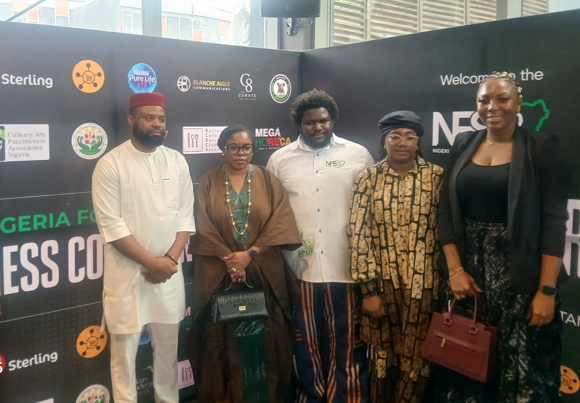
The organisers of the Nigeria Food Summit have said that the country’s food industry must adopt standardised recipes, processes and hygiene to meet growing global demand for African cuisine.
Speaking at the third edition of the summit in Lagos, ‘Gastronomy in Nigeria: Journey to Standardisation,’ Gbolabo Adebakin, a chef, culinary consultant, and the convener of the summit, said the event aims to connect the entire food value chain from farmers to chefs, aggregators, and creators.
Nigeria’s food sector remains fragmented, with businesses struggling to scale due to a lack of structure, inconsistent quality, and misconceptions about food safety, Adebakin, who is popularly known as Chef Gibbs, said.
He noted that while staples like suya, pepper soup, egusi and afang can drive global popularity, the industry needs standardised processes for licences, production and customer service to build export capacity.
“We want to come out of the summit and say this is the right way to do this,” he said, adding that even a standardised recipe for egusi soup will be attempted.
He linked standardisation to food safety and exports. “People say that when you eat Nigerian food, sometimes you get food poisoning. We need to fix that. Standardisation solves that. People say there’s a lot of misconception about our food, that it’s not healthy. Standardisation solves that.”
The renowned chef described standardisation as the missing link for scaling. “Everything that we want to do as an industry is built on standardisation, process, structure,” he said.
Read also: The woman who looked at cassava and saw a factory
The summit is also pushing education for food creators on social media, who he described as “enablers” shaping how the world perceives Nigerian food.
“If the world wants to know about Nigerian food today, the first thing they go to is social media,” he said.
“Creators need to understand that the information that they put out is as equally important as what we do in the professional space. You cannot put out wrong information.”
“We are going to have a career and education fair where recruiters and educators in the culinary industry will be brought together to dissect the food curriculum and endorse it.” The chef also added that the summit will host the first edition of the food industry awards.
In her keynote address, Abisola Olusanya, commissioner of Agriculture and Food Systems, said food must be treated as more than production and marketing. “Food and the food ecosystem is a much bigger platform,” she said.
“It’s part of our tradition. It’s part of our culture. It’s a way of life for us, and therefore we must elevate it beyond what we are doing currently.”
Olusanya said Nigeria has the land and human capital to lead but is losing out to food waste and post-harvest losses. “We just don’t seem to have it all put together,” she said. “When we start connecting actors and people start to understand their place… then we’ll start working together as a collective and not in silos and therefore we’ll get to that food security level that we want Nigeria to get to.”
To address this, Lagos is investing in food logistics, middle-level markets and cold-chain transportation. The state is also reorganising markets, which Olusanya called foundational to food security. “If you have the largest market in sub-Saharan Africa, you must reorganise,” she said. “We see ourselves as a market city state.”
She noted that Lagos is investing heavily in food logistics, markets and youth training as it seeks to position food at the center of its economy and tourism push.
“We have people who are investing in the food space already, but Lagos by itself is actually doing so much towards ensuring that it positions food as the heart of what you see today.” “Lagos being the dirty December destination for the entire continent.”
Olusanya said reorganising markets is key to food security because Lagos operates as a “market city state.” “If you have the largest market in sub-Saharan Africa, you must reorganise,” she said. “Food being a part and parcel of who we are, what we do. I mean all of you must eat. Everyone eats.” She added that “reorganising markets” is “foundational to ensuring that food security becomes a mainstay in the Nigeria ecosystem.”
Speaking on the food summit, she said the summit, now in its third year, aims to bring together all actors in the farm-to-table chain to offer solutions and “give an endearing legacy to what our youth should actually aspire to, particularly in the gastronomic space,” Olusanya said.
“There are so many intermediaries in between that a lot of people actually do not pay attention to, and we believe that a platform like this will bring all of us together as a collective towards offering solutions.

Join BusinessDay whatsapp Channel, to stay up to date
Open In Whatsapp