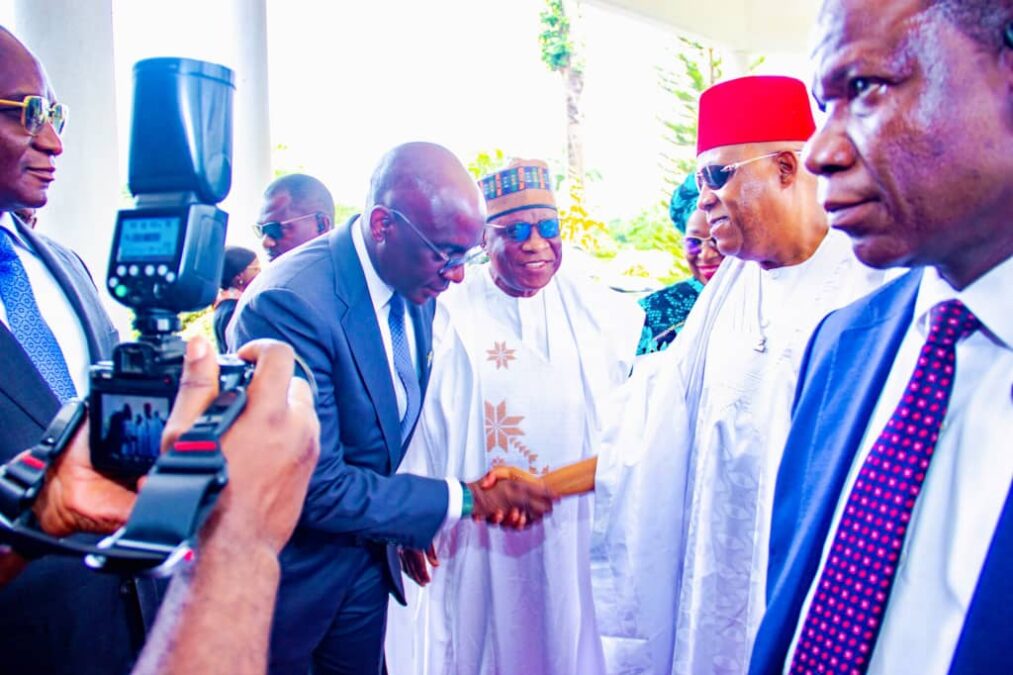
Delivering his keynote address at the fund launch in Abuja on Wednesday, Kashim Shettima, Nigeria’s vice president the promise of an agricultural boom is one that the country cannot afford to take for granted, stressing that Nations survive on many resources, but they endure because they can feed themselves.
He explained that Agriculture is not only the foundation of civilisation; it is the first guarantee of political stability.
“Before a people raise cities, they must learn to feed them, and before a state earns the loyalty of its citizens, it must secure their daily bread. This is why agriculture has remained at the very heart of our national agenda, and I am honoured to stand with you at this distinguished gathering as we march into the future.”
Shettima noted that while the Niger Delta has spent generations drawing wealth from beneath its soil, it has chosen also to draw abundance from the soil itself. “Oil built an economy; agriculture will secure a civilisation.
Read also: Nigeria eyes green finance to shield food systems from climate shock
“We began as an agrarian economy, and the foundation of this nation was laid upon it. Before the barrel, it was the soil that paid our bills. The groundnut pyramids of the North, the cocoa estates of the West, and the palm produce of the East and the Delta financed our earliest schools and hospitals and underwrote the young institutions of a new republic.
“Then oil arrived, only to sidetrack that journey, for its ease dulled the industry of the cutlass, and a country that once fed itself learned instead to import what its own soil could grow,” he said.
He commended the move by the leaders in the region, stating that they have chosen to return to an identity older than crude itself, adding that what makes this vision inspiring is that it arises from a region that could have rested on its oil wealth and left feeding the nation to other hands.
The vice president explained that the Niger Delta Agricultural Investment Fund of $500 million is a commercial, returns-driven vehicle spanning the value chain, from aquaculture and palm oil to cassava, cocoa, rice, horticulture, marine resources, and livestock.
“Around it, we coordinate the commitments already pledged by the World Bank, the African Development Bank, the Islamic Development Bank, the European Bank for Reconstruction and Development, and our private and commercial financiers. Above both stands the Niger Delta Agricultural Development and Investment Council, which I am honoured to chair, with the NDDC as its Secretariat. Beneath it lies a demand-side strategy preparing bankable projects across all nine mandate states,” he added.
In his remarks, Samuel Ogbuku, Managing Director, Niger Delta Development Commission, NDDC, expressed optimism that the Summit opens a new vista for the people of the Niger Delta region as the $500 million Fund is to drive agricultural revolution that would unlock the hidden potential overshadowed by oil and gas production over seven decades, which the region was known for before oil discovery.
Ogbuku assured that Fund would be a source of driving agribusiness investments and investors making huge returns on investment.
He also said the investment plan is to quickly serve as an alternative to the shift of oil companies moving their operations from onshore to off-shore in order to unlock private capital and diversify the regional economy.
He said, “While the IOCs are moving offshore, we are inviting agribusiness into the Niger Delta. Agribusiness is capable of creating jobs, generating wealth and driving sustainable development across the region.”
Also speaking at the event, Kingsley Uzoma, Senior Special Assistant to the President on Agribusiness and Productivity, explained the essence of the Summit, which is to unlock the huge agricultural potential of the region but had remained untapped following a lack in coordination to attract investors into the region.
Uzoma also said this promoted President Bola Tinubu directive to ensure massive expansion of non-oil investment, then accelerate agricultural development and position the Niger Delta as a major contributor to Nigeria’s food security and economic growth.
“By the end of today, our goal is to leave with more than ideas. We should leave with stronger partnerships, clearer commitments, a shared implementation pathway and renewed confidence that the Niger Delta can become one of Nigeria’s foremost destinations for agricultural investment”, he said.

Join BusinessDay whatsapp Channel, to stay up to date
Open In Whatsapp