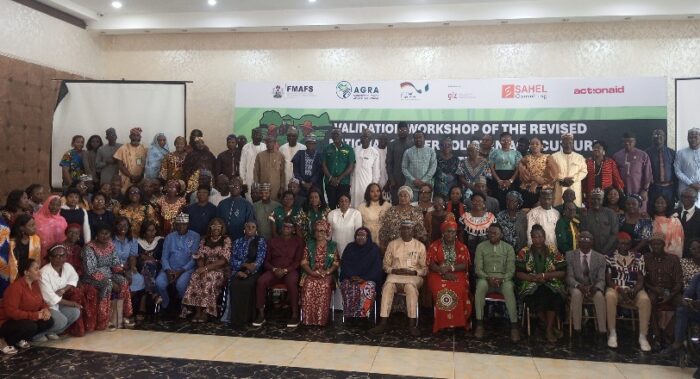
The federal government has validated the Revised National Gender Policy in Agriculture and its Strategic Action Plan (2025–2030), aimed at promoting inclusivity, equity, and productivity across Nigeria’s agricultural sector.
The policy, which addresses long-standing gender barriers in access to land, finance, technology, and decision-making, was validated at a workshop organised by the Federal Ministry of Agriculture and Food Security (FMAFS) in Abuja on Thursday.
The event brought together representatives from the National Assembly, ActionAid Nigeria, GIZ, AGRA, Sahel Consulting, and other partners, alongside farmer-based groups such as SWOFON, AWITA, and YOFIN.
Read also: Northern Nigeria’s agriculture revival key to beating country-wide hunger
Kachalla Damaturu, director, Special Duties, FMAFS, said the validation marked the culmination of a year-long consultative process that began in January 2025, involving over 1,200 stakeholders across Nigeria’s six geopolitical zones.
“This policy is our collective response to the gender disparities that have long constrained productivity and inclusivity in the sector,” Damaturu said. “It provides a framework for equitable participation and resource allocation for women, youth, and persons with disabilities.”
Marcus O. Ogunbiyi, permanent secretary, FMAFS, described the policy as a milestone in mainstreaming gender equality in agricultural planning and budgeting.
“The revised framework ensures that the perspectives of women and other vulnerable groups are fully integrated into agricultural programmes and decision-making,” he stated.
He commended President Bola Ahmed Tinubu’s administration for prioritising agriculture as a driver of economic growth and reaffirmed the ministry’s commitment to implementing gender-inclusive reforms.
Azubuike Nwokoye, chairperson, National Gender Steering Committee and Food Systems Specialist at ActionAid Nigeria, noted that the updated policy incorporates new measures to address emerging issues, including gender-based violence and the differentiated needs of young men and women in agriculture.
He added that discussions are ongoing with state ministries of agriculture to include dedicated budget lines for implementation in the 2026 fiscal year.
The policy, expected to be submitted to the National Council on Agriculture for endorsement, will guide inclusive agricultural growth and support Nigeria’s food and nutrition security agenda.
“This is not just a gender document—it is a roadmap for social justice and national food security,” Nwokoye said.

Join BusinessDay whatsapp Channel, to stay up to date
Open In Whatsapp