African equities are delivering some of the world’s strongest returns as of May 2026, buoyed by improving macroeconomic conditions, easing inflation, currency stabilisation and renewed investor appetite for frontier and emerging markets.
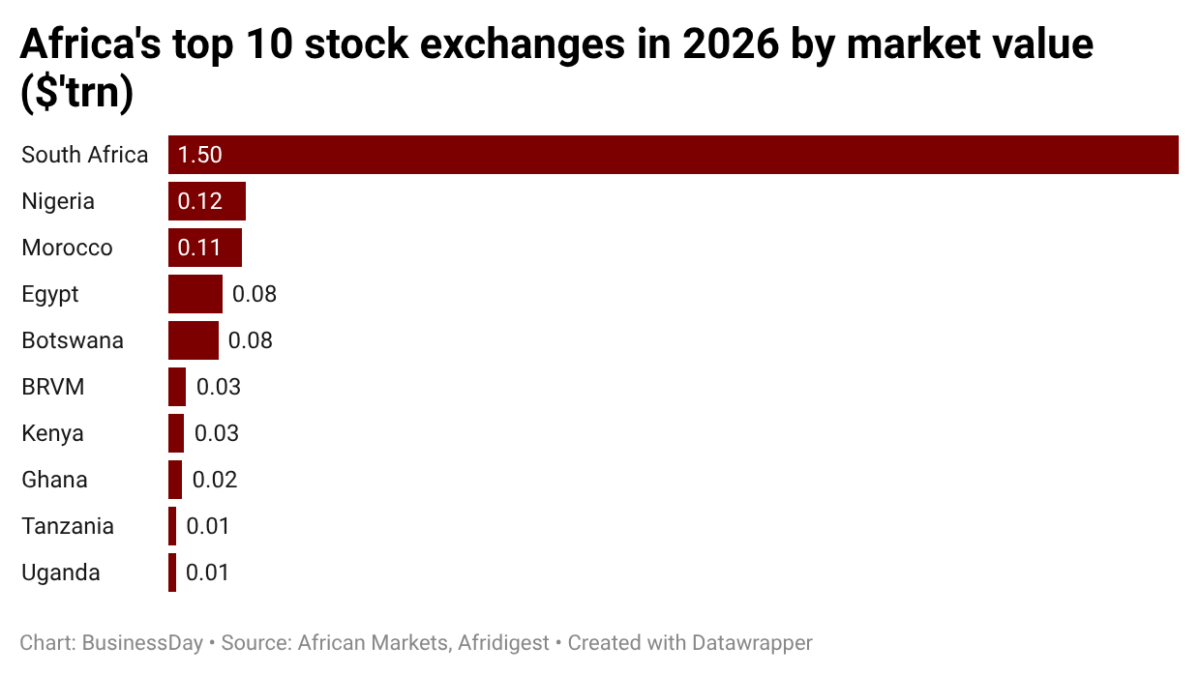
Yet the exchanges generating those gains remain smaller than many investors realise. Data compiled by Afridigest, a pan-African strategic intelligence platform, from real-time trading platform African Markets, shows that market capitalisation remains heavily concentrated, with South Africa’s Johannesburg Stock Exchange (JSE) dwarfing every other bourse on the continent.
More details on the Exchanges
South Africa (JSE) – $1.5 trillion
The Johannesburg Stock Exchange remains Africa’s undisputed capital markets powerhouse. With a market value of $1.5 trillion as of May 15, the JSE is larger than the combined value of the other nine exchanges on this list, underlining its deep liquidity, institutional sophistication and decades of market development.
Nigeria (NGX) – $117 billion
Nigeria’s stock market has climbed to second place following a powerful rally driven by banking sector repricing, foreign exchange reforms, strong corporate earnings, increased domestic institutional participation and renewed foreign investor interest.
Morocco (BVC) – $111 billion
Morocco’s Casablanca Stock Exchange continues to punch above its weight, boasting a market value nearly equal to Nigeria’s despite having a significantly smaller population and economy. The exchange reflects the country’s deep financial institutionalisation and mature listed corporate sector.
Read also: Nigeria overtakes Morocco to become Africa’s second-largest stock market
Egypt (EGX) – $81 billion
Egypt’s stock exchange remains one of the continent’s largest despite the impact of currency depreciation and economic reforms. Investor interest is expected to receive further support from a pipeline of planned initial public offerings this year.
Botswana (BSE) – $75 billion
Botswana’s stock market is one of Africa’s most remarkable success stories. Supported by dual-listed mining giants and a strong institutional investor base, the exchange’s market value far exceeds what might be expected from a country of just over two million people.
BRVM (WAEMU/UEMOA) – $28 billion
The Bourse Régionale des Valeurs Mobilières remains Africa’s only regional stock exchange, serving eight Francophone West African nations. Despite covering a large economic bloc and population base, its market capitalisation remains relatively modest.
Kenya (NSE) – $25 billion
Kenya’s Nairobi Securities Exchange continues to serve as East Africa’s principal capital market, supported by a diversified corporate sector and growing investor participation.
Ghana (GSE) – $22 billion
The Ghana Stock Exchange has benefited from improving macroeconomic stability and stronger investor sentiment as the country’s economy recovers from recent challenges.
Tanzania (DSE) – $13 billion
Tanzania’s exchange continues to grow steadily, supported by economic expansion and efforts to deepen participation in the capital market.
Uganda (USE) – $12 billion
Uganda rounds out the list of Africa’s largest exchanges, reflecting the gradual development of its capital markets and increasing interest from domestic and regional investors.
According to Daba Finance, African stock markets delivered one of their strongest performances in recent history in 2025, with many exchanges posting double-digit gains in local currency terms and impressive returns in dollar and euro terms.
“Across the continent, equities posted double-digit gains in local currencies, with many markets also generating exceptional returns in USD and EUR, thanks to currency stabilisation, declining inflation in key economies and renewed global appetite for frontier and emerging market assets,” the investment platform said.
Despite the strong performance, the latest rankings highlight the significant gap between Africa’s largest exchange and the rest of the continent, as well as the substantial room for growth in many of the region’s capital markets.

Join BusinessDay whatsapp Channel, to stay up to date
Open In Whatsapp