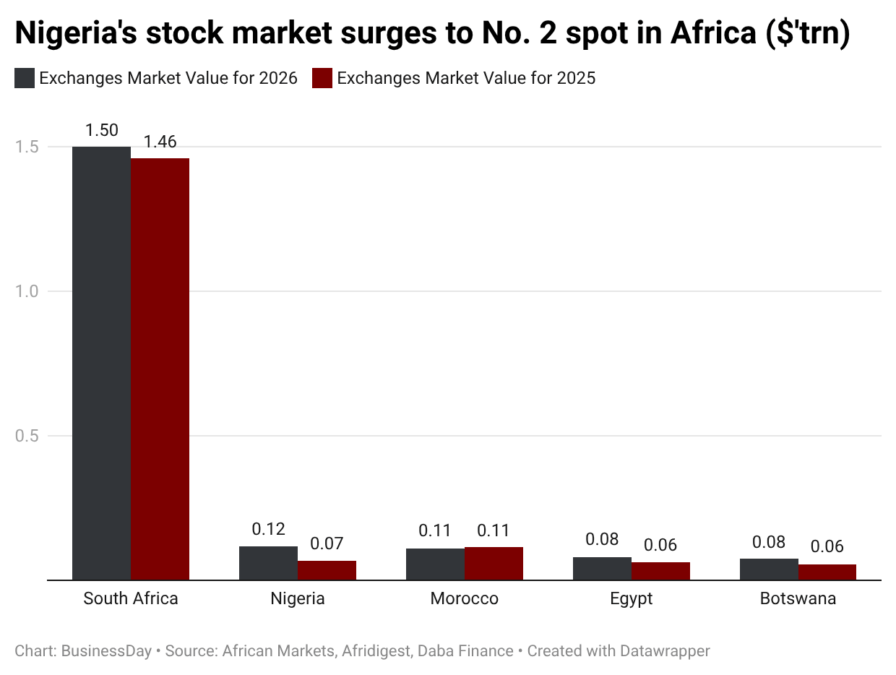
Nigeria has emerged as Africa’s second-largest stock market in 2026, overtaking Morocco after almost a two-year rally that has transformed the Nigerian Exchange Limited (NGX) into one of the continent’s best-performing bourses.
Data compiled by Afridigest, a pan-African strategic intelligence platform, from real-time trading platform African Markets showed that the NGX was valued at $117 billion as of May 15, 2026, ranking behind only South Africa’s Johannesburg Stock Exchange (JSE), which remains the continent’s largest bourse with a market capitalisation of $1.5 trillion.
The latest ranking marks an improvement from 2025 when Nigeria was Africa’s third-largest stock market.
According to Daba Finance, a unified investment platform, the NGX was valued at $68.8 billion in 2025, supported by Nigeria’s reclassification to Frontier Market status by global index providers, increased foreign portfolio inflows, banking sector recapitalisation efforts, and strong corporate earnings across key sectors.
Read also: Eight stocks Nigerian investors made over 200% return in 5 months
“After an unprecedented rally that saw market capitalisation grow fivefold from 2023 to today, driven by banking sector repricing, aggressive foreign exchange reforms, strong corporate earnings, heavy domestic institutional participation and renewed foreign interest,” Afridigest said in a LinkedIn post.
Despite the surge, Afridigest noted that Nigeria’s capital market remains relatively shallow compared with the size of the economy.
“At a $117 billion market cap, it represents just 35 percent of Nigeria’s GDP. For a $377 billion economy, that’s a thin capital market,” the platform said.
Reforms drive record equity market performance
The NGX has also been one of Africa’s best-performing markets this year. As of May 29, the NGX All-Share Index had gained 69.4 percent in dollar terms, the highest return among 17 African stock exchanges tracked by African Markets.
Analysts attribute the rally to a combination of regulatory reforms, improving macroeconomic conditions and increased institutional participation. Pension reforms introduced in February expanded equity investment limits and imposed stricter capitalisation requirements on Pension Fund Administrators, allowing more retirement assets to flow into the stock market and boosting liquidity.
Other market reforms implemented this year include the Securities and Exchange Commission’s transition to a T+1 settlement cycle, new tiered minimum capital requirements for market operators, the completion of banking sector recapitalisation programmes and the expansion of NGX trading hours.
South Africa remains dominant as African equities rally
Afridigest said African equities are delivering some of the world’s strongest returns in 2026, although many of the continent’s exchanges remain relatively small compared with the economies they serve.
After South Africa and Nigeria, Morocco’s Casablanca Stock Exchange ranked third with a market capitalisation of $111 billion, followed by Egypt’s Exchange at $81 billion and the Botswana Stock Exchange at $75 billion.
The regional Bourse Régionale des Valeurs Mobilières (BRVM), which serves eight Francophone West African countries, was valued at $28 billion.
Kenya’s Nairobi Securities Exchange stood at $25 billion, followed by the Ghana Stock Exchange at $22 billion, the Dar es Salaam Stock Exchange at $13 billion and the Uganda Securities Exchange at $12 billion.
Daba Finance noted in a recent report that African stock markets recorded one of their strongest performances in recent history in 2025.
“Across the continent, equities posted double-digit gains in local currencies, with many markets also generating exceptional returns in US dollar and euro terms, supported by currency stabilisation, easing inflation in key economies and renewed global appetite for frontier and emerging market assets,” the platform said.

Join BusinessDay whatsapp Channel, to stay up to date
Open In Whatsapp