Access Holdings recorded Africa’s biggest increase in Tier 1 capital, leading a strong showing by Nigerian lenders in The Banker’s latest global banking rankings.
An analysis by BusinessDay of The Banker’s 2026 Top 1000 World Banks report shows that four Nigerian lenders ranked among the continent’s 10 fastest-growing banks by Tier 1 capital, reflecting gains from recapitalisation, cross-border acquisitions, and a stabilising domestic economy.
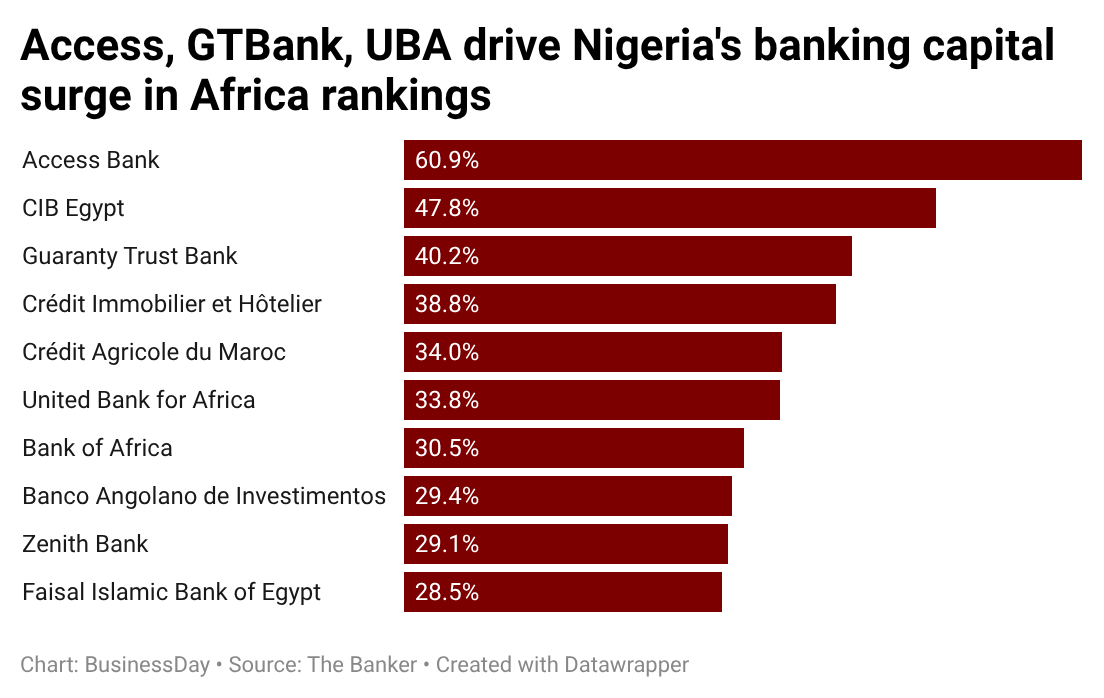
Access, Nigeria’s largest banking group by assets, posted a 60.9 per cent increase in Tier 1 capital to $2.46 billion, the highest growth among African lenders. Egypt’s Commercial International Bank (CIB) followed with a 47.8 per cent increase to $3.91 billion, while Guaranty Trust Bank (GTBank) ranked third, growing Tier 1 capital by 40.2 per cent to $1.85 billion.
Tier 1 capital, regarded as the highest-quality measure of a bank’s financial strength, consists mainly of common equity and retained earnings that can absorb losses while allowing a bank to continue operating. Regulators use it under the Basel III framework to assess a bank’s resilience during periods of financial stress.
Morocco’s Crédit Immobilier et Hôtelier and Crédit Agricole du Maroc occupied fourth and fifth positions with growth of 38.8 percent and 34 percent, respectively. United Bank for Africa (UBA) ranked sixth with a 33.8 percent increase, followed by Morocco’s Bank of Africa. Angola’s Banco Angolano de Investimentos came eighth, while Zenith Bank placed ninth after increasing Tier 1 capital by 29.1 percent. Egypt’s Faisal Islamic Bank completed the top 10 with a growth of 28.5 percent.
“Nigerian banks similarly march up this year’s rankings, taking advantage of a stabilising economy and the dollar’s weakness,” The Banker said.
The UK-based banking and financial intelligence publication attributed Access Holdings’ performance to the final phase of its aggressive acquisition strategy, noting that the lender recorded “the continent’s largest annual increase in Tier 1 capital” after completing the acquisitions of National Bank of Kenya and several Standard Chartered subsidiaries across Africa.
The rankings highlight that years of expansion by Nigerian lenders are beginning to translate into stronger capital positions and greater regional influence.
Zenith Bank climbed 55 places to 526th globally after increasing its Tier 1 capital by 29.1 percent. However, The Banker said the lender narrowly trailed GTBank in its Nigerian performance rankings, with GTBank outperforming on operational efficiency, asset quality and financial soundness.
Outside Nigeria, Egypt’s CIB was Africa’s biggest mover in the global rankings, climbing 89 places to 407th after increasing Tier 1 capital by 47.8 percent, supported by higher retained earnings.
Capital gains from expansion
The list comes as Nigerian banks begin to reap the rewards of a recapitalisation drive that has seen the industry raise about N4.65 trillion ($3.24 billion) in fresh capital since March 2024. The Central Bank of Nigeria requires international banks to maintain a minimum capital base of N500 billion ($345 million) by March 31, 2026, while national and regional banks must hold N200 billion ($138 million) and N50 billion ($34.5 million), respectively.
Access became the first lender to meet the N500 billion ($345 million) threshold after raising N351 billion ($242 million) through a rights issue in December 2024.
Speaking during the group’s 2024 investor call, Roosevelt Ogbonna, group managing director of Access Bank, said much of the capital raised had already been deployed to finance the acquisition of Standard Chartered’s subsidiaries across Africa.
“We have consistently stated that our capital raise had nothing to do with the Central Bank’s directive requiring banks to raise their minimum capital,” Ogbonna said. “The raise was designed to support the investment phase of our strategy. The capital was deployed immediately, and its impact is already visible, including the acquisition of Standard Chartered’s five African subsidiaries.”
In 2023, the group, which operates in nearly 20 African markets, agreed to acquire Standard Chartered’s businesses in Angola, Cameroon, The Gambia and Sierra Leone, as well as the Consumer, Private and Business Banking business in Tanzania. By November 2024, it had completed the acquisitions in Angola and Sierra Leone.
It also completed the acquisition of National Bank of Kenya from KCB Group last year, acquired a 76 percent majority stake in Mauritius-based AfrAsia Bank, and finalised the purchase of Standard Chartered’s consumer banking operations in Tanzania and its subsidiary in The Gambia.
Its pan-African expansion strategy is also reshaping the group’s earnings profile. According to the company’s latest investor presentation, Nigeria contributed 37 percent of pre-tax profit between January and September 2025, down from 61 percent during the same period in 2023. Contributions from African subsidiaries rose to 35 percent from 18 percent, while the UK and other international businesses increased to 28 percent from 21 percent.
“We are creating real value and long-term wealth through our subsidiary operations,” Ogbonna said, noting that the group had invested about $1.2 billion across its African subsidiaries.
Ayokunle Olubunmi, head of financial institutions ratings at Agusto & Co., told BusinessDay that the strategy was helping diversify earnings away from Nigeria’s volatile macroeconomic environment.
“Given the exposure of its business to Nigeria’s macroeconomic environment, Access is deliberately diversifying its income base,” he said. “Expanding into countries with stronger sovereign ratings helps reduce the group’s overall risk profile.”
The expansion has coincided with the retreat of international lenders from Africa. Over the past decade, banks including Barclays, HSBC and Société Générale have exited or scaled back operations across the continent, creating acquisition opportunities for regional lenders.
The strategy, however, has weighed on the bank’s brand value. Brand Finance’s latest Africa Banking 200 report showed Access Bank’s brand value declined 3.9 percent to $538 million in 2026 from $559.2 million a year earlier, although it retained its position as Nigeria’s most valuable banking brand.
“Access Bank’s rapid expansion via bolt-on acquisitions necessitates significant short-term outlays,” said Babatunde Odumeru, managing director of Brand Finance Nigeria. “Managing a disparate portfolio of brand architectures across diverse markets can temporarily dilute brand equity and strain capital efficiency as the group works to harmonise its global operations.”
Beyond Nigeria, The Banker noted that Africa’s banking industry continues to outperform its global peers despite its relatively small size. Although the continent accounts for about one-fifth of the world’s population, African banks represent less than 1 percent of the Tier 1 capital of the world’s 1,000 largest lenders.
Yet the publication said the continent’s biggest banks continue to “punch above their weight”, with aggregate profit and Tier 1 capital growth well above the average for the global Top 1000. All 33 African banks in this year’s rankings increased their Tier 1 capital in dollar terms, with lenders in Nigeria, South Africa and Morocco benefiting from the weaker US dollar during 2025.

Join BusinessDay whatsapp Channel, to stay up to date
Open In Whatsapp