…deal values surge 55% to $4.5bn in Q1 despite fewer transactions
Africa’s Mergers and Acquisitions (M&A) market began the year on a strong note, with deal values climbing to their highest level in four years even as the number of transactions declined, highlighting a growing investor preference for larger, lower-risk acquisitions.
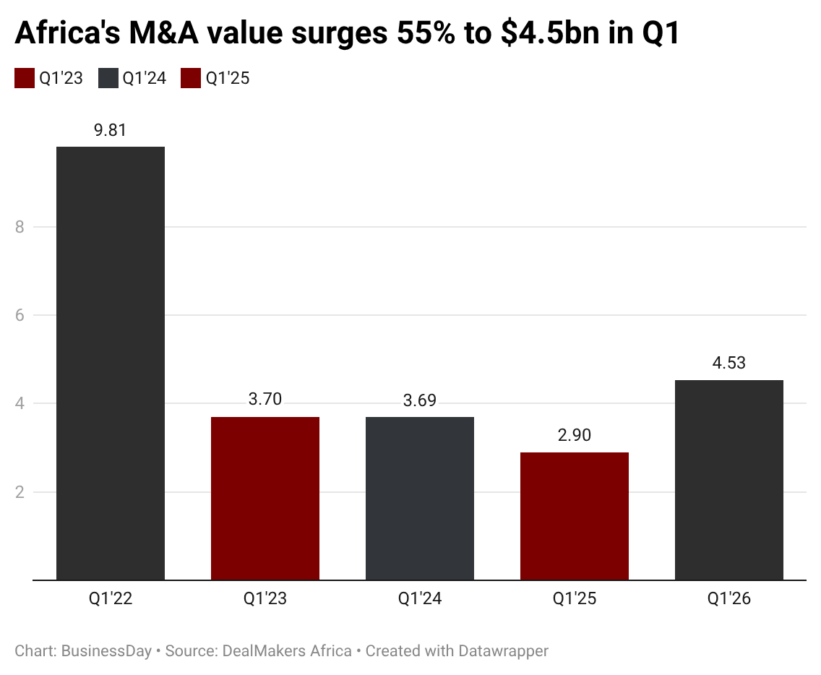
BusinessDay’s analysis of the latest data from DealMakers Africa shows that announced deals across the continent—excluding South Africa, foreign transactions, and failed deals—rose by 55.1 percent to $4.53 billion in the first quarter of 2026, from $2.92 billion in the same period of 2025.
The value increase came despite a slight decline in deal volumes, with 89 transactions recorded between January and March compared with 92 deals a year earlier.
The divergence between deal value and deal volume highlightes a broader shift in the continent’s investment landscape. Rather than deploying capital across a wide range of businesses, investors are increasingly concentrating funds in larger, established companies and strategic sectors such as energy, financial services, and telecommunications.
According to the South African-based deal tracking firm, private equity remained a major force in the market, accounting for half of all transactions completed during the quarter.
The trend also shows that Africa is not facing a shortage of capital. Instead, funding is becoming increasingly selective, favouring mature businesses with proven business models, stable cash flows and clear growth prospects. At the same time, smaller companies and early-stage ventures face a more difficult fundraising environment.
“While debt and equity investors each play distinct but equally important roles in the development of a maturing start-up ecosystem, concerns remain around the decline in smaller early-stage equity deals,” said Marylou Greig, editor at DealMakers Africa. “These transactions are critical for building the next generation of companies capable of attracting larger funding rounds in the future.”
Greig warned that although larger deals continue to support overall investment activity, the slowdown in seed and early-stage funding could weaken the future pipeline of scalable African businesses.
“The slowdown in early-stage activity may not immediately affect aggregate funding totals – particularly while larger equity rounds and debt transactions continue to come through – but its longer-term implications for the pipeline of scalable African businesses are worth watching,” she said.
West Africa leads deal activity
West Africa emerged as the continent’s most active M&A market during the quarter, accounting for 30 deals, or 34 percent of all reported transactions.
North Africa followed with 19 deals, while East Africa recorded 18.
At the country level, Nigeria led the continent with 22 transactions, followed by Kenya with 13 and Morocco with 10, reinforcing their positions as key investment destinations.
The concentration of deals in a handful of markets reflects investors’ continued preference for economies with deeper capital markets, larger consumer bases and more developed regulatory frameworks.
Energy and finance dominate
Energy remained the most attractive sector for investors during the quarter.
Four of the ten largest deals announced in Q1 were energy transactions, including two in Angola and one each in Equatorial Guinea and Ghana, with a combined value of nearly $1 billion.
The dominance of energy deals highlights growing investor appetite for cash-generating assets linked to Africa’s oil, gas and power sectors at a time when global energy security remains a strategic priority.
Financial services also continued to attract significant interest as banks pursued regional expansion and consolidation opportunities.
The quarter’s largest transaction was MTN’s acquisition of the remaining 75.3 percent stake in IHS not already owned by the telecommunications giant. Valued at $2.2 billion, the deal accounted for almost half of the total value of the continent’s largest transactions during the period.
The second-largest deal was Nedbank’s acquisition of a 66 percent stake in Kenya’s NCBA Group, valued at approximately $855 million, underscoring the growing consolidation taking place across Africa’s banking industry.
Startup funding shifts toward debt
The changing nature of African dealmaking is also evident in the startup ecosystem.
Data from Africa: The Big Deal shows African startups raised $3.3 billion over the 12 months to March 2026, excluding exits. The total comprised $1.8 billion in equity funding and $1.4 billion in debt financing.
According to DealMakers, the figures point to a significant shift in how startups are being financed.
“However, a closer look at the data points to an evolving funding landscape, where overall growth has increasingly been driven by a surge in debt funding, offsetting a decline in equity capital raised,” the report said.
The trend reflects a more cautious investment environment in which investors are prioritising capital preservation and proven business models over speculative growth.
For Africa’s startup ecosystem, the challenge will be ensuring that a slowdown in early-stage investment today does not undermine the emergence of the continent’s next generation of high-growth companies tomorrow.

Join BusinessDay whatsapp Channel, to stay up to date
Open In Whatsapp