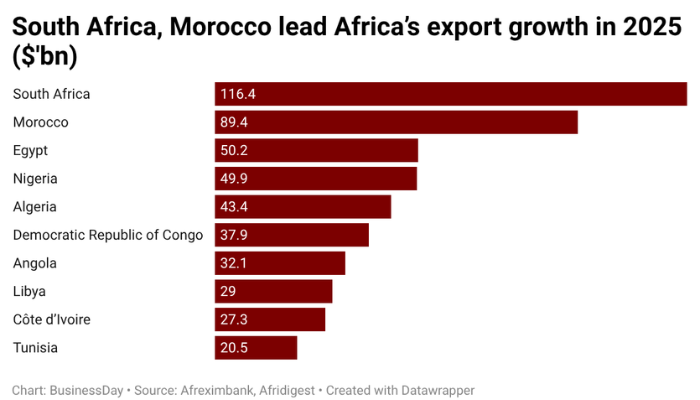
Africa’s export economy remains concentrated in a relatively small group of countries, but the last year’s rankings reveal a sharp divide between economies exporting manufactured goods and those still dependent on oil, gas and minerals. The largest exporting economies shipped nearly half a trillion dollars worth of goods to the rest of the world, with combined merchandise exports reaching $496.2 billion.
It’s a good indicator of a country’s productive capacity and economic health as it measures global demand for a nation’s output.
South Africa and Morocco lead the continent’s merchandise export league because of their more diversified industrial bases, while Nigeria, Algeria, Angola and Libya continue to rely heavily on energy exports. The Democratic Republic of Congo’s position reflects the growing global demand for copper and cobalt, which are critical to electric vehicles and renewable-energy technologies.
Read also: Why Nigeria is losing billions in gum arabic export
According to Afreximbank’s African Trade Heatmaps 2026, a small group of countries accounts for the bulk of Africa’s trade with the rest of the world. Smaller and landlocked economies continue to record lower trade volumes because of limited industrial capacity, smaller domestic markets, and weak transport links.
The report identifies China as Africa’s largest trading partner in 2025, while France, Spain, the United States, India and Italy remained important markets for African exporters. Afreximbank said the concentration of trade reinforces the need for African countries to diversify exports, lower logistics and border costs, and build stronger regional value chains under the African Continental Free Trade Area.
Using merchandise export data from the report, Afridigest, a pan-African business intelligence platform, ranks the 10 African countries that exported the most goods to the world in 2025.
“As a continent, roughly 70 percent of total export value comes from oil and gas and metals and mining,” Emeka Ajene, founder of Afridigest, said.
“Across Africa, in country after country, moving up the value chain to refine and process petroleum, mineral, and metal goods that are currently exported raw remains a key opportunity.”
Ajene added that after all, export power is national earning power.
South Africa
Merchandise exports: $116.4 billion
South Africa remained Africa’s largest goods exporter in 2025, supported by the continent’s most diversified industrial economy.
Its exports include minerals, precious metals, vehicles, machinery, chemicals, and agricultural products. This broad export base has helped South Africa retain its lead over larger commodity exporters, whose trade earnings are more vulnerable to swings in global oil and mineral prices.
China was South Africa’s largest overall trading partner, with bilateral trade valued at $37.45 billion. Germany, the United States, Japan, Namibia, and Botswana were also important trade partners.
Read also: These 10 countries supply nearly half the world’s food exports
Morocco
Merchandise exports: $89.4 billion
Morocco has become one of Africa’s strongest manufacturing export stories, driven by investment in automotive assembly, aerospace, electrical equipment and fertiliser production.
The country exports passenger vehicles, automotive parts, aircraft components, textiles, electrical equipment, and phosphate-based fertilisers. Its growing industrial base has reduced its dependence on raw phosphate exports and deepened its integration with European supply chains.
France and Spain remain Morocco’s largest overall trading partners, with bilateral trade worth $33.16 billion and $30.15 billion, respectively. China is also a major trade partner.
Egypt
Merchandise exports: $50.2 billion
Egypt ranked third, supported by exports of petroleum products, fertilisers, chemicals, food products, textiles and other manufactured goods.
Its location along the Suez Canal has strengthened its role as a trade and logistics hub linking Africa, Europe, the Middle East and Asia. Egypt’s export base remains more diversified than that of many African economies, although energy products still account for a significant share of foreign-exchange earnings.
China and the United States were Egypt’s largest overall trading partners, with bilateral trade valued at $17.24 billion and $15.64 billion respectively.
Nigeria
Merchandise exports: $49.9 billion
Nigeria remained one of Africa’s biggest exporters in 2025, although crude oil and liquefied natural gas continued to dominate its export earnings.
Fertiliser, cocoa, sesame seeds, and other agricultural products contributed to exports, but their value remained small compared with oil and gas. Nigeria’s ranking highlights the scale of its resource wealth but also the limits of an export model that remains heavily exposed to global energy prices.
India was Nigeria’s largest overall trading partner, with bilateral trade valued at $8.14 billion. The Netherlands followed with $6.18 billion, while trade with China reached $6.10 billion.
Read also: Sesame exporters fear insecurity, floods will derail 2026 boom
Algeria
Merchandise exports: $43.4 billion
Algeria remained one of Africa’s largest exporters, driven almost entirely by crude oil, natural gas and refined petroleum products.
European energy demand has kept Algeria closely linked to markets such as Italy, France and Spain. The government has been pushing to increase non-energy exports, but hydrocarbons remain the backbone of the country’s trade earnings.
Democratic Republic of Congo
Merchandise exports: $37.9 billion
Democratic Republic of Congo ranked sixth, reflecting its position as one of the world’s largest producers of cobalt and a major supplier of copper.
Both minerals are central to electric vehicle batteries, renewable-energy infrastructure and global efforts to transition away from fossil fuels. However, the country’s export strength remains concentrated in raw mineral extraction rather than higher-value processing.
China dominated the DRC’s trade relationship, with bilateral trade reaching $29.06 billion in 2025.
Angola
Merchandise exports: $32.1 billion
Angola continued to rely heavily on crude oil exports, with diamonds, liquefied natural gas and other minerals providing additional foreign-exchange earnings.
China remained Angola’s biggest customer because of its demand for crude oil, while India and several European countries also imported Angolan energy products. The country has been trying to diversify its economy, but oil remains its dominant export.
Libya
Merchandise exports: $29.0 billion
Libya remained heavily dependent on crude oil and petroleum products, which account for the overwhelming majority of its export earnings.
Italy was Libya’s largest overall trading partner, with bilateral trade valued at $8.83 billion, reflecting Europe’s continuing demand for North African energy supplies.
Côte d’Ivoire
Merchandise exports: $27.3 billion
Côte d’Ivoire was the only major agricultural exporter in the top 10.
The country is the world’s largest producer of cocoa beans and also exports coffee, cashew nuts, palm oil, natural rubber and refined petroleum products. Its export base is broader than that of several commodity-dependent peers, although much of its trade still consists of raw or lightly processed agricultural goods.
Europe remains a key market for Ivorian agricultural exports, while trade with Asian markets is also expanding.
Tunisia
Merchandise exports: $20.5 billion
Tunisia rounded out the top 10, supported by exports of electrical equipment, mechanical products, textiles, olive oil and agricultural goods.
Its close manufacturing links with Europe have helped it build an export base that is more industrialised than those of many African economies. France, Italy and Germany remain Tunisia’s most important trading partners because of long-standing supply-chain connections.
What the ranking shows
The ranking highlights both Africa’s export potential and its vulnerabilities.
South Africa, Morocco, Egypt and Tunisia show how manufacturing, industrial policy and integration into global supply chains can support more diversified export growth. By contrast, Nigeria, Algeria, Angola and Libya remain highly exposed to changes in global oil and gas prices, while the DRC’s trade performance depends heavily on demand for copper and cobalt.
For Africa to broaden its export base, more countries will need to move beyond raw commodities, invest in processing and manufacturing, and use the African Continental Free Trade Area to build regional value chains that can compete in global markets.

Join BusinessDay whatsapp Channel, to stay up to date
Open In Whatsapp