Atiku Abubakar, former vice president and presidential candidate of the African Democratic Congress (ADC), has called for a forensic investigation into the 2026 Appropriation Act following a BusinessDay Investigative report that identified at least N210.23 billion in overlapping allocations and duplicated functions across Ministries, Departments and Agencies (MDAs).
The former vice president urged the National Assembly to identify and expose officials responsible for the allocations, arguing that the findings raised fresh concerns about transparency, accountability, and fiscal discipline in public spending.
The call followed BusinessDay Investigations’ report titled ‘How Nigeria’s 2026 budget buried N210bn in overlapping allocations’, which examined the 2,604-page Appropriation Act and uncovered multiple cases where similar programmes, projects, and government functions appeared under separate budget provisions.
BusinessDay Investigation found that some offices received funding through multiple allocations, flagship government programmes appeared under different spending channels, and several projects were fragmented into multiple budget lines carrying similar descriptions.
Atiku, who reacted to the findings in a statement issued by his Senior Special Assistant on Public Communication, Phrank Shaibu, said the reported duplications undermined the federal government’s claims that ongoing economic reforms were restoring fiscal stability.
“For more than three years, Nigerians have been subjected to relentless hardship. They were told that fuel subsidy removal, exchange rate unification, higher taxes and rising tariffs were bitter pills that would eventually restore economic stability.
“Yet today, the same government cannot explain how more than N210bn found its way into duplicated and overlapping budget provisions,” Atiku noted.
The former vice president argued that a government demanding sacrifices from citizens must itself demonstrate prudence in managing public resources.
He added, “When a government asks its people to sacrifice, it must first demonstrate discipline. Instead, what Nigerians have seen is a budget riddled with duplication, questionable insertions, overlapping projects and expenditures that offend both common sense and fiscal responsibility.”
Atiku further said that the allocations identified in the investigation reflected broader weaknesses in public financial management and budget implementation.
He also linked the issue to wider concerns about government spending and accountability, arguing that questionable budget practices could undermine public confidence and investor trust.
According to him, the integrity of the national budget is critical because it serves as the government’s primary economic policy document and should clearly reflect national priorities.
The former vice president called on the National Assembly to conduct a comprehensive forensic review of the 2026 budget, publish all duplicated allocations, identify officials responsible for approving them and recover any improperly appropriated funds.
He also urged the Auditor-General of the Federation, anti-corruption agencies and civil society organisations to independently scrutinise the budget.
“The days when budget manipulation could be dismissed as mere clerical errors must come to an end. Every duplicated allocation represents a classroom not built, a hospital not equipped, a road left abandoned and a community denied development,” he said.
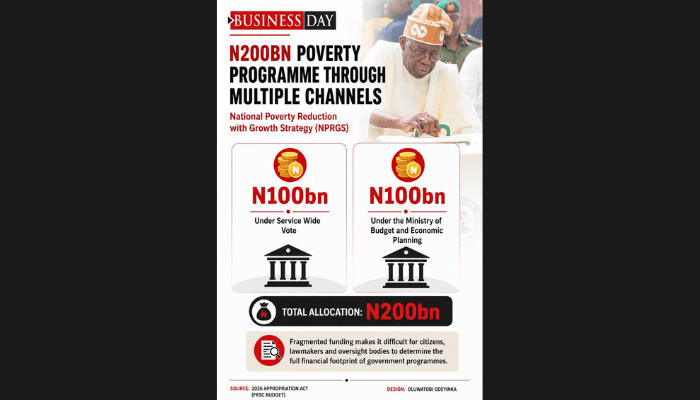
Among BusinessDay Investigation’s findings were separate allocations linked to the Office of the Special Adviser on Policy and Coordination, funding streams associated with the National Poverty Reduction with Growth Strategy under different budget channels, parallel Lagos liaison office allocations under separate government institutions and multiple budget entries linked to the Federal Road Safety Corps’ mass transit bus programme.
This paper had noted that while some of the allocations may have administrative explanations, public finance experts warned that fragmented budgeting structures can make it more difficult for citizens, auditors and lawmakers to determine the full scale of government spending.
The report cited provisions of the Fiscal Responsibility Act 2007 and the Public Procurement Act 2007, which emphasise transparency, accountability and efficient management of public resources.
Budget analysts who reviewed the findings described the practice as project fragmentation or budget atomisation, warning that excessive duplication of spending lines can complicate oversight and weaken transparency.
Prior to publication of the investigation, BusinessDay sent enquiries to the Federal Ministry of Budget and Economic Planning, the Budget Office of the Federation, the Office of the Secretary to the Government of the Federation and the Federal Road Safety Corps seeking explanations for the allocations identified in the budget.
As of the time the report was published, none of the institutions had responded to the questions raised regarding the budget provisions examined in the investigation.

Join BusinessDay whatsapp Channel, to stay up to date
Open In Whatsapp