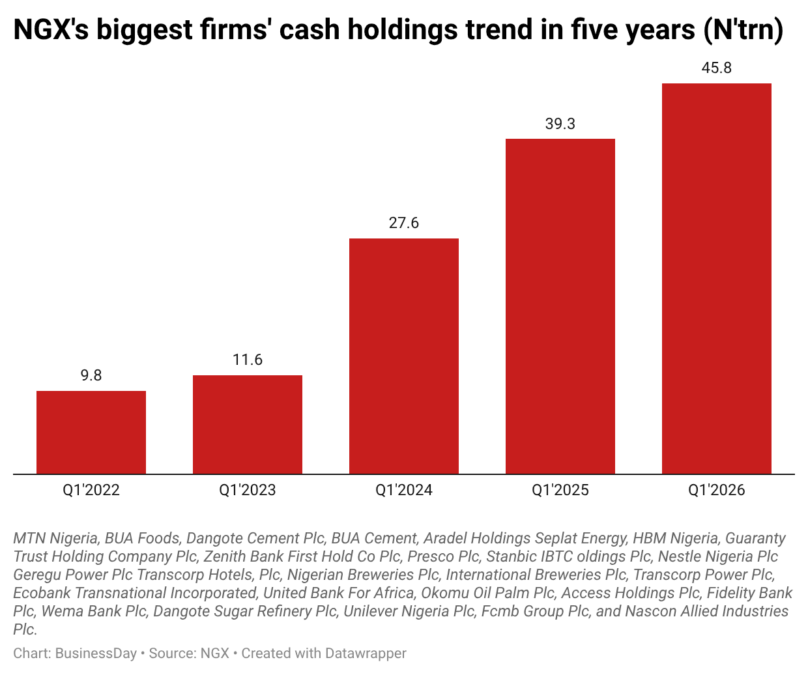
Nigeria’s biggest listed companies have been holding more cash than ever over the past five years, as high interest rates, inflation, foreign exchange volatility, and economic uncertainty push businesses to prioritise liquidity over expansion.
An analysis of the cash and cash equivalents of 28 companies listed on the Nigerian Exchange (NGX) by BusinessDay shows that corporate cash holdings have expanded sharply by 367.3 percent to N45.8 trillion in the first quarter of 2026, from N9.79 trillion in the same period of 2022. However, when compared to Q1 ‘2025, it grew to N39.3 trillion.
While capital expenditure (CAPEX), which includes the purchase of property, plant, and equipment, grew at a much slower pace in the last five years. In Q1 2026, it rose to N1.04 trillion across the 28 firms surveyed compared to N797 billion reported in the same period of 2025.
The firms surveyed include MTN Nigeria, BUA Foods, Dangote Cement Plc, BUA Cement, Aradel Holdings, Seplat Energy, HBM Nigeria, Guaranty Trust Holding Company Plc, Zenith Bank, First Hold Co Plc, Presco Plc, Stanbic IBTC Holdings Plc, Nestle Nigeria Plc, Geregu Power Plc, Transcorp Hotels, Plc, Nigerian Breweries Plc, International Breweries Plc, Transcorp Power Plc, Ecobank Transnational Incorporated, United Bank For Africa, Okomu Oil Palm Plc, Access Holdings Plc, Fidelity Bank Plc, Wema Bank Plc, Dangote Sugar Refinery Plc, Unilever Nigeria Plc, FCMB Group Plc, and Nascon Allied Industries Plc
The sharp increase comes against the backdrop of one of Nigeria’s toughest macroeconomic cycles in decades. Since 2023, President Bola Tinubu’s economic reforms, including the removal of petrol subsidies, the liberalisation of the foreign exchange market, and tighter monetary policy by the Central Bank of Nigeria (CBN), have pushed interest rates and inflation to multi-year highs, forcing companies to become more defensive with liquidity.
The apex bank benchmarked its Monetary Policy Rate (MPR) at 26.5 percent to anchor inflation expectations, curb rising consumer prices, and defend the value of the naira.
At the same time, Nigeria’s inflation rate stood at 15.93 percent in May 2026, rising from 15.60 percent reported in April as a result of price pressure from the increase in food prices during the period.
Despite macroeconomic pressure, the economy expanded by 3.89 percent in the first quarter of 2026, according to the National Bureau of Statistics (NBS).
Read also: Africa’s 43 mllion displaced population generates $27bn annually – report
Although inflation has moderated from last year’s peak, financing costs remain elevated, prompting corporates to preserve liquidity, delay expansion plans, and maximise returns from short-term investments.
For banks, the surge in cash holdings also reflects stronger deposit mobilisation, higher interest income generated from elevated yields, and cash generated from the post recapitalisation programme. The banking sector accounts for the largest share of the N45.82 trillion cash balance.
Ecobank Transnational Incorporated recorded the largest cash balance in the dataset, rising from N1.59 trillion in Q1 2022 to N9.36 trillion in Q1 2026. Followed by Access Holdings, which then more than doubled its cash position from N1.2 trillion in Q1 2022 to N8.8 trillion by Q1 2026.
Guaranty Trust Holding Company also delivered one of the strongest performances, with cash balances rising from N913 billion in Q1 2022 to N5.9 billion in Q1 2026, while Fidelity Bank’s cash position expanded almost fivefold from N345 billion to N1.5 trillion over the same period.
Although Zenith Bank and First HoldCo ended Q1 2026 with lower cash balances than in Q1 2025, both institutions remain substantially more liquid than they were five years ago. Zenith Bank’s cash position rose from N1.3 trillion in Q1 2022 to N3.6 trillion in Q1 2026, while First HoldCo increased from N1.6 trillion to N3.6 trillion over the period.
United Bank for Africa similarly expanded its liquidity from N713 billion in Q1 2022 to N3.3 trillion by Q1 2026, while FCMB Group and Wema Bank more than quintupled their cash balances during the five years to N1.8 trillion and N1.07 trillion, respectively.
Outside financial services, energy companies also strengthened their liquidity positions.
Seplat Energy increased cash balances from N129 billion in Q1 2022 to N639 billion in Q1 2026, while Aradel Holdings, which became listed in 2024, reported a strong increase from N315 billion in Q1 2024 to N1.6 trillion in just two years.
Among cement manufacturers, both Dangote Cement and BUA Cement significantly strengthened their cash positions. Dangote Cement’s cash rose from N126 billion in Q1 2022 to N471 billion in Q1 2026 despite fluctuations during the period, while BUA Cement expanded its cash holdings from N84 billion to N404 billion.
HBM Nigeria, formerly Lafarge Africa, delivered one of the most notable improvements in the industrial sector, with cash increasing nearly fourfold from N38 billion in Q1 2022 to N439 billion in Q1 2026.
Consumer goods companies presented a more uneven picture.
Nigerian Breweries increased cash holdings from N23 billion to N132 billion over five years, while International Breweries more than tripled its liquidity from N62 billion to N161 billion.
Read also: Africa’s aid shock leaves governments choosing between debt and development – IMF
Unilever Nigeria almost tripled its cash balance from N61 billion to N114 billion, but Nestlé Nigeria’s cash position remained relatively flat over the period, ending Q1 2026 at N51 billion compared with N95 billion five years earlier.
BUA Foods also maintained relatively modest cash balances despite strong revenue growth, ending Q1 2026 at N30 billion compared with N27 billion in Q1 2022.
Agriculture companies strengthened their liquidity positions as well. Presco’s cash reserves increased more than fourfold from N13 billion in Q1 2022 to N136 billion in Q1 2026, while NASCON Allied Industries grew from N9 billion to N49 billion over the same period.
One of the few negative outliers was Dangote Sugar Refinery, whose cash position slipped into negative territory at -N13 billion in Q1 2026 after standing at N128 billion in Q1 2022, suggesting increased pressure on working capital and liquidity.
Since 2023, companies have faced one of the toughest operating environments in decades following the removal of petrol subsidies, exchange-rate liberalisation, soaring inflation, and sharply higher interest rates. The resulting uncertainty has made liquidity a strategic asset, enabling companies to finance operations internally, manage foreign exchange obligations, and reduce dependence on expensive bank borrowing.
The growing cash piles also position many firms to pursue acquisitions, expand capacity, or accelerate capital expenditure once macroeconomic conditions become more predictable. Until then, preserving liquidity appears to have become one of corporate Nigeria’s most important financial strategies.
Analysts view
Industry analysts say that with firms holding cash, capital expenditure growing at a slower pace signals a cautious investment approach from corporates still recovering from the shocks of currency devaluation, FX shortages, and rising interest rates earlier in the year.
“Companies are in a period of watchful waiting,” said Kemi Adedoyin, a Lagos-based investment analyst. “They are focusing on maintaining cash flow, repaying debt, and strengthening balance sheets, rather than committing to large-scale expansion projects.”
Tajudeen Ibrahim, director of research and strategy at Lagos-based investment bank Chapel Hill Denham, said companies typically embark on capital expenditure planning and spending at different periods, with some allocating more in the second half (H2) of the year.
“Some companies would have invested heavily in the past year. So, in the current year, they are either focusing on maintenance and repairs rather than growth-driven capex,” Ibrahim said.

Join BusinessDay whatsapp Channel, to stay up to date
Open In Whatsapp