Nigeria’s listed pharmaceutical companies delivered a strong performance in the first quarter of 2026 as firms navigated a challenging operating environment marked by persistent inflationary pressures, rising healthcare demand, and global tension.
While revenue growth remained strong across much of the sector, the ability to convert sales into profits and generate returns for shareholders emerged as the key differentiator among industry players.
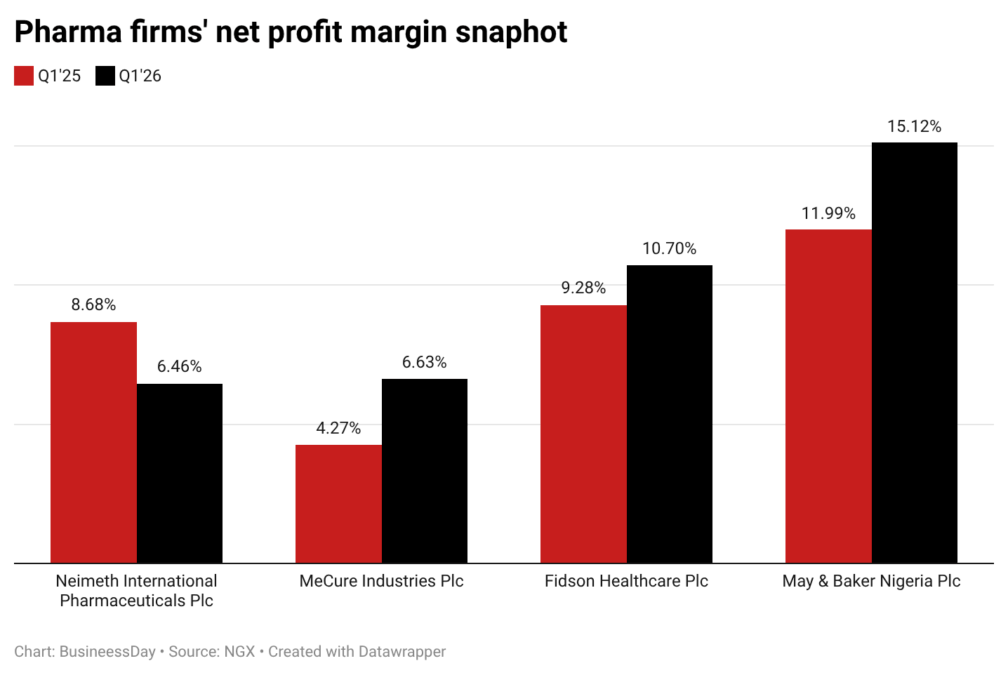
An analysis of the drugmakers’ firms listed on the Nigerian Stock Exchange, which include Fidson Healthcare Plc, MeCure Industries Plc, May & Baker Nigeria Plc, and Neimeth International Pharmaceuticals Plc, shows that their combined net profit margin rose by 9.98 percent in the first quarter of 2026, compared to 8.58 percent reported in the corresponding period of 2025.
In absolute terms, their combined profit rose to N7.2 billion in the first three months of the year, as against N5.06 billion reported in Q1 ’25. While revenue rose by 23 percent to N72.95 billion.
Profit margin is a financial ratio that measures the percentage of profit a company earns from its revenue. Expressed as a percentage, it indicates how much profit the company makes for every dollar of revenue generated.
May & Baker emerged as one of the quarter’s standout performers after increasing its net profit margin to 15.12 percent in Q1 2026 from 11.99 percent in the corresponding period of 2025. The improvement came despite revenue declining to N8.4 billion from N9.51 billion a year earlier. The company’s profit rose to N1.27 billion from N1.14 billion.
Fidson Healthcare ranked second with a net profit margin of 10.7 percent, improving from 9.28 percent in the corresponding period of 2025. Revenue grew by 21.7 percent to N42.6 billion, while net profit rose 40.3 percent to N4.56 billion.
MeCure Industries recorded the third-highest margin at 6.63 percent, up significantly from 4.27 percent a year earlier. Revenue climbed 51.9 percent to N20.2 billion, while net profit more than doubled to N1.34 billion. In contrast, Neimeth reported a decline in net profit margin of 6.46 percent, down from 8.68 percent in Q1 2025. Although revenue increased by 44.6 percent to N1.75 billion and net profit edged up to N113 million, earnings growth failed to keep pace with sales growth.
Return on Equity
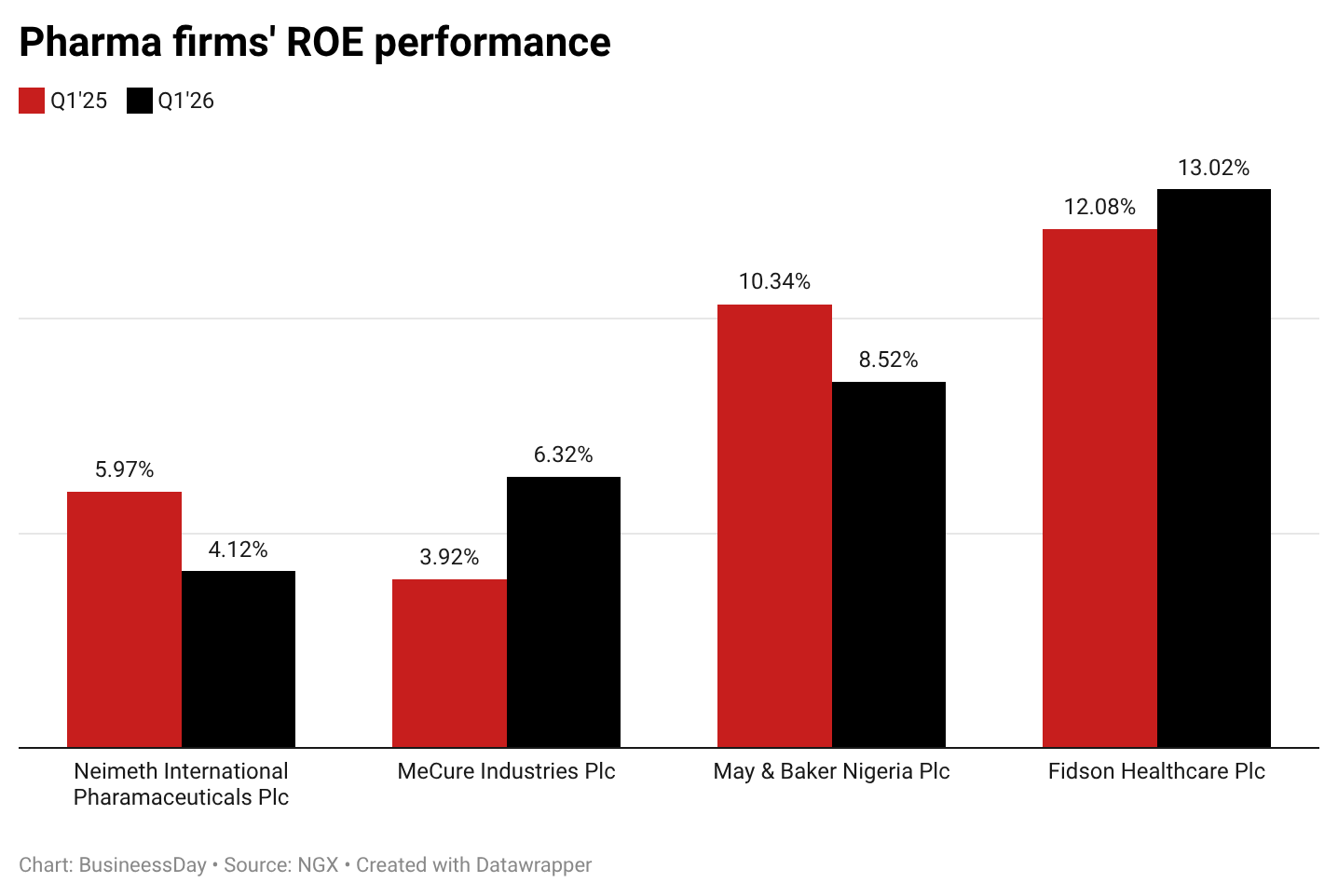
While MeCure led on profitability, Fidson Healthcare emerged as the sector’s strongest creator of shareholder value based on return on equity.
The company generated an ROE of 13.02 percent in Q1 2026, up from 12.08 percent in the corresponding period of 2025, making it the highest among the pharmaceutical firms under review.
This means that the company generates a 13.02 kobo return on every N1 of equity invested by shareholders.
May & Baker generated the second-highest ROE in the sector at 8.52 percent in Q1 2026, although this represented a decline from 10.34 percent in the corresponding period of 2025.
With profit rising, shareholders’ funds expanded to N14.9 billion from N11.03 billion. As a result, earnings growth was insufficient to maintain the previous year’s level of capital efficiency.
MeCure Industries recorded one of the strongest improvements in shareholder returns, with ROE rising to 6.32 percent from 3.92 percent.
The increase was driven by substantial profit growth, with earnings more than doubling to N1.34 billion from N568 million. Although shareholders’ funds also expanded significantly to N21.2 billion from N14.5 billion, profit growth outpaced the increase in equity.
In contrast, Neimeth recorded the weakest ROE among the pharmaceutical firms reviewed, with returns declining to 4.12 percent in Q1 2026 from 5.97 percent a year earlier.
Which firm delivered better value to the investors?
Nigeria’s pharmaceutical stocks have been among the strongest performers on the Nigerian Exchange in 2026, as investors rewarded companies that demonstrated resilience.
According to BusinessDay analysis, Fidson delivered the strongest return to investors in 2026, with its share price surging 172 percent year-to-date from N50.10 to N136.50. The rally lifted its market capitalisation to N409.5 billion, making it the largest listed pharmaceutical company among the firms reviewed.
May & Baker delivered the second-best share price performance, with its stock rising by 147 percent from N19 to N47. The stock’s remarkable appreciation suggests investors rewarded the company for improving profitability and operational efficiency rather than revenue growth alone
Neimeth’s share price gained 82.8 percent during the period, outperforming the broader market but trailing Fidson and May & Baker.
Despite the impressive fundamentals, MeCure stock returned only 45.6 percent year-to-date, the lowest among the peer group.
One explanation may be valuation. With a market capitalisation of N379.6 billion, investors may have already priced much of the company’s growth potential into the stock.
Macroeconomic headwinds continue to test the sector
The escalating conflict involving Iran, Israel, and the United States is emerging as a new threat to Nigeria’s healthcare and pharmaceutical industry, raising concerns over medicine shortages, rising production costs, and higher drug prices.
For Nigerian pharmaceutical companies, the conflict comes at a particularly difficult time. The industry is already grappling with naira volatility, high interest rates, inflationary pressures, and a heavy dependence on imported active pharmaceutical ingredients (APIs) and finished medicines.
According to a recent report by BusinessDay, the war is disrupting global shipping routes and freight networks that are critical to pharmaceutical supply chains. Industry experts warned that prolonged instability around key Middle East trade corridors could delay medicine shipments, increase freight costs, and worsen supply shortages. Nigeria imported approximately $1.14 billion worth of pharmaceutical products in 2024, with India and China accounting for more than 60 percent of supplies. Any disruption to shipping routes connecting Asia to Africa, therefore poses a direct risk to medicine availability in Nigeria.
Beyond pricing, availability is becoming a major concern.
Reports show that disruptions affecting shipping routes from Asia could directly affect supplies of antibiotics, antimalarials, insulin, antiretroviral drugs, and other critical medicines commonly used in Nigeria.
Globally, pharmaceutical companies are already rerouting shipments because of disruptions to key Middle East logistics hubs. Reuters reported that major cargo hubs such as Dubai, Abu Dhabi and Doha have faced operational disruptions, affecting the movement of temperature-sensitive medicines and increasing transit times.
For Nigerian manufacturers, delayed delivery of APIs could slow production schedules and create inventory shortages.

Join BusinessDay whatsapp Channel, to stay up to date
Open In Whatsapp