…Nigeria’s displaced population generates $300m
Africa’s 43.1 million displaced population generate an estimated $27 billion in annual income, creating one of the continent’s largest untapped investment markets despite being viewed primarily as recipients of humanitarian aid, according to a new report released by Amahoro Coalition.
The report, Hiding in Plain Sight, described itself as the first comprehensive analysis of Africa’s displacement economy as a private sector investment opportunity. It found that more than 56% of displaced Africans are economically active, earning income across agriculture, entrepreneurship, finance, manufacturing and supply chains, yet attracting little commercial investment.
The report argued that Africa’s displaced population, larger than the populations of 45 of the continent’s 54 countries, should be viewed as an economy rather than a crisis.
It found that displaced entrepreneurs fail at only one-third the rate of businesses owned by host communities, challenging long-held assumptions about the commercial risks of investing in displaced populations.
Despite the scale of the market, fewer than 10 formal financial service providers currently serve about 27 million displaced people across Africa, while 852 banks compete for mainstream consumers, highlighting a major financing gap.
The report also argued that businesses do not need to build entirely new ecosystems to enter displacement markets because infrastructure, demand and labour already exist in many displacement zones. Instead, it says the private sector can build on foundations largely supported by humanitarian and development organisations.
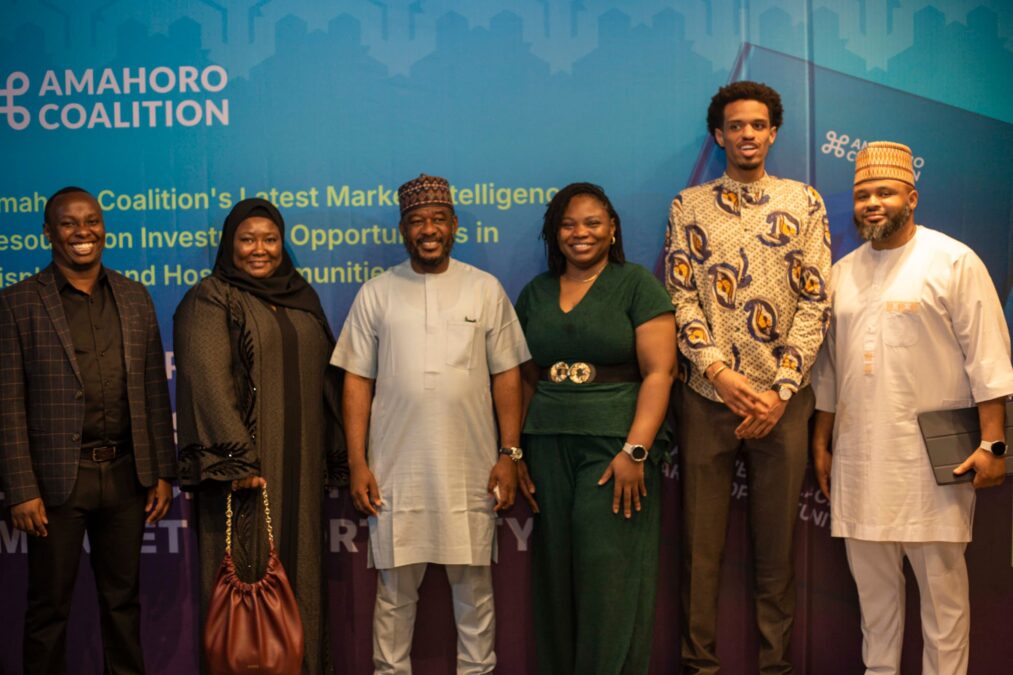
The findings were presented in Abuja on Thursday where stakeholders from the humanitarian, agricultural, financial and development sectors called for a shift from aid-driven responses towards commercially sustainable investment in internally displaced persons (IDPs) and refugees.
Speaking at the launch, Tito Mbathi, Strategy Custodian for Partnerships at Amahoro Coalition, said Nigeria’s displaced population alone generates an estimated $300 million annually, demonstrating that displacement should be viewed as an economic issue as much as a humanitarian one.
“We do not want this conversation to focus only on aid. We want to have a commercial conversation. We want to discuss investment potential and explore how the private sector can address displacement through sustainable economic participation,” Mbathi said.
Nigeria is home to about 3.7 million internally displaced persons, although estimates by the National Commission for Refugees, Migrants and Internally Displaced Persons suggest the number could be as high as seven million.
Drawing on research across agriculture, entrepreneurship, finance, manufacturing and supply chains, Mbathi said one of the biggest commercial opportunities lies in agriculture.
According to him, giving displaced people across Africa access to productive assets such as land could unlock an estimated $2.4 billion agricultural opportunity, while northern Nigeria offers one of the continent’s most attractive entry points because it combines vast agricultural potential with one of Africa’s largest concentrations of displaced populations.
He said millions of displaced farmers possess decades of farming experience but remain disconnected from formal agricultural value chains because of insecurity.
“The knowledge has not disappeared. These are experienced farmers who understand their land, crops and farming systems. The opportunity is to support them in applying this knowledge while introducing improved technologies that increase productivity,” he said.
Mbathi said businesses could tap into the market through outgrower schemes, integrating displaced farmers into existing off-taker networks and employing displaced community members as extension workers and field agents in difficult-to-reach locations.
Frederick Degbe, Amahoro Coalition’s Lead for Private Sector Partnerships in West Africa, said the organisation works with businesses to identify commercially viable ways of integrating displaced populations into existing operations rather than relying on charity.
“We work with businesses that are already growing. We look at how displaced persons can become part of their expansion plans, supply chains and operations. The goal is sustainability, not dependency,” he said.
Degbe identified agriculture, digital skills and renewable energy as sectors capable of creating jobs and financing opportunities for displaced communities.
“Where people see crisis, we see opportunity. If you have a phone and internet access today, you can work. There are opportunities in agriculture, digital services and clean energy that can transform lives,” he added.
Kabiru Ibrahim, Former President of the All Farmers Association of Nigeria, said he was initially sceptical about viewing displacement through an economic lens but had become convinced after engaging with stakeholders.
“Many people are displaced because of insecurity, and at first glance it may be difficult to see how this creates opportunities. But there are opportunities in adversity. If we harness them properly, the country will be better for it,” he said.
He cited estimates showing that agricultural opportunities linked to displaced populations could exceed $2.4 billion across Africa and urged young entrepreneurs to develop innovative business models that transform humanitarian challenges into economic opportunities.
Also speaking, Chairman of AgroLog Ltd, Manzo Maigari, said agribusinesses must adapt to the realities of displacement, particularly as insecurity continues to disrupt rural farming communities that underpin Nigeria’s food production.
He cited a livelihood restoration programme in Benue State that provided female piglets and extension services to 5,000 internally displaced families.
“Within 12 months, there was no family that did not earn up to N2 million from that intervention. It showed that restoring livelihoods is possible when people are given productive assets and support,” he said.

Join BusinessDay whatsapp Channel, to stay up to date
Open In Whatsapp