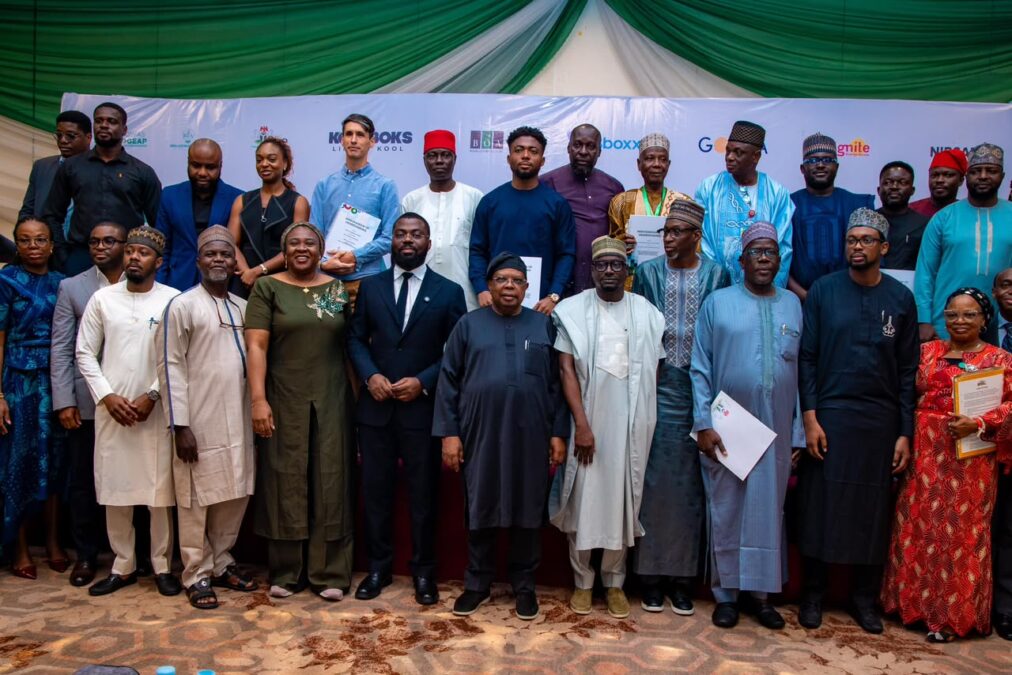
The Rural Electrification Agency (REA), has partnered the ECOWAS Commission through the Regional Off-Grid Electricity Access Project (ROGEAP), to accelerate the deployment of energy-efficient, productive-use technologies across regional agricultural chains.
Aimed at modernizing traditional farming and boosting crop yields, the partnership seeks to promote clean-energy solutions in Nigerian farming system, to insulate food production from high diesel costs, cut post-harvest losses, and fortify Nigeria’s food security.
Speaking at the National stakeholders workshop in Abuja on Thursday, Joseph Tegbe, Nigeria’s Minister of power, said that the Productive Use of Energy agenda deserves a collective attention, as it sits at the intersection of energy, agriculture, industrialisation, financial inclusion, climate resilience, food security, rural development and job creation.
He decried that even though Nigeria possesses one of Africa’s largest
agricultural economies, industrious farmers are industrious and fertile land is fertile, yet far too much agricultural value is still lost between harvest and market due to
challenges that transcend agricultural into energy challenges.
“We lose crops because there is insufficient cold storage. We lose income because processing capacity remains inadequate. We lose jobs because raw produce leaves our farms without value addition. We lose competitiveness because production costs remain unnecessarily high. We lose
opportunities because energy-intensive productive equipment remains beyond the reach of many rural enterprises.
“These are exactly the challenges that Productive Use of Energy seeks to solve. The business case is compelling. For farmers, energy-efficient equipment means lower operating costs, increased productivity and higher incomes. For financial institutions, it creates a new class of bankable productive assets capable of generating predictable cash flows.
“For equipment manufacturers, it opens an expanding domestic market driven by
genuine demand. For technology providers, it creates opportunities for innovation,
localisation and after-sales services. For Government (at both state and federal levels), it stimulates local economic development, expands internally generated revenue, creates employment, improves food security, reduces post-harvest losses, strengthens rural economies and advances our commitments to sustainable development.”
Tegbe emphasized that at its core, the true success of electrification lies in its ability to drive meaningful impact, and empowering businesses, agro-processing activities.
In his remarks, Abba Aliyu, managing director, REA, called for an end to isolated, siloed government projects. He argued that while individual agencies have historically designed separate agricultural and energy interventions, a unified ecosystem is the only way to achieve sustainable, long-term food security and maximize public funds.
Aliyu clarified that historically government, agencies designed parallel agricultural intervention projects within their own scopes of control, pointing out that this fragmented approach fails to yield optimal economic efficiency.
“Inasmuch as these projects may deliver the desired result, when different government agencies working within a specific sector align their project designs, we optimize the utilization of public funds,” Aliyu explained. “We end up creating a much more viable, workable system that outlives the project design.”
The REA boss emphasized that Nigeria’s rural economy is vast but highly fragmented. He noted that while individual smallholders may seem insignificant on their own, their aggregated output forms the bedrock of the national food system.
“When you look at the farmers individually, each appears too small to impact a national food system. But when you aggregate their output across thousands of communities, across 36 states, you realize that is the foundation of Nigeria’s food security,” Aliyu said. “They are not the marginal story of Nigeria’s food system—they are the main story.”
He also expressed deep appreciation to the Economic Community of West African States (ECOWAS) for its continuous collaboration and funding support, noting that the regional body is currently partnering with the REA on two major development programs.
“We are here to build an ecosystem,” Aliyu said. “To build a system that will align our specific strengths and address our individual weaknesses.”
Also speaking, El hadji Sylla, Coordinator of ROGEAP, said that the strategic importance of energy in achieving sustainable development and reducing poverty in sub-Saharan Africa is universally acknowledged.
He explained that renewable energy, and in particular solar photovoltaic technology, stands as one of the principal solutions for achieving universal energy access. He added that true regional transformation requires must move beyond simple illumination to ensure that energy is put to work directly as an engine for wealth
creation, local processing, and enterprise growth within our off-grid communities.
“We gather here at a critical juncture for our sub-region’s economic integration and
development. Insufficient electricity supply and poor access remain among the
most significant barriers to socio-economic progress and poverty reduction across
the ECOWAS region.
“In response, the ECOWAS Commission has placed access to modern, sustainable
energy services at the very top of our regional priorities. Through the Regional Off-Grid Electricity Access Project (ROGEAP), our objective is to assist Member States in establishing an enabling framework for a vibrant, harmonised off-grid solar market.

Join BusinessDay whatsapp Channel, to stay up to date
Open In Whatsapp