…Why Africa should care
The resignation of British Prime Minister Keir Starmer adds another chapter to a period of unprecedented political churn in the United Kingdom, a country once known for stable leadership and predictable policymaking.
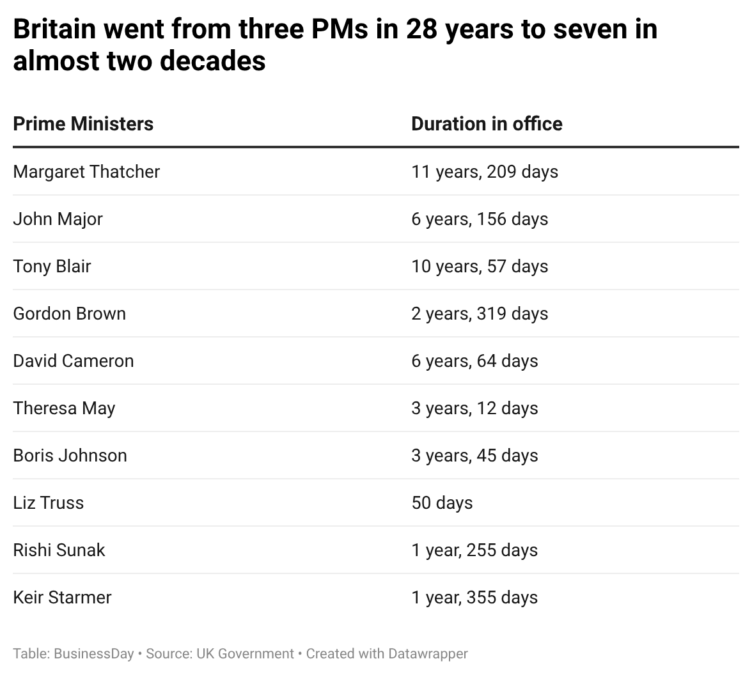
Starmer’s departure means Britain is set to have its eighth prime minister in nearly two decades, compared with just three leaders who governed during the 28 years between 1979 and 2007. The contrast highlights how dramatically Britain’s political landscape has changed since the Brexit era began.
For Africa, the implications extend far beyond Westminster. Britain remains a major source of investment, trade, development finance and institutional capital across the continent, making political stability in London an important consideration for governments, businesses and investors alike.
The significance is particularly pronounced for countries such as Nigeria, South Africa, and Egypt, which rank among Britain’s most important economic and diplomatic partners on the continent. The UK remains a major destination for African students, migrants, and investment. At the same time, British companies continue to wield considerable influence in sectors ranging from finance and energy to consumer goods, infrastructure and professional services.
Yet analysts say Africa should not expect major changes in Britain’s engagement with the continent despite another leadership transition.
“African countries with close historical and economic ties to the UK, such as Nigeria and South Africa, are already accustomed to changes in British leadership,” said Ikemesit Effiong, managing partner at SBM Intelligence. “While the frequency of prime ministerial changes may create a sense of instability, the substance of British foreign policy toward Africa has remained remarkably consistent under both Conservative and Labour governments.”
Temitope Omosuyi, head of Research and Strategy at VNL Capital Asset Management, agrees.
“Policy commitments in the UK are driven largely by the governing party, Parliament and key institutions rather than by one individual leader,” he said. “Since the governing party remains in power until the next general election, I would not expect a drastic shift in overall policy direction simply because of a change in leadership.”
Brexit and the end of Britain’s political certainty
The common thread running through almost every leadership change since 2016 is Brexit.
The referendum was intended to settle Britain’s relationship with Europe and restore political certainty. Instead, it triggered a decade of political upheaval whose effects are still being felt today.
David Cameron resigned after losing the Brexit referendum he had called. Theresa May struggled to secure parliamentary backing for her Brexit deal and was eventually forced out. Boris Johnson’s government was engulfed by scandals. Liz Truss lasted only 50 days after financial markets reacted negatively to her economic plans. Rishi Sunak inherited a divided Conservative Party and lost the 2024 election, while Starmer’s resignation comes less than two years after Labour’s landslide victory.
The result has been an extraordinary turnover of leaders in a political system once regarded as one of the world’s most stable.
From 1979 to 2007, Britain had only three prime ministers: Margaret Thatcher, John Major, and Tony Blair. Since then, the country has cycled through leaders at a pace more commonly associated with coalition governments elsewhere in Europe.
“The period since 2010 has been very different,” Tony McNulty, lecturer in British Politics and Public Policy at Queen Mary University of London, wrote recently in an article.
“The UK system that was famed for having the stability of government at its core suddenly started shedding prime ministers like winter coats in the height of summer.”
For Effiong, the more important question is not who replaces Starmer but whether Britain can restore the perception of political stability it once enjoyed.
“Brexit marked a turning point,” he said. “The political and economic disruption that followed has reshaped perceptions of the UK from a model of stability to a country grappling with many of the same political pressures affecting other advanced democracies.”
Why Africa should pay attention
Britain’s relationship with Africa has evolved significantly over the past decade.
Successive UK governments have sought to reduce reliance on traditional aid programmes while deepening ties through trade, investment, climate cooperation, and security partnerships. Key economies such as Nigeria, South Africa, and Kenya have become central to Britain’s post-Brexit strategy to expand its global economic footprint.
However, the data show that Africa’s relative importance within Britain’s economic relationships has declined despite these efforts.
According to ODI Global, UK trade in services with Africa doubled over the last three years, reaching £6.1 billion in the first quarter of 2025. Yet Africa’s share of total UK trade fell from 3.1 percent in 2016 to 2.9 percent in 2025.
The same trend is visible in investment flows. The stock of UK foreign direct investment in Africa increased from £42.7 billion to £49.6 billion between 2013 and 2023. But Africa’s share of total UK overseas investment declined from 4 percent to 2.6 percent during the period.
The figures reveal that while commercial ties continue to grow in absolute terms, the continent is becoming relatively less important within Britain’s global investment portfolio.
“Africa’s perspective is unlikely to change much,” Effiong said. “Like many Western European countries, the UK is increasingly focused on domestic priorities while maintaining its historic relationships abroad. There is unlikely to be any major shift in policy or engagement.”
What the leadership churn means for investors
For investors, Britain’s rapid turnover of leaders creates political headlines but not necessarily policy upheaval.
Omosuyi noted that while a new prime minister may alter the tone, pace, and emphasis of policy implementation, the broader direction of economic policy is unlikely to change significantly.
“The UK system is built around institutions, parliamentary accountability and party policy, not a single individual,” he said. “Leadership changes can affect confidence and execution, but they do not usually lead to major policy reversals without a broader political mandate.”
That institutional continuity helps explain why financial markets have generally remained resilient through successive leadership transitions. Investors are typically more concerned about fiscal credibility, economic growth and inflation than the identity of the occupant of Number 10 Downing Street.
However, Britain’s political instability comes at a time when the country faces significant economic challenges.
Jennifer Oyelade, an international recruitment business leader based in the UK, said the country’s deeper problem is the widening gap between political promises and economic realities.
“The UK economy is built around households facing constant financial pressure,” she said. “People are dealing with mortgages, rent, food costs, childcare, and the rising cost of living. Policy decisions have an immediate impact on people’s lives.”
According to Oyelade, the challenge for any prime minister is balancing competing demands from taxpayers, pensioners, businesses and those who depend on public services.
“The question is who your policies are designed to serve and how you balance those competing interests fairly,” she said.
Britain’s economic difficulties did not begin with Brexit, but the country’s departure from the European Union coincided with a series of major shocks. The Covid-19 pandemic strained public finances, Russia’s invasion of Ukraine fuelled inflation and energy costs, while recent tensions in the Middle East have added further uncertainty to global markets.
Together, these pressures have left governments struggling to improve living standards and restore confidence in the economy.
Britain remains a global leader in sectors such as financial services, technology, artificial intelligence and life sciences. Yet economic growth remains subdued, public debt is elevated, and productivity growth continues to lag behind many of its peers.
For investors, the key question is no longer who becomes Britain’s next prime minister, but whether future governments can deliver sustained economic growth and restore confidence in the country’s long-term direction.
A symptom, not the cause
Britain’s political volatility is not occurring in isolation. Across advanced economies, governments are facing rising voter frustration over living costs, immigration, economic stagnation and declining trust in public institutions.
But Britain’s experience stands out because of how quickly its reputation for political stability has eroded.
For decades, the country projected itself as a model of effective governance, strong institutions and predictable policymaking. Today, it increasingly resembles other advanced democracies grappling with political fragmentation and economic uncertainty.
“The UK was once viewed as a highly influential middle power that exercised outsized influence through its soft power, diplomacy and economic strength,” Effiong said.
“But it is no longer seen as the uniquely stable force it once was.”
The country remains an important economic and diplomatic partner for Africa, and few analysts expect another change in leadership to fundamentally alter that relationship. Trade, investment and security cooperation are likely to continue regardless of who occupies Downing Street.
What has changed is the perception of Britain itself.
“The UK used to help shape reality,” Effiong said. “Now it is increasingly a place where reality happens.”
That may be the most important lesson from Britain’s extraordinary turnover of prime ministers. The leadership changes are not the cause of the country’s challenges. They are a symptom of a nation still searching for its place in a rapidly changing world.

Join BusinessDay whatsapp Channel, to stay up to date
Open In Whatsapp