Since the return of democracy in 1999, dozens of former governors across Nigeria have moved from Government House to the Senate in what many describe as a political retirement pathway. But Lagos has remained a notable exception, as none of its civilian governors has been allowed to retire to the Senate. SODIQ OJUROUNGBE writes
In several states across Nigeria, the transition of former governors to the Nigerian Senate has become almost routine. For many ex-governors, the Senate offers a way to remain politically relevant, retain influence and stay close to power after completing their tenure.
Few politicians illustrate that trend better than Danjuma Goje.
After serving two terms as governor of Gombe State, Goje won election to represent Gombe Central in the Senate in 2011, relying on the political structure and influence he built while in office.
Twelve years later, he was still in the Red Chamber, surviving changes in administration, shifting alliances and multiple election cycles before facing resistance within his party ahead of the 2027 elections.
In Ogun State, the same pattern is already playing out ahead of the 2027 general elections.
For months, Ogun State governor, Dapo Abiodun, and former governor, Gbenga Daniel, once political allies, moved aggressively against each other over who would clinch the All Progressives Congress Ogun East senatorial ticket ahead of the 2027 elections.
Daniel, already representing Ogun East in the Senate, wanted another term in the Red Chamber. But Abiodun was determined to install himself as the preferred candidate and tighten his grip on the state’s political structure before leaving office.
The struggle reflects a broader political culture across Nigeria where former governors routinely see the Senate as the next destination after leaving office. But in Lagos, the path from Government House to the National Assembly has been far less common.
Senate as political soft landing
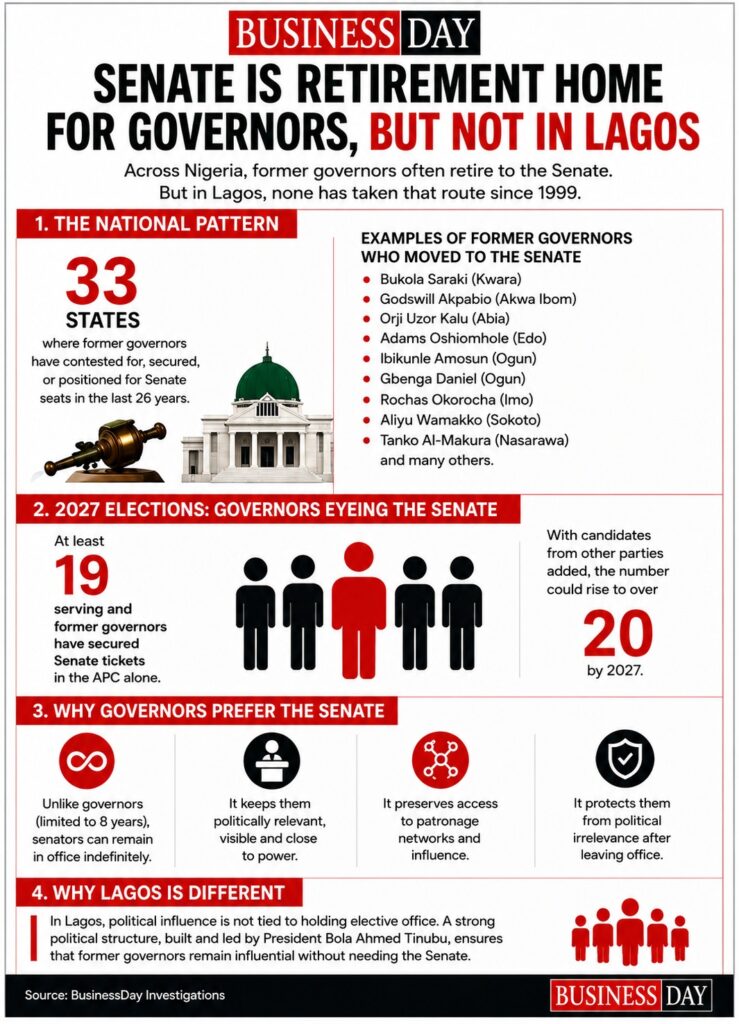
BusinessDay analysis showed that in about 33 states, former governors have either contested for Senate seats, secured party tickets, or openly positioned themselves for the Red Chamber at different times over the last 26 years.
While many succeeded, some were stopped by internal party battles, electoral defeats, or shifting political alliances.
Former governors such as Bukola Saraki(Kwara),Godswill Akpabio(Akwa Ibom), Orji Uzor Kalu(Abia), Adams Oshiomhole(Edo), Ibikunle Amosunand Gbenga Daniel(Ogun), Rochas Okorocha(Imo), Aliyu Wamakko (Sokoto), and Tanko Al-Makura(Nasarawa) all moved from Government House to the Senate.
Even governors who failed still made attempts.
Former Abia governor Theodore Orji successfully became a senator, but his successor, Okezie Ikpeazu, lost his senatorial bid in 2023 to Enyinnaya Abaribe.
In Delta, former governor Ifeanyi Okowa recently clinched the APC ticket for the Delta North Senatorial District l, after defeating businessman and politician Ned Nwoko.
In Kano, former governor Ibrahim Shekarau moved to the Senate after leaving office, while former governor Abdullahi Ganduje was widely reported to be considering a senatorial bid before becoming national chairman of the APC.
BusinessDay observed that this pattern cuts across regions and political parties.
In some states, outgoing governors practically handpick themselves for Senate seats before leaving office. In others, fierce political wars break out between sitting governors, former governors, and longtime loyalists over who controls the ticket.
This reality has reinforced a growing public perception of the Senate as a political retirement home for governors.
Lagos exception
While former governors across most states continue to view the Senate as a natural next destination after office, Lagos has remained a notable exception.
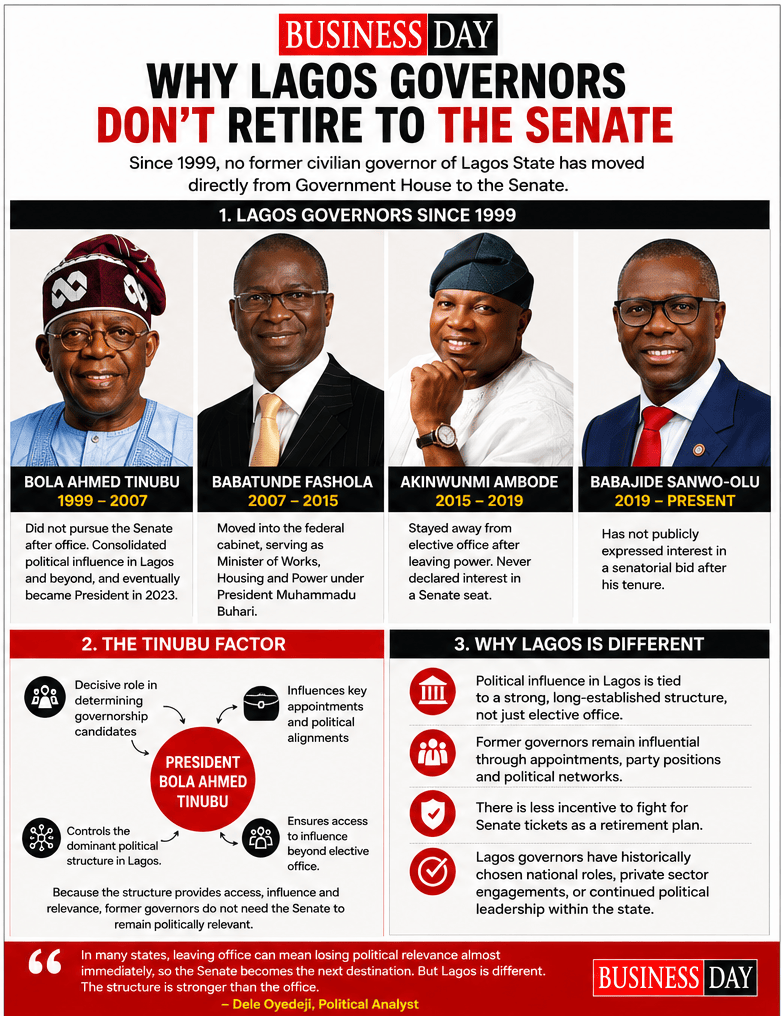
Since 1999, no former civilian governor of Lagos State has ever transitioned from Government House to the Senate immediately after leaving office.
Instead, former governors have either moved into national appointments or remained influential through the state’s political structure.
Though a Senator before he emerged as Lagos State governor, Bola Ahmed Tinubu never pursued the Senate after leaving office in 2007. Rather than seeking elective office, he consolidated his hold on Lagos politics, expanded his influence nationally, and eventually emerged as President of Nigeria in 2023.
He has remained the only Lagos State governor who was ever a member of the Nigerian Senate.
His successor, Babatunde Fashola, moved into the federal cabinet, where he served as Minister of Works, Housing and Power under former President Muhammadu Buhari.
Akinwunmi Ambode also stayed away from elective office after leaving power in 2019 despite periodic speculation about a political comeback.
Even incumbent governor Babajide Sanwo-Olu has not publicly indicated any interest in a senatorial bid after his tenure.
Over 20 governors, ex-governors currently eying the Senate in 2027
Findings by BusinessDay showed that the scale of the country’s governor-to-Senate culture is perhaps clearest in the build-up to the 2027 elections.
An analysis of published APC senatorial candidates for 2027 by this paper showed that at least seven serving governors and 12 former governors secured senatorial tickets within the ruling party alone.
This means that no fewer than 19 current and former governors are already on the ballot for the Senate under just one political party.
BusinessDay observed that when candidates from other parties, such as the PDP, African Democratic Congress (ADC), and Nigeria Democratic Congress (NDC), are added, the number of current and former governors contesting Senate seats ahead of 2027 could rise to over 20.
From Ogun to Imo, Nasarawa to Gombe, governors leaving office are increasingly moving almost directly to the Red Chamber, while former governors continue to battle fiercely to retain their seats.
This paper observed that in several states, senatorial contests have become extensions of governorship politics, with outgoing governors seeking to preserve influence, maintain control of party structures, and remain politically visible after leaving office.
Why governors prefer the Senate
Political experts have long linked the post-office behaviour of African politicians to the desire to preserve influence, elite networks, and access to power after leaving office.
A study published in the Journal of Governance and Development found that Nigerian political elites rarely exit the power circle completely but instead circulate from one office to another to retain relevance and influence.
Another study published by SAGE Open argued that Nigeria’s political class has developed an interconnected power structure that allows the same elites to continuously reproduce themselves across different political offices and institutions.
The study also noted that political offices in Nigeria are closely tied to patronage networks, state resources, and political protection, making it difficult for many politicians to completely withdraw from power.
A separate study in Party Politics found that Nigerian politicians often remain within the political system because their careers, influence, and networks are deeply connected to party structures and access to state power.
For many former governors, the Senate naturally fits into that structure.
BusinessDay observed that, unlike governors who are constitutionally limited to two terms, senators can remain in office for decades while retaining national relevance, media visibility, and influence within party structures.
Political experts and lawyers stressed that the reality partly explains why Senate contests involving former governors are often among the fiercest political battles in many states.
Constitutional lawyer Liborous Oshoma said the fear of becoming politically irrelevant largely drives many former governors toward the Senate.
Speaking with our correspondent, Oshoma described the Senate as a fallback plan for many governors.
He stated that, unlike governors who are limited to eight years, senators can remain there indefinitely. And after being a governor, many politicians do not want to step down politically.
He added, “In Nigeria’s political landscape, governors often wield enormous influence, effectively controlling party structures at the state level. However, once they leave office, many become politically irrelevant unless they remain close to the centres of power. This is why many outgoing governors seek seats in the Senate, to retain political relevance, preserve their influence, and maintain a foothold in the power structure.”
Why Lagos is different
Political analysts said Lagos differs from most states because political relevance is not necessarily tied to holding elective office.
Instead, influence is largely exercised through the political structure built and maintained by Tinubu over the last two decades.
Unlike many governors across the country who seek Senate seats to preserve relevance after office, Lagos governors often remain politically protected within the state’s dominant power network.
BusinessDay findings showed that political succession in Lagos has historically been heavily influenced by Tinubu, who has played a decisive role in determining who becomes governor, who gets key appointments, and who occupies strategic political positions.
As a result, former governors do not necessarily need Senate seats to remain politically relevant.
Dele Oyedeji, a political analyst, said Lagos operates differently because political influence is concentrated within a long-established structure rather than individual offices.
According to him, many former governors in other states need the Senate to remain relevant because their influence is tied directly to holding office.
Also speaking, Oshoma argued that political succession in Lagos is largely determined by President Tinubu rather than by governors themselves.
According to the constitutional lawyer, individuals do not become governors in Lagos because they control political structures, but because they are selected and elevated by influential political forces led by Tinubu.
He noted that even a governor’s tenure is shaped by the former Lagos governor’s influence and the need to accommodate numerous party loyalists and stakeholders seeking elective and appointive positions.
“In Lagos, you don’t become a governor because you control any structure; you become governor because you have been called and elevated. Even when you are elevated, your stay in Government House is determined by one person because many other people are waiting to take that position,” Oshoma said.
He added that Tinubu, as the dominant figure in Lagos politics, often has to balance competing interests by ensuring that political actors who cannot occupy the governorship are accommodated through appointments to the Senate, House of Representatives and other public offices.

Join BusinessDay whatsapp Channel, to stay up to date
Open In Whatsapp