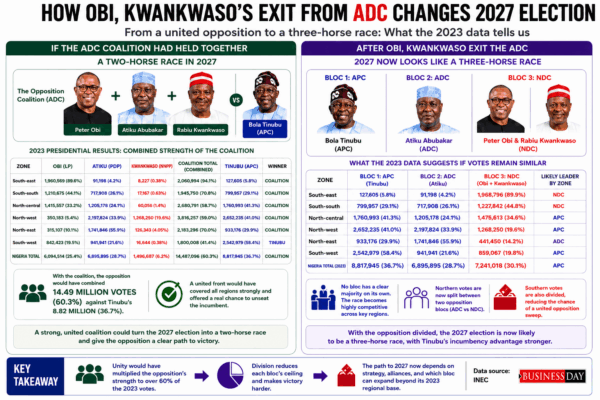
The decision by ex-governors Peter Obi and Rabiu Kwankwaso to dump the African Democratic Congress (ADC) coalition and align with the Nigeria Democratic Congress (NDC) may have fundamentally altered the trajectory of the 2027 presidential election.
What had appeared to be a potentially formidable united opposition front against President Bola Tinubu is now increasingly evolving into a fragmented three-way contest involving Tinubu, former Vice President Atiku Abubakar, and the Obi-Kwankwaso bloc.
The implications become clearer when the regional voting patterns from the 2023 presidential election are examined.
The coalition arithmetic that could have threatened Tinubu
The ADC coalition initially brought together the three biggest opposition vote blocs from the 2023 election: Atiku’s dominance in the North-east, Obi’s overwhelming strength in the South-east and strong urban youth support and Kwankwaso’s Kano-centred Northern base.
Combined, the opposition leaders hoped to recreate a broad anti-incumbent coalition capable of overcoming Tinubu’s entrenched South-west machinery and APC incumbency advantage.
But the alliance was always vulnerable to one unresolved issue: who gets the presidential ticket.
Obi’s supporters viewed him as the strongest challenger after his performance in 2023, while Atiku’s camp insisted the former vice president remained the most nationally competitive opposition figure. That disagreement has now ruptured the coalition.
Obi’s regional dominance remains unmatched in the South East
The 2023 results show Obi’s extraordinary hold on the South-east. In the zone, Obi secured 1.96 million votes, representing 89.6 percent of total ballots cast. Tinubu managed just 127,605 votes, while Atiku received 119,842.
That level of regional dominance remains unmatched by any candidate in any zone during the election.
Obi also led in the South-south with 1.21 million votes (44.1 percent), ahead of Atiku’s 779,908 and Tinubu’s 799,957. Combined, Obi secured more than 3.17 million votes from the South-east and South-south alone.
That southern base gives any platform he joins immediate national relevance.
Kwankwaso’s Kano factor remains strategic
Although Rabiu Kwankwaso finished a distant fourth nationally in 2023, his electoral value lies in Kano, Nigeria’s second-largest voting state.
Kwankwaso won over 1.26 million votes in the North-west, despite competing against both Tinubu and Atiku in a heavily contested region.
Most of those votes came from Kano, where his Kwankwasiyya movement remains deeply entrenched.
For Obi, the partnership with Kwankwaso potentially solves one of the biggest weaknesses of his 2023 candidacy: limited penetration into core Northern Muslim voting blocs.
Tinubu remains strongest in the South West and competitive nationwide
Tinubu’s 2023 victory was built on regional dominance in the South West and broad competitiveness elsewhere.
He secured: 2.54 million votes in the South West (58.4 percent), 2.65 million votes in the North West and 1.76 million votes in the North Central.
Unlike Obi, whose support was regionally concentrated, or Kwankwaso, whose strength was heavily localised, Tinubu maintained competitive numbers across nearly all zones.
That nationwide spread remains one of the APC’s strongest structural advantages heading into 2027.
Atiku’s biggest challenge is opposition fragmentation
Atiku’s political strength remains concentrated in the North East, where he polled 1.74 million votes, representing 55.9 percent of ballots cast in the zone.
However, the collapse of opposition unity may hurt him more than any other contender.
The original coalition offered Atiku access to Obi’s Southern urban base and Kwankwaso’s Kano machinery. Without both men, his electoral map narrows considerably.
This is particularly critical because Atiku already suffered substantial vote erosion in 2023 compared to previous election cycles, especially in the South.
If Obi and Kwankwaso consolidate under the NDC, they could split anti-Tinubu votes in ways that make an APC victory easier, even without dramatic improvements in Tinubu’s raw vote totals.
Why the race may now become three-horse instead of two-horse

Before the coalition collapse, the 2027 election was shaping into a classic two-bloc contest: APC versus a united opposition coalition.
Now, three major power centres are emerging: APC/Tinubu, Atiku and remnants of the ADC coalition and Obi-Kwankwaso alliance under the NDC.
That fragmentation significantly changes electoral calculations.
In Nigeria’s presidential system, victory depends not only on total votes but also on spread across states and geopolitical zones. A divided opposition could once again allow the APC to win pluralities across multiple battleground states without necessarily dominating nationally.
The North becomes the decisive battlefield again
The emerging configuration suggests the North may once again determine the election outcome.
Obi remains strongest in the South-east and urban youth demographics, but his path to victory still requires major Northern inroads.
Kwankwaso improves that equation, but questions remain whether the NDC can expand beyond Kano and parts of the North West.
Atiku, meanwhile, still commands substantial loyalty in the North East and sections of the North West.
The result could be a split Northern opposition vote between Atiku and the Obi-Kwankwaso alliance, a scenario likely to favour Tinubu.
The biggest winner so far may be Tinubu
Politically, the fragmentation of the opposition may represent an early strategic advantage for the APC.
In 2023, Tinubu won with 8.79 million votes despite facing three major opposition candidates simultaneously.
“A unified opposition in 2027 could have posed a much more dangerous threat,” Abiola Olajide, a political scientist, said. “Instead, the collapse of the ADC coalition may recreate the same fractured opposition landscape that helped Tinubu prevail in the last election.”
Unless one opposition bloc eventually collapses into another, the 2027 election is increasingly looking less like a referendum on APC rule and more like another battle among competing opposition power centres.

Join BusinessDay whatsapp Channel, to stay up to date
Open In Whatsapp