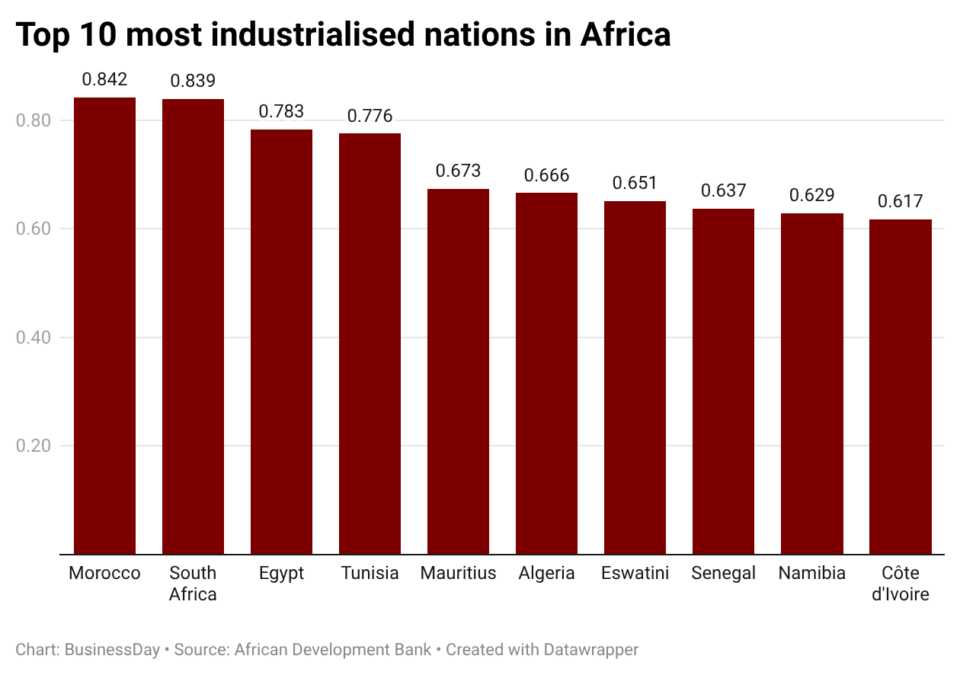
Morocco has overtaken South Africa as Africa’s leading industrial economy for the first time in 15 years, driven by aggressive state-backed industrial policies, rising manufacturing exports, large-scale infrastructure investments, and stronger economic diversification.
According to the African Development Bank’s (AfDB) 2025 Africa Industrialisation Index (AII), Morocco emerged as the continent’s top-ranked industrial economy in 2024, edging past South Africa, whose industrial competitiveness has steadily weakened over the past decade.
The AfDB report, which assesses industrial performance using 19 indicators ranging from manufacturing capacity and export diversification to governance and labour conditions, said Morocco’s rise reflects “sustained industrial upgrading, export diversification, and effective implementation of strategic industrial policies.”
“Morocco surpasses South Africa to emerge as the highest-ranked industrial economy in Africa over the coverage period,” the report added.
Morocco’s industrial transformation
Morocco’s industrial rise has been more than two decades in the making.
Since launching its industrial emergence strategy in 2005, the North African nation has pursued an export-led manufacturing model aimed at positioning the kingdom as a gateway between Europe, Africa and the Middle East.
According to The Africa Report, Morocco’s sectoral strategies have helped create globally competitive industries that now drive much of the country’s industrial output. Over the past 20 years, aerospace has emerged as a key pillar of the kingdom’s industrialisation plans, attracting more than 150 companies, including Boeing, Airbus, Safran and Thales.
The country’s industrial sector now contributes more than a quarter of GDP, one of the highest manufacturing shares on the continent, while Morocco’s broader economy — estimated at almost $200 billion — has maintained relatively stable GDP growth averaging between 3 and 4 percent over the past decade despite global economic shocks.
The Arab nation’s rise follows more than 15 years of industrial policy backed by heavy public investment and expanding economic engagement across Africa, according to The North Africa Journal, an English-language publication focused on North Africa.
Long associated with phosphates and agriculture, Morocco has expanded into higher-value industries including automotive manufacturing, aerospace, electronics and renewable energy.
The automotive sector has become the country’s largest export industry. Nearly one million vehicles were produced in 2025, compared with 535,000 in 2023 and 465,000 in 2022, according to industry data. Automotive exports to the European Union reached €15.1 billion in 2023, placing Morocco ahead of China and Japan in export value to the bloc for certain vehicle categories.
Global manufacturers, including Renault and Stellantis, have expanded production in Morocco, supported by industrial zones around Tangier and Kenitra.
The aerospace industry has also become a major pillar of industrial growth, generating more than $2.5 billion in export revenues in 2024. More than 150 companies now operate across Casablanca, Tangier and Nouaceur, reinforcing Morocco’s ambition to become a regional industrial and logistics hub.
Infrastructure fuels industrial growth
Morocco’s industrial expansion has been underpinned by large-scale infrastructure investments unmatched in much of Africa.
Key projects include the Al Boraq high-speed rail line linking Tangier and Casablanca, the expansion of Tanger Med port, the Nador West Med complex, plans for the Atlantic port of Dakhla, and the continued expansion of Casablanca’s Mohammed V Airport.
Tanger Med has become one of Africa’s largest and most efficient ports, helping Morocco strengthen supply chains and improve export competitiveness to Europe and global markets.
The country has also aggressively invested in renewable energy, particularly solar and wind power, as part of efforts to lower industrial energy costs and reduce dependence on imported fuel.
Morocco’s updated Investment Charter, which came into effect in 2023, further strengthened investor confidence through expanded tax incentives, simplified administrative procedures and stronger support mechanisms for foreign investors.
South Africa’s industrial decline
While South Africa remains one of Africa’s largest manufacturing economies, the country’s industrial competitiveness has steadily weakened.
Under the updated AfDB index, Morocco’s score improved to 0.8415 in 2024 from 0.8333 in 2023, while South Africa slipped marginally to 0.8396 from 0.8401. This is the first time since 2010 that Africa’s biggest economy has failed to top the continental rankings.
The report said the country “continues to experience a gradual decline in industrial competitiveness.” Analysts attribute much of the decline to the collapse of state infrastructure monopolies, Eskom and Transnet.
Persistent electricity shortages have raised manufacturing costs as companies increasingly rely on expensive self-generation. At the same time, the deterioration of rail infrastructure and congestion at the ports of Durban and Cape Town have disrupted logistics and weakened export efficiency.
South Africa’s economy has also remained largely stagnant, averaging around 1 percent annual GDP growth over the past decade.
“The continent’s real deficit is no longer an absence of industrial strategies,” Harouna Kaboré, president of Witba Invest and contributor to the AfDB report, told The Africa Report. “What is still lacking is rigour in implementation.”
Business leaders have increasingly warned that investment capital could continue shifting away from South Africa toward faster-growing industrial hubs.
“The world competes for capital,” said Sim Tshabalala, CEO of Standard Bank. “If countries reduce investment risk and generate stronger returns, capital will flow there rather than to South Africa.”
Uneven industrialisation across Africa
The AfDB report said industrialisation progress across Africa remains measurable but uneven.
Forty-one of 54 African countries improved their industrialisation scores in 2024, although only 24 improved their continental ranking.
North African economies continue to dominate the upper tier of industrial development, with Morocco, Egypt and Tunisia outperforming most sub-Saharan peers. South Africa remains the only sub-Saharan economy consistently competing at that level.
In West Africa, Senegal, Côte d’Ivoire, Nigeria and Ghana remain among the region’s most advanced industrial economies, while Kenya, Uganda and Tanzania lead East Africa.
Morocco’s rise is increasingly being viewed as evidence that long-term industrial policy, infrastructure development and export-oriented manufacturing can significantly reshape Africa’s economic competitiveness.

Join BusinessDay whatsapp Channel, to stay up to date
Open In Whatsapp