Since the start of the year, a growing number of African central banks have reduced benchmark interest rates to multi-year lows as inflationary pressures ease, more economies return to single-digit price growth, and currencies stabilise — helped in part by record precious metal prices.
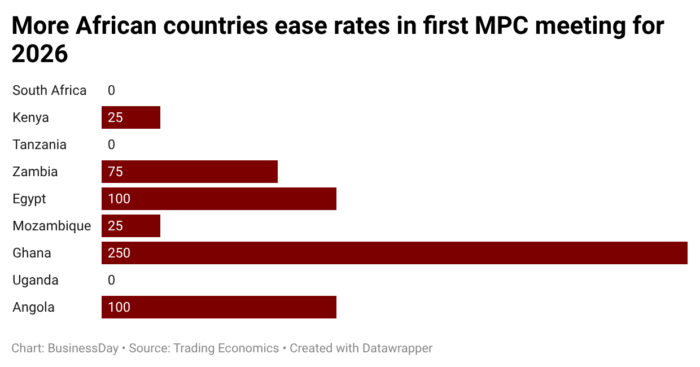
A BusinessDay analysis of nine countries that have held their first Monetary Policy Committee (MPC) meetings of 2026 shows that six — Kenya, Egypt, Angola, Ghana, Mozambique, and Zambia — have cut policy rates, while Uganda, South Africa, and Tanzania opted to hold. Notably, four of the easing economies rank among Africa’s 10 largest by GDP, underscoring the breadth of the shift.
The trend reflects a wider regional pivot. “In response to easing inflationary pressures, most central banks in sub-Saharan Africa have begun cutting interest rates or paused their contractionary monetary stance for several months,” the World Bank said in its latest Africa Pulse report, warning that renewed inflation risks tied to global political uncertainty remain.
Lower inflation and borrowing costs are expected to support private consumption and investment, although fiscal consolidation continues to constrain public spending.
Ghana leads the easing cycle
Ghana remains Africa’s most aggressive rate cutter after trimming its benchmark rate by a cumulative 250 basis points to 15.5 percent in January—its lowest level since February 2022.
The move follows a dramatic disinflation cycle. Consumer prices slowed for a 13th consecutive month to a near 30-year low of 3.8 percent in January, down from 5.4 percent in December and now firmly within the central bank’s 6–10 percent target band. Inflation had peaked above 54 percent in December 2022 during the height of the country’s currency crisis.
Improved fiscal conditions and record-high gold prices have strengthened external reserves and helped the cedi appreciate sharply against the dollar over the past year, easing imported price pressures and reinforcing expectations of further rate cuts in March.
Egypt and Angola deepen policy pivot
Egypt and Angola follow as the second largest cutters so far, reducing rates by 100 basis points each, to 19 percent and 17.5 percent, respectively.
Egypt’s latest move brings borrowing costs to their lowest level since July 2023 and extends one of Africa’s most significant easing cycles. Between February and December last year, policymakers slashed rates by a cumulative 725 basis points as inflation retreated from a peak of 38 percent in September 2023 to 11.9 percent in January 2026, supported by improved foreign-currency inflows and greater exchange-rate stability.
Angola’s easing reflects a similar disinflation story. Annual inflation slowed to 14.56 percent in January from 15.7 percent in December, continuing a steady decline from much higher levels in 2024. Greater stability in the currency and moderating domestic price pressures allowed policymakers in Africa’s third biggest oil producer to push borrowing costs to their lowest level since October 2023.
Southern and East Africa join the shift
Zambia cut its policy rate by 75 basis points to 13.5 percent, the second consecutive reduction and the lowest since April 2024, after inflation dropped to 9.4 percent in January—a near three-year low supported by a bumper maize harvest and a stronger kwacha.
Mozambique and Kenya delivered more modest 25 basis point reductions. Mozambique’s move lowered borrowing costs to 9.25 percent, the cheapest since 2015, while Kenya’s cut to 8.75 percent marked its tenth consecutive easing step, signalling confidence that inflation risks remain contained.
Holdouts stay cautious
Not all central banks have joined the easing wave. Uganda, South Africa, and Tanzania maintained policy rates at 9.75 percent, 6.75 percent and 5.75 percent, respectively, reflecting lingering caution over inflation persistence, currency volatility, and uncertain global financial conditions.
Nigeria’s decision in focus
Attention now turns to Nigeria, Africa’s most populous economy, ahead of its first MPC meeting of the year taking place next week. The country cautiously entered the easing cycle in September with a 50-basis-point cut—its first in five years—after inflation began to moderate.
Analysts increasingly expect a further reduction that could bring the policy rate to 26 percent, provided disinflation continues. On Monday, the National Bureau of Statistics reported that headline inflation slowed for the 10th consecutive time to 15.10 percent in January from 15.15 percent in December.
Last month’s rate marks the lowest level since November 2020, partly due to a stronger currency reducing the cost of imports.
A fragile but meaningful turning point
Cooling inflation, stronger commodity revenues and stabilising currencies are creating space for rate cuts—though risks from global volatility, fiscal pressures and weather-related food shocks remain.
For investors and businesses, the shift signals improving financial conditions and the potential revival of credit growth across several of Africa’s biggest economies—marking a cautiously optimistic start to 2026.

Join BusinessDay whatsapp Channel, to stay up to date
Open In Whatsapp