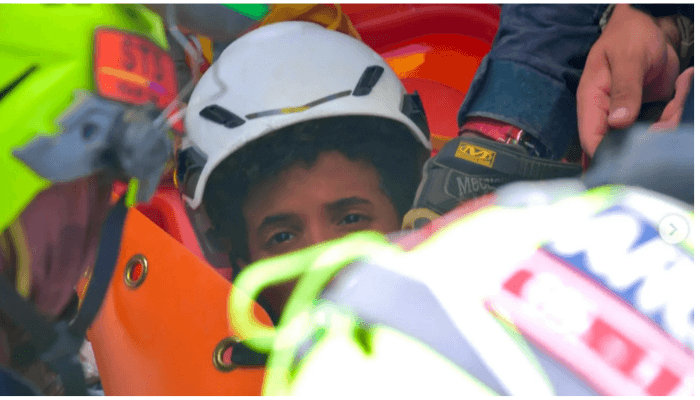
Rescuers in Venezuela have pulled two 11-year-old boys alive from the rubble of collapsed buildings, offering a rare moment of hope as the country battles the devastating aftermath of two powerful earthquakes that have killed at least 1,430 people.
The boys were rescued within hours of each other after spending days trapped beneath layers of concrete and twisted metal following the magnitude 7.2 and 7.5 earthquakes that struck just 39 seconds apart on Wednesday, according to the BBC.
The first boy, identified as Moises, was lifted from the wreckage to applause from rescue workers. Video footage showed his eyes covered to protect them from the bright sunlight as he emerged after days in darkness.
Colombia’s National Unit for Disaster Risk Management said Moises had been buried beneath about three metres of debris. Rescue teams spent six painstaking hours carrying out what they described as “high precision work” to reach him.
Reuters reported that rescuers believed the boy had been trapped close to his mother and sister, who both died in the collapse.
Hours later, Venezuela’s interim President, Delcy Rodríguez, announced that another 11-year-old boy had also been rescued in the coastal town of Caraballeda. Sharing footage of the operation on X, she wrote: “In these hours, every life is hope for Venezuela.”
Read also: Trump’s Venezuela oil grab squeezes Nigeria out of America’s market
The rescues have lifted spirits as emergency workers continue searching for survivors more than 85 hours after the earthquakes struck. Officials believe more people could still be alive beneath the rubble, particularly if they have access to food or water.
The earthquakes destroyed hundreds of buildings, leaving tens of thousands of people missing. Across the disaster zone, families have been digging through debris with their bare hands, desperate to reach loved ones before it is too late.
- WORLD IN BRIEF:South Africa secures $1.5bn World Bank loan, Trump hits Canada with 50% tariffs, Senegal backs Ex-president for UN top job and other stories
- FIFA eyes £220m jackpot with luxury world cup rings for wealthy collectors
- Ethiopia's inflation hits one-year high as food prices squeeze households
Some residents told the BBC they could hear voices coming from beneath collapsed buildings but were powerless to move the massive slabs of concrete without heavy equipment.
Search efforts have also been complicated by repeated aftershocks, forcing rescuers and survivors to work under constant danger.
“To be honest, it makes you feel kind of nervous. Any little noise… horrible,” 64 year old bus driver Jesús Andueza told BBC Mundo.
Read also: Trump’s Venezuela oil grab squeezes Nigeria out of America’s market
The coastal state of La Guaira has suffered some of the worst destruction. Thousands of displaced residents are now sleeping in cars or sheltering in open spaces, fearing damaged buildings could collapse at any moment.
A golf course in Caraballeda has become the centre of the emergency response, transformed into a temporary hospital, relief distribution point and helicopter landing area for aid arriving from across Venezuela and abroad.
Milagros González, whose apartment building was left uninhabitable, said escaping with her family was all that mattered.
“I left with my two young daughters and my two elderly relatives. But thank God we got out alive. The building can’t be lived in. But we’re alive, which is what matters,” she told BBC Mundo.
International rescue teams from Mexico, Spain, Qatar, the United States and the United Kingdom have joined the operation. According to United Nations humanitarian chief Tom Fletcher, 39 search and rescue teams, including almost 2,000 personnel, 111 rescue dogs, medical teams and specialised drones, are now working across the affected areas.
Despite growing criticism that help has been slow to reach some of the hardest hit communities, rescuers continue to search the ruins, determined that more survivors may still be found.

Join BusinessDay whatsapp Channel, to stay up to date
Open In Whatsapp