Japan’s food service sector is rapidly advancing to master and replicate the skills of veteran culinary professionals with artificial intelligence-powered robots in a bid to curb its ageing workforce, shrinking labour pool, and shortage of traditional successors.
The integration of automated culinary intelligence comes amid persistent supply-side pressures in the Japanese labour market as technological advancement is providing crucial relief to automate tradition and artisanal precision.
These AI models are powered by deep learning and are now capable of analysing vast datasets of images, thermal metrics, and motion patterns to digitise human technique.
Data from Japan’s Ministry of Health, Labour and Welfare highlighted the severity of the shortage, revealing that the job-openings-to-applicants ratio for food service workers stood at 2.31, significantly exceeding the national cross-industry average of 1.13.
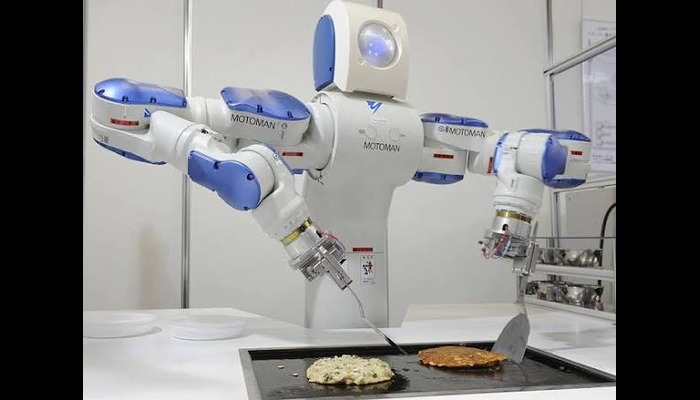
In Kobe, Japan, a confectionery manufacturer,r Juchheim, recently established a dedicated showroom and training facility for “Theo,” an AI-equipped baking robot designed to recreate the precise preparation of baumkuchen.
First introduced to Japan in 1919 by founder Karl Juchheim, the multi-layered spit-roasted cake traditionally requires years of apprenticeship to master, as roasting times must continuously adapt to real-time ambient temperature and humidity.
By utilising cameras and high-precision image sensors, Theo analyses the physical movements and thermal judgments of master bakers, allowing it to determine optimal cooking conditions and learn new recipes within days.
Following a demonstration at the 2025 Osaka-Kansai Expo, the robot system has been deployed across roughly 20 commercial kitchens nationwide, with targets to reach 100 deployments by the end of the fiscal year.
“It can greatly help the food service industry, which is facing a shortage of successor workers,” said Hideo Kawamoto, president of Juchheim.
Digitising ‘Tacit Knowledge’ in the Kitchen
Historically, elite culinary techniques have been classified as “tacit knowledge”, expertise acquired through implicit observation and years of physical repetition rather than formal instruction.
While this exclusivity long provided competitive advantages to individual kitchens, it has increasingly created structural vulnerabilities for succession.
Industry experts note that advanced neural network architectures are fundamentally altering this dynamic.
“In the pre-deep learning era, AI could not teach tacit knowledge, but as technology has advanced, it has become possible to digitise skilled workers’ movements, which involve tacit knowledge,” explained Professor Hitoshi Matsubara, an AI development expert at Kyoto Tachibana University.
Other technology developers are deploying similar solutions to standardise complex culinary operations across the market.
Tokyo-based TechMagic developed an application that calculates optimal pan rotation speeds, flame intensity, and thermal timing for high-heat stir-fry dishes like yakisoba and fried rice, allowing robotic arms to execute complex recipes with heightened consistency.
In the seafood sector, media firm Dentsu introduced “Tuna Scope,” an algorithm trained to analyse cross-sectional imagery of tuna tails. The system replicates mekiki, the expert visual evaluation of fish quality that typically demands a decade of manual training, and has been deployed commercially by major conveyor-belt operator Kura Sushi.
Additionally, Hiroshima-based Otafuku Sauce deployed an AI archive search engine trained on more than 15,000 past condiment formulations, cutting historical recipe-matching times from two hours down to five minutes.
As demographic contraction continues to weigh on service operations, the commercialisation of AI-driven culinary automation offers a sustainable pathway to preserve traditional gastronomic heritage while maintaining operational scale.

Join BusinessDay whatsapp Channel, to stay up to date
Open In Whatsapp