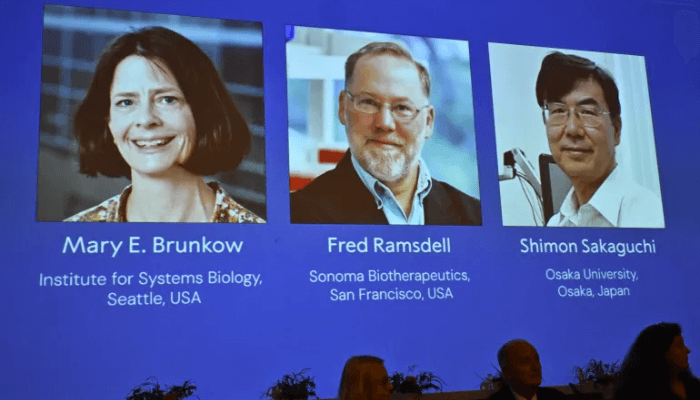
Three scientists — Mary E. Brunkow, Fred Ramsdell, and Shimon Sakaguchi — have been awarded the 2025 Nobel Prize in Physiology or Medicine for their groundbreaking discoveries that explain how the immune system avoids attacking the body it is meant to protect.
The prize, announced on Monday by Sweden’s Karolinska Institute, recognises their decades-long work in uncovering how the immune system maintains a delicate balance between defending against disease and preventing self-destruction.
Read also: America’s Ambros, Ruvkun win 2024 Nobel Prize in Medicine
Their research, which identified a crucial mechanism known as peripheral immune tolerance, revealed how certain immune cells act as internal peacekeepers. These cells, called regulatory T cells, prevent the body’s defence system from turning on itself — a process that, when it fails, can lead to autoimmune diseases such as type 1 diabetes, multiple sclerosis, and lupus.
“Their discoveries have been decisive for our understanding of how the immune system functions and why we do not all develop serious autoimmune diseases,” said Olle Kämpe, chair of the Nobel Committee, as he announced the award.
The trio will share the prize of 11 million Swedish kronor (about $1.17 million), and each will receive a gold medal from the King of Sweden in December.
Read also: Youngest Nigerian Nobel Prize Nominee rallies private sector on education investment
The story of this discovery began three decades ago. In 1995, Sakaguchi, a Japanese immunologist now 74 years old and a distinguished professor at Osaka University, challenged the prevailing wisdom of the time. Back then, most scientists believed that immune tolerance — the body’s ability to distinguish between its own cells and harmful invaders — was established only through a process in the thymus gland known as central tolerance. During this process, potentially dangerous immune cells were thought to be eliminated before they could cause harm.
Read also:Chinua Achebe, Nobel Prize and African Literature
A few years later, in 2001, Brunkow and Ramsdell — both American researchers — made a discovery that provided the missing link. Working with a particular strain of mice that were unusually prone to autoimmune diseases, they traced the problem to a mutation in a single gene, which they named Foxp3. The faulty gene disrupted the mice’s immune regulation, causing their immune systems to attack their own tissues. Brunkow and Ramsdell later demonstrated that similar mutations in humans lead to a rare but devastating autoimmune disorder known as IPEX syndrome.
Two years later, Sakaguchi built on their findings and showed that the Foxp3 gene is essential for the development of regulatory T cells — the same cells he had first discovered in 1995. His work connected the dots, proving that Foxp3 effectively acts as a genetic switch that allows these “security guard” cells to form and function properly.
The result was a complete shift in scientific understanding. What had once been seen as a simple defence system was revealed to be a finely tuned network of checks and balances, capable of attacking invading microbes while sparing the body’s own cells.
Read also: Baker, Hassabis, Jumper win Nobel Prize in Chemistry with protein research
“Their discoveries have laid the foundation for a new field of research and spurred the development of new treatments, for example for cancer and autoimmune diseases,” the Nobel Committee said in a statement. The findings not only deepened understanding of the immune system but also opened doors to new medical therapies. By learning how to manipulate regulatory T cells, scientists hope to treat autoimmune disorders, improve the success of organ transplants, and even enhance cancer immunotherapy. Several of these treatment approaches are now undergoing clinical trials.
Thomas Perlmann, Secretary-General of the Nobel Committee, said he personally delivered the news to Sakaguchi, who was at his laboratory when the call came through. “He sounded incredibly grateful and expressed that it was a fantastic honour. He was quite taken by the news,” Perlmann said. He added that he had left messages for Brunkow and Ramsdell, who were unavailable at the time.
Brunkow, 64, holds a Ph.D. from Princeton University and currently serves as Senior Programme Manager at the Institute for Systems Biology in Seattle. Ramsdell, also 64, earned his doctorate from the University of California, Los Angeles, and works as a scientific adviser at Sonoma Biotherapeutics in San Francisco. Sakaguchi received his M.D. and Ph.D. from Kyoto University and continues his research at Osaka University’s Immunology Frontier Research Centre.
The medicine prize traditionally opens the Nobel season, which continues in the coming days with awards in physics, chemistry, literature, peace, and economics. For Brunkow, Ramsdell, and Sakaguchi, their shared Nobel honour crowns years of patient inquiry into one of biology’s most intricate mysteries, how the human body manages to defend itself so fiercely, yet avoid destroying its own fragile harmony.

Join BusinessDay whatsapp Channel, to stay up to date
Open In Whatsapp