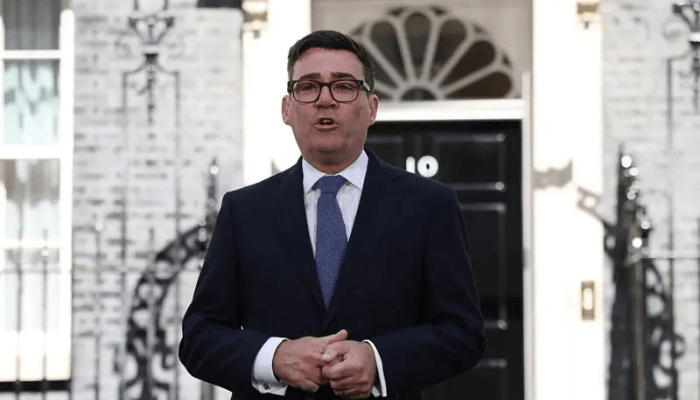
Andy Burnham has officially become the United Kingdom’s prime minister after being invited by King Charles III to form a government, promising to restore trust in politics, devolve power from Westminster and set the country on a new long term path for economic renewal.
Read also: badenoch-congratulates-burnham-but-warns-new-uk-pm-faces-early-test
Burnham was formally appointed on Monday at Buckingham Palace, where King Charles III asked him to form a new administration following the resignation of Keir Starmer.
In a statement, Buckingham Palace said: “His Majesty received in audience the Rt Hon Andrew Burnham MP and requested him to form a new Administration. The Rt Hon Andrew Burnham MP accepted The King’s offer and kissed hands upon his appointment as Prime Minister and First Lord of the Treasury.”
The Palace added that Burnham’s wife, Marie France van Heel, was also received by the King.
Read also: andy-burnham-and-the-africa-policy-question-why-experience-is-not-the-same-as-judgment
Burnham becomes Labour’s eighth prime minister and Britain’s 59th overall. His appointment also makes him the fourth prime minister of King Charles III’s reign, which began in 2022, and the fifth person to occupy 10 Downing Street in just four years, extending a period of political instability at the top of British government.
Delivering his first speech as prime minister, Burnham acknowledged growing public frustration with politics and said his government must earn back the trust of voters.
“I hear you. We have not been good enough and we need to be better. We will be,” he said.
The new prime minister described his administration as a chance to reset British politics after years of division and uncertainty.
“We will make this moment a circuit breaker for Britain and there will be a new political model,” he said.
Burnham argued that Britain’s economic and political challenges stemmed in part from decisions made in the 1980s, including privatisation and deindustrialisation, which he said had left many communities behind.
“Many areas still haven’t recovered,” he said, adding that politics should become more collaborative and focused on solving problems rather than scoring political points.
He also said his generation of political leaders must rise to the challenges facing the country.
“Britain has to show that we can regain our stability once again and that is our challenge,” Burnham said.
A central part of his agenda, he said, would be shifting power away from Westminster and giving local communities greater control over decisions that affect their daily lives.
“As prime minister, I will take power out of Westminster and bring it into every postcode in the land, so they can do more,” he said.
Burnham also pledged to build what he called “a new economy” by putting “life’s essentials back under public control” to make them more affordable, while supporting the reindustrialisation of Britain and expanding investment in British industry.
Looking beyond the early months of his premiership, Burnham said his government would later this year publish a 10-year national plan setting out its long term vision for the country.
He said the strategy would outline where he wants Britain to be over the next decade and the steps needed to achieve that goal.
The new prime minister is expected to begin his administration with a nationwide listening tour during Parliament’s summer recess in August. The tour will take him to communities across the United Kingdom as he seeks public views on the government’s priorities.
Among the locations expected to feature on the itinerary is Port Talbot in south Wales, where the closure of the town’s last steelmaking blast furnace in September 2024 became a symbol of Britain’s industrial decline.
Burnham will not face Members of Parliament until September when the House of Commons returns from six-weekweek summer recess, unless he decides to recall Parliament earlier.
His appointment follows the long established constitutional convention under which the leader of the governing party becomes prime minister without a general election. Under Britain’s parliamentary system, a change of party leader does not automatically trigger a national vote.
Although Burnham has the authority to call an early election, there is no legal requirement for him to do so. The next general election must be held no later than August 15, 2029.
The transfer of power followed one of Britain’s oldest constitutional traditions, with the outgoing prime minister first meeting the King before Burnham was invited to form a government. While the ceremony is still formally known as “kissing hands,” it now consists of a handshake before the new prime minister assumes office.
Burnham now inherits a government under pressure to revive economic growth, improve strained public services and restore confidence in British politics after years of rapid leadership changes. His challenge will be to translate promises of a different style of government into tangible results for a country eager for greater stability.

Join BusinessDay whatsapp Channel, to stay up to date
Open In Whatsapp